
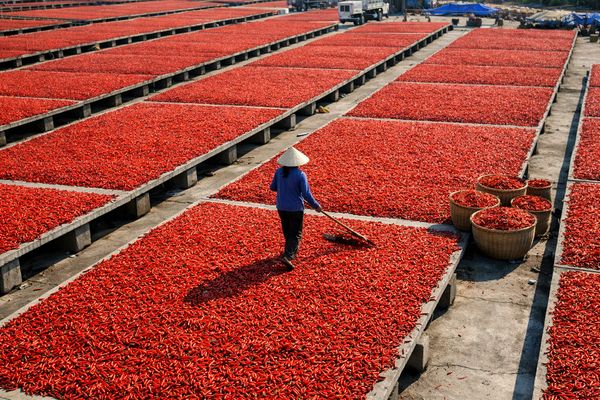
Vietnam’s chilli market is under severe pressure, with farm-gate prices in key producing regions down more than 70–80% from last year as strong production meets sharply weaker Chinese demand and rising logistics costs.
Producers in Quang Ngai and surrounding areas report good yields and crop quality, but export flows to China have slowed and container costs are up, leaving domestic markets oversupplied and prices close to or below production costs. Farmers are increasingly turning to drying and storage in the hope of a later recovery, but in the short term both smallholders and large-scale growers face substantial income losses.
Exclusive Offers on CMBroker

Chilli dried whole
bird eye, grade a
FOB 4.63 €/kg
(from IN)

Chilli dried
powder, grade a
FOB 4.38 €/kg
(from IN)

Chilli dried
flakes, grade a
FOB 4.33 €/kg
(from IN)
📈 Prices & Market Structure
Quang Ngai, one of Vietnam’s main chilli-producing provinces, has over 1,000 hectares under chilli cultivation, with roughly 765 hectares already in early harvest. Yields are strong at more than 82 quintals per hectare, and quality is reported as good. However, the market has failed to absorb this volume, triggering a sharp price correction at farm level.
Year-on-year, prices have collapsed from around USD 2.00/kg (peaking at USD 2.80/kg last season) to an opening level of about USD 0.56/kg this season and currently just USD 0.20–0.28/kg. At these levels, revenues fall far short of covering seed, fertilizer and labour costs, leaving growers with little incentive to harvest fully and pushing some to leave fields unpicked.
🌍 Supply, Demand & Trade Flows
The core imbalance is clear: robust supply versus weak external demand, especially from China. Vietnam’s chilli trade remains heavily geared towards the Chinese market, where this season demand has softened and export volumes have slowed. Container availability has tightened and export clearances have become slower, further restricting the flow of fresh chilli across the border and diverting more product into the domestic market.
For small farmers like those in An Phu commune, even good-yielding, high-quality crops no longer break even once input and harvesting costs are accounted for. Larger growers report similar constraints: one producer in Binh Son commune harvesting around 2.5 tonnes per day is forced to sell at roughly USD 0.20/kg, generating cashflow but not recovering fertilizer, labour and maintenance costs. Export facilities continue to procure over 10 tonnes per day, yet demand remains insufficient to lift prices meaningfully.
📊 Regional Price Context & Product Mix
While Vietnamese fresh chilli growers face a collapse in farm-gate prices, downstream and regional dry chilli markets remain relatively firmer. Recent offers from India for dried chilli products (FOB, converted into EUR) indicate stable to slightly softer levels over the past week: organic bird eye whole around EUR 4.63/kg, organic powder near EUR 4.38/kg, organic flakes about EUR 4.33/kg, and conventional whole and with-stem grades close to EUR 2.13–2.14/kg. This suggests that the current crisis is concentrated in Vietnam’s fresh export segment rather than in all chilli derivatives globally.
The price disconnect underscores the role of logistics and market access. With higher freight rates and limited container availability out of Vietnam, the arbitrage between low local fresh prices and relatively resilient international dry chilli quotations cannot be fully exploited by farmers. Instead, value capture shifts towards actors with storage, drying and export capabilities that can bridge this gap once trade flows normalise.
🌦️ Weather & Logistics Outlook
Weather conditions in Quang Ngai this season have generally been favourable for chilli cultivation, supporting high yields and good fruit quality. There are currently no major weather-related threats reported that could significantly tighten near-term supply. As a result, production-side relief for prices is unlikely in the immediate future.
On the logistics side, exporters continue to face higher transport costs and slower export procedures. Broader trade data for Vietnam’s fruit and vegetable sector in early 2026 point to weaker shipments to China compared with earlier periods, aligning with the slowdown reported by chilli exporters. Unless freight conditions improve and customs processes accelerate, export channels will remain partially constrained, limiting any swift recovery in fresh chilli prices.
📆 Market Outlook
Short Term (next 1–3 months)
- Prices in key producing regions of Vietnam are expected to stay depressed as the main harvest progresses and oversupply persists.
- Weak Chinese demand, combined with elevated logistics costs and limited containers, will likely cap export volumes and keep domestic markets heavy.
- More farmers may shift from immediate fresh sales to drying and temporary storage, spreading supply over a longer period but only modestly supporting prices.
Medium Term (3–12 months)
- Any meaningful recovery depends on a rebound in Chinese buying interest and a normalisation of freight rates and export clearances.
- If low prices persist, a reduction in planted area or input use in upcoming seasons is likely, which could tighten supply and support prices in later cycles.
- Expansion of alternative markets beyond China and investment in local drying and processing capacity will be critical to reduce vulnerability to single-market shocks.
📌 Trading & Procurement Recommendations
- Importers / Buyers: Consider gradually extending coverage for Vietnamese dried chilli products while farm-gate prices are under pressure, focusing on quality lots that have been properly dried and stored. However, avoid overstocking given uncertainty around future Chinese demand.
- Exporters: Prioritise building flexible logistics solutions and diversifying destinations beyond China to reduce dependence on a single outlet. Where possible, support contract drying and storage with partner farmers to secure supply at current low levels.
- Producers / Cooperatives: Emphasise on-farm drying, cooperative storage and potential forward sales for dried product rather than distress selling fresh. Evaluate cost structures to determine minimum viable prices before committing to labour-intensive harvesting.
📉 3-Day Directional Outlook (Indicative)
| Market / Product | Price Level (EUR/kg, indicative) | 3-Day Bias |
|---|---|---|
| Vietnam fresh chilli, Quang Ngai (farm-gate, equivalent) | ~EUR 0.19–0.27 | Sideways to slightly lower – ongoing oversupply, weak export pull |
| India dried chilli whole, stemless (FOB) | ~EUR 2.13 | Sideways – stable offers, no major new shocks visible |
| India dried chilli powder, organic (FOB) | ~EUR 4.38 | Sideways to slightly softer – ample availability |
Related posts:
 Indian Chilli Prices Ease Slightly but Remain Firm on Tight Crop and Hot Demand
 Indian Chilli Prices Hold Firm as Tight Crop Offsets Record Arrivals
 Indian Chilli Prices Spike as Stockists Step Back and Demand Surges
 Coriander pauses for direction as Gulf exports face logistics drag
 Indian Chilli Prices Hold Firm as New Crop Flows Steady from Andhra Pradesh
 Egyptian Spearmint FOB Cairo Inches Higher Amid Logistics and Cost Pressures
 Egyptian Dried Sage FOB Cairo Edges Lower Amid Logistics Uncertainty
 Indian Chilli Market Holds Firm at Peak Arrivals as Export Demand Stays Hot