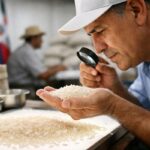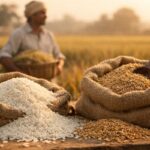
Haiti’s rice balance is tightening structurally: domestic production is falling toward 50,000 metric tons while import needs rise to around 540,000 metric tons, leaving consumers ever more exposed to global price levels and local insecurity. Limited stocks and disrupted logistics around Port-au-Prince keep internal prices elevated, even as some FOB quotations from competing origins ease slightly.
Haiti’s grain and rice market is entering 2026/27 in a highly fragile position. Armed group activity in the key Artibonite production zone and along main transport corridors is eroding local supply, raising transaction costs and constraining stocks. At the same time, concessional flows from the United States and competitively priced Pakistan rice remain essential to cover a rising structural import gap. For traders and humanitarian buyers, Haiti stands out as a price‑sensitive, high‑risk demand center where security and policy developments will matter at least as much as global price trends.
Exclusive Offers on CMBroker

Rice
all golden, sella
FOB 0.90 €/kg
(from IN)

Rice
all steam, pr11
FOB 0.41 €/kg
(from IN)

Rice
al ısteam, sharbati
FOB 0.56 €/kg
(from IN)
📈 Prices & Import Parity
Global export quotations relevant for Haiti remain mixed but slightly softer in EUR terms, while Haiti’s internal prices stay elevated due to logistics and security premiums. Pakistan remains a key low‑cost supplier, with rice priced around USD 380/mt FOB versus roughly USD 525/mt for US rice, translating into lower retail prices in Haitian markets despite higher freight costs. In March 2026, Pakistani rice retailed near USD 22 per 25-kg bag in Croix-des-Bouquets, undercutting US rice at about USD 25 for the same weight.
Indicative Indian FOB prices in New Delhi (as a benchmark) show a mild downward trend since late March. Converting to EUR at approximately 1 EUR = 1.07 USD, recent levels imply roughly EUR 0.96/kg for 1121 golden sella, EUR 0.44/kg for PR11 steam and EUR 0.60/kg for Sharbati steam, all slightly below quotations from late March. While India is not a main supplier to Haiti, these moves signal modest easing in segments of the Asian export market, which can support import parity calculations for alternative origins.
| Origin & Type (FOB) | Price (EUR/kg) | Trend vs late March |
|---|---|---|
| India, 1121 golden sella | ≈ 0.96 EUR/kg | Softening |
| India, PR11 steam | ≈ 0.44 EUR/kg | Softening |
| India, Sharbati steam | ≈ 0.60 EUR/kg | Softening |
| Pakistan, export benchmark | ≈ 0.36 EUR/kg (USD 380/mt) | Competitive vs US |
| United States, export benchmark | ≈ 0.50 EUR/kg (USD 525/mt) | Premium to Pakistan |
🌍 Supply, Demand & Structural Dependence
Haiti’s domestic rice production is forecast to decline to about 50,000 metric tons in 2026/27, from a revised 53,000 metric tons in 2025/26. The earlier season was already hit by Hurricane Melissa in October 2025, which destroyed more than 900 hectares of rice, while average yields linger near 2 metric tons per hectare—well below regional peers. Artibonite, which supplies over 80% of national rice output, faces widespread land abandonment and deliberate field destruction due to armed group activity.
Against this backdrop, rice import needs are set to rise to around 540,000 metric tons in 2026/27, up from roughly 525,000 metric tons in 2025/26. The United States retains a dominant, often concessional, supply role through programs such as Food for Peace, while Pakistan offers a cheaper commercial alternative. Haiti’s grain dependency is not limited to rice: the country produces no wheat at all and relies structurally on imports for wheat flour and growing volumes of corn, underscoring that rice market stress sits within a broader cereal deficit.
📊 Logistics, Stocks & Risk Premiums
Port-au-Prince remains the critical entry node for rice imports, but the capital’s corridors are heavily disrupted by armed groups. Illegal tolls of up to several thousand dollars per container, coupled with heightened security and insurance costs, directly inflate the inland cost of imported rice. Insurers have become increasingly reluctant to cover commodity stocks, offering reduced cover at sharply higher premiums.
As a result, importers operate with very lean buffers: rice stocks are forecast at only about 28,000 metric tons, while wheat stocks stand near 69,000 metric tons—around 1.5 months of consumption. Low inventories amplify price volatility and transmission from any supply interruption. Even when FOB prices ease modestly, the pass-through to households is muted by logistics bottlenecks, insecurity, and a prolonged economic contraction that has left roughly half the population acutely food insecure.
🌤️ Weather & Production Outlook
Over the next 30–90 days, near-term rice output will be shaped more by security conditions and access to inputs than by weather alone, but climate risks are building into the 2026/27 marketing year. Forecasts of a potential transition toward El Niño-like conditions later in 2026 raise the probability of drier, more erratic rainfall across parts of the Caribbean. For Haiti’s already low-yielding rice sector, such patterns would likely translate into further yield losses, especially in irrigated systems affected by damaged infrastructure and poor maintenance.
Combined with ongoing field abandonment in Artibonite and other key departments, these climatic uncertainties reinforce the expectation that domestic rice and corn production will trend lower. The absence of substantial government measures to offset rising fertilizer and fuel costs leaves farmers highly exposed to both weather and price shocks, and increases the likelihood that import requirements will continue to rise over a six- to twelve‑month horizon.
📆 Trading & Procurement Outlook (Next 30–90 Days)
- Importers & traders: Treat Haiti as a structurally short, high‑risk rice market where modest FOB softness can be offset by rising inland costs. Prioritise flexible shipment schedules, diversified origins (US, Pakistan, potentially Asian suppliers) and close monitoring of security around Port‑au‑Prince corridors.
- Humanitarian buyers: Assume rice import needs will remain elevated and potentially grow as domestic output falls and food insecurity stays severe. Concessional US-origin supply will remain central; however, opportunistic buying from lower-cost origins like Pakistan can stretch budgets and expand coverage.
- European traders: View Haiti as a niche but strategically important demand center within the wider Caribbean balance. Rising Haitian imports, if combined with weather‑driven output issues elsewhere in the region, could tighten regional availabilities and support a floor under medium‑grain and long‑grain prices in EUR terms.
📍 3‑Day Directional Price Indication (EUR)
- Asian FOB benchmarks (India/Vietnam, long-grain, EUR/kg): Mild downward bias as recent softening persists, barring sudden policy or currency shocks.
- Pakistan FOB (standard white, EUR/kg): Stable to slightly firm, remaining at a discount of roughly EUR 0.10–0.15/kg versus US-origin rice at comparable grades.
- Haiti landed/import-parity levels: Sideways to slightly firm in EUR terms, as any marginal FOB relief is likely absorbed by elevated freight, insurance and inland security costs in the short term.