
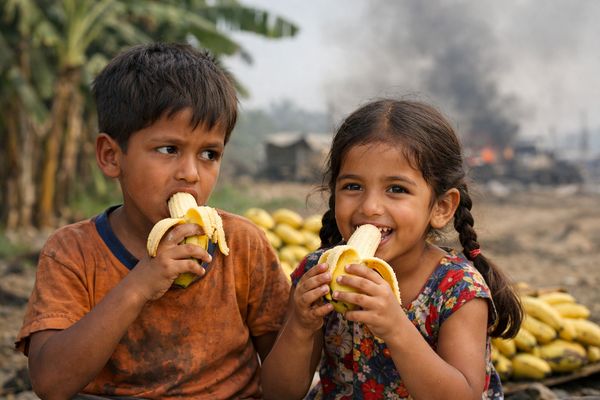
Banana growers in Maharashtra are facing a severe price collapse as Middle East export routes seize up, flooding the domestic market and pushing farm-gate prices to unsustainably low levels, even as retail and processed-product prices remain relatively firm.
A sudden halt in exports to Gulf markets has turned what began as a promising season into a deep crisis for producers in Jalgaon, Solapur and nearby belts. Containers are stuck in cold stores, fruit is being rerouted to wholesale markets, and prices at the farm have plunged from roughly EUR 0.21–0.26/kg in February to as low as EUR 0.02–0.04/kg in April, far below production costs. Retail consumers, however, still pay around EUR 0.57–0.66/kg, underlining structural supply-chain inefficiencies and widened margins between fields and store shelves.
[cmb_offer ids=91,785,784]
📈 Prices & Market Structure
In Maharashtra’s core banana regions, export-grade volumes that typically move to the UAE, Iran, Iraq and other Gulf buyers are now trapped in India. As a result, farm-gate prices fell in successive waves: from about EUR 0.21–0.26/kg in February, to EUR 0.09–0.11/kg in March, and then to just EUR 0.02–0.04/kg in April. These levels do not cover even basic harvesting and transport, let alone year-round cultivation costs.
Despite this collapse at origin, retail prices in Indian cities remain elevated, around EUR 0.57–0.66/kg, reflecting strong consumer demand, tight urban market structures, and high intermediary margins. At the same time, processed banana products aimed at export markets, such as dried banana chips from Vietnam and the Philippines into Europe, are trading steadily in the EUR 1.75–3.50/kg range FCA/FOB, with only marginal week‑on‑week changes. This divergence shows that the current crisis is highly localized in fresh bananas from Maharashtra rather than a broad-based banana glut across all products.
| Segment | Location | Period | Price (EUR/kg) | Trend |
|---|---|---|---|---|
| Fresh bananas, farm-gate | Maharashtra (Jalgaon/Solapur) | Feb 2026 | 0.21–0.26 | Stable/high |
| Fresh bananas, farm-gate | Maharashtra | Mar 2026 | 0.09–0.11 | Sharply lower |
| Fresh bananas, farm-gate | Maharashtra | Apr 2026 | 0.02–0.04 | Collapse |
| Fresh bananas, retail | Indian urban markets | Apr 2026 | 0.57–0.66 | Elevated |
| Banana chips, whole (conv.) | Dordrecht, NL (PH origin) | Apr 2026 | ≈2.37 | Sideways to slightly firmer |
| Banana chips, broken (conv.) | Dordrecht, NL (PH origin) | Apr 2026 | ≈1.87 | Sideways |
| Banana chips, whole (organic) | Dordrecht, NL (PH origin) | Apr 2026 | ≈2.90 | Sideways to slightly firmer |
🌍 Supply, Demand & Logistics
The core driver of the Maharashtra crisis is an external, geopolitical shock. Heightened tensions in West Asia have disrupted shipping routes and import demand in key Middle Eastern markets, leading to stalled shipments, container backlogs at ports and cold storages, and forced diversions of export-grade bananas into India’s domestic market. This abrupt shift has produced a classic oversupply scenario in local mandis, particularly around Jalgaon, Solapur and Baramati.
On the demand side, underlying consumption of bananas in India remains robust, but the domestic marketing system cannot absorb a sudden inflow of export-quality fruit at scale without a severe price response at origin. Retail structures and intermediary control over flows mean that consumer prices adjust much less than farm-gate prices. In effect, growers are absorbing almost the entire burden of the export shock, while traders and retailers maintain margins by keeping shelf prices relatively sticky.
📊 Farm Economics & Structural Stress
Banana is a year‑round, input‑intensive crop, requiring continuous spending on fertilisers, irrigation systems, pesticides, labour and crop management. With current farm-gate prices in Maharashtra barely covering or even falling below harvesting and logistics costs, growers are now facing losses reaching tens of thousands of euros per hectare for the season. Many are also servicing loans on drip irrigation and plantation establishment, which amplifies financial stress.
The severity of the price collapse has pushed some farmers to destroy standing crops and accelerate a shift toward alternatives such as sugarcane. However, banana plantations involve sunk costs and long crop cycles, making an exit neither quick nor costless. Rising input prices—especially for fertilisers and labour—have further eroded margins. In this context, the persistent gap between farm and retail prices is fuelling demands for more transparent pricing, better market access, and policy intervention to stabilise incomes.
🌦 Weather & Near-Term Physical Outlook
Current reports do not point to immediate weather-driven production losses in Maharashtra’s banana belt; the crisis is primarily logistics- and demand-driven rather than agronomic. Plantations in Jalgaon and Solapur remain capable of strong output, which, absent a rapid normalisation of export flows, risks prolonging the oversupply into the next marketing weeks. If monsoon onset in June arrives broadly on schedule, agronomic conditions for bananas could remain favourable, limiting any natural supply relief.
This combination—good growing conditions but impaired export demand—suggests that physical availability for domestic buyers will stay ample in the near term. Any incremental weather shock (such as unseasonal storms or heat spikes) could trim volumes later in the year, but is unlikely to materially offset the current glut unless it is both severe and regionally concentrated.
📆 Market & Trading Outlook
- Short term (next 2–4 weeks): Farm-gate prices in Maharashtra are likely to hover near current depressed levels as long as containers remain stranded and Gulf demand is uncertain. Domestic wholesale markets will stay well supplied, limiting any spontaneous recovery at origin even if festival demand or regional buying improves slightly.
- Medium term (3–6 months): Price normalisation depends heavily on the restoration of predictable export channels to the Middle East and successful diversification into alternative markets. If shipping flows resume gradually, farm-gate prices could recover from April’s extreme lows but may still underperform historical averages given farmer distress sales and lingering stocks.
- Processed segment: With EU banana chip prices broadly stable and only modest recent firming, importers and industrial users should not expect significant cost relief from the current Indian fresh-banana glut. However, the crisis may encourage some processors to lock in supply contracts or explore Indian-origin processed products if logistics permit.
📌 Strategic Notes for Market Participants
- Growers & cooperatives (Maharashtra): Prioritise cash-flow management and quality segregation—channel the best fruit into any available export or premium domestic channels while considering cost-based decisions on harvesting marginal bunches. Engage with local associations to push for targeted government relief and for initiatives to diversify export destinations beyond the current Middle East focus.
- Domestic traders & retailers (India): The wide gap between farm and retail prices suggests scope to expand volumes and promotional activity while still maintaining acceptable margins. Forward-buying or short-term supply agreements with distressed growers may secure attractive procurement prices but carry reputational and policy risk if perceived as exploitative.
- International buyers (EU, MENA, Asia): The disruption creates an opportunity to negotiate favourable terms once shipping lanes stabilise, particularly for fresh Jalgaon bananas with established quality credentials. Nonetheless, buyers should factor in volatility premiums and potential policy moves (such as minimum export prices or support schemes) that could lift offer levels off current theoretical lows.
📉 3‑Day Regional Price Indication (Directional)
- Maharashtra farm-gate (fresh bananas, EUR/kg): 0.02–0.04 over the next three days; bias sideways to slightly lower as more stranded export lots hit local mandis.
- Indian urban retail (fresh bananas, EUR/kg): 0.57–0.66; bias largely steady with minor regional discounting possible if wholesale congestion intensifies.
- EU import (banana chips, Dordrecht & Hanoi, EUR/kg): 1.80–3.50 depending on origin and specification; bias sideways given stable offers and limited direct impact from the Maharashtra fresh segment.
[cmb_chart ids=91,785,784]
Related posts:
 Middle East Conflict and Hormuz Disruption Set to Lift European Fruit Prices by 10–15%
 Vietnam Banana Chips Prices Hold Firm as EU Demand Lifts Philippine Offers
 Costa Rican Bananas: Varcli’s Direct-Retail Model Under Climate and FX Pressure
 Philippine Banana Chips Prices Edge Higher on Stable Supply