
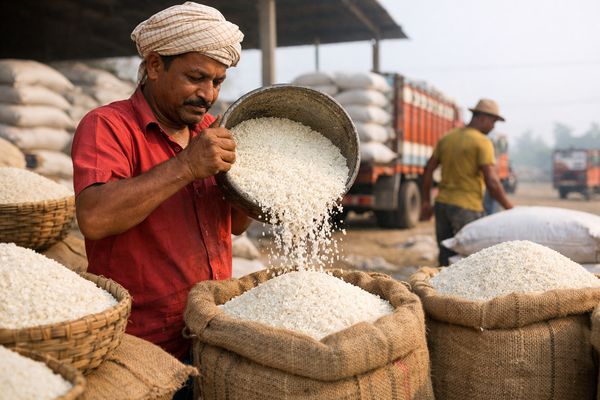
China’s return to the Indian broken rice market is reinforcing India’s role as the global price setter, even as rising freight, currency swings and looming weather risks cap any significant downside in rice prices.
The renewed Chinese demand comes just as Indian broken and 5% white rice remain among the cheapest origins worldwide, widening the spread to Thailand, Vietnam and Pakistan. Export margins, however, are under pressure from sharply higher container freight linked to the Iran conflict and bunker fuel costs, while basmati exports to West Asia face logistics bottlenecks. With India’s domestic rice production outlook robust but global weather risks escalating, the market is poised for volatile but broadly supported prices rather than a deep correction.
[cmb_offer ids=502,501,500]
📈 Prices & Competitiveness
Indian broken rice is currently offered around USD 300–310/tonne (FOB), translating to roughly EUR 280–290/tonne, keeping India clearly at the low end of the global price curve. Indian 5% broken white rice at USD 335–339/tonne (≈ EUR 312–316) undercuts Thailand at about USD 423, Vietnam at USD 344–348 and Pakistan at USD 345–349 per tonne.
Domestic FOB indications in India and Vietnam show a gentle softening over recent weeks, in line with reports that Asian export prices have eased on ample supply and intense competition. This reinforces India’s role as price floor setter, with Vietnam and Thailand adjusting downwards when import demand weakens and buyers switch back to cheaper Indian origins.
| Product | Origin | Latest FOB price (EUR/kg) | 1-month trend |
|---|---|---|---|
| Rice, all steam PR11 | India (New Delhi) | 0.41 | Down from 0.45 |
| Rice, 1121 steam | India (New Delhi) | 0.79 | Down from 0.85 |
| Rice, long white 5% | Vietnam (Hanoi) | 0.41 | Down from 0.44 |
🌍 Supply, Demand & Trade Flows
China has resumed purchases of Indian broken rice despite recently voiced concerns over alleged GMO content in some consignments. The quick normalisation of trade signals that China still depends on competitively priced Indian supplies, particularly for feed and industrial uses, and is willing to manage regulatory risks rather than forgo cheap volume.
India’s pricing edge versus Thailand, Vietnam and Pakistan continues to attract buyers in China and West Africa, anchoring global trade flows around Indian origins. Non-basmati exports have so far been resilient to geopolitical disruptions, whereas basmati shipments into West Asia are experiencing route disruptions, delays and higher freight, temporarily tilting India’s export mix even more toward non-basmati and broken rice segments.
📊 Fundamentals & Weather Risks
On fundamentals, India’s rice balance remains comfortable. The ongoing rabi paddy harvest is reported healthy, especially in southern states that escaped the unseasonal rains and hail which harmed crops in the north. Overall rice output for the 2025–26 crop year is expected to exceed 150 million tonnes, underlining India’s capacity to keep exporting large volumes while maintaining domestic food security.
By contrast, wheat output is now expected to fall 5–10% from earlier 120 million tonne projections due to adverse weather. This raises the strategic importance of rice in India’s grain balance and may encourage the government to stay vigilant on export flows if domestic food inflation accelerates, even though current rice supplies look robust.
Globally, new harvests in Thailand and Vietnam are likely to add near-term supply and promote a modest softening of export prices. However, the risk of a developing Super El Niño implies a real threat of prolonged dryness across key Asian producers such as India, Thailand, Indonesia and the Philippines. If realised, this could curb yields in late 2025 and 2026 crops, preventing any sustained downturn in international prices despite today’s comfortable stocks.
🚢 Logistics, Freight & Currency
Indian exporters are facing a pronounced squeeze from logistics. Container freight on key lanes has risen to roughly USD 75–80/tonne (≈ EUR 70–75) for a 20-foot container, principally due to the Iran conflict and the associated surge in bunker fuel prices. For low-margin broken rice shipments priced near USD 300/tonne, freight now represents a sizeable share of the delivered cost, eroding exporter profitability.
Basmati shipments into West Asia are especially exposed to these disruptions, with reroutings, delays and higher insurance premia adding to costs. At the same time, currency volatility, including recent swings in the Indian rupee, is complicating offer strategies and hedging. While a weaker rupee can briefly boost price competitiveness, sudden rebounds may force exporters to adjust offers quickly, contributing to short-term volatility in quoted FOB levels.
🌦️ Weather Outlook for Key Producers
Short-term weather forecasts for major rice belts in India, Thailand and Vietnam point to mostly seasonally normal to slightly drier-than-average conditions into late April, keeping field operations on track for now. There are, however, increasing model signals of a potential transition toward a stronger El Niño pattern later in the year, which historically correlates with rainfall deficits in parts of South and Southeast Asia.
For now, the market is not facing an immediate weather shock, but traders are beginning to price in the tail risk of yield losses in the 2025–26 planting cycles. Against this backdrop, any negative shift in monsoon expectations or early signs of soil moisture stress could quickly translate into firmer forward prices and more aggressive stock building by import-dependent countries.
📆 Market & Trading Outlook
- Price direction: Near term, FOB prices for Indian non-basmati and broken rice are likely to stay soft to sideways in EUR terms, capped by ample supply but underpinned by strong import demand from China and Africa.
- Risk premium: Freight, Middle East tensions and looming El Niño risks argue for a modest risk premium in forward pricing, limiting downside even if Thai and Vietnamese new crops pressure offers lower.
- Policy watch: India’s comfortable rice production but tighter wheat balance suggest no immediate rice export clampdown, yet any flare-up in domestic food inflation could quickly bring policy risk back into focus.
🔎 Strategy Pointers
- Importers (China, West Africa, Middle East): Use current Indian offers around the EUR 280–320/tonne range equivalent for broken and 5% white to extend coverage for Q2–Q3, but avoid overstocking given uncertainty on El Niño timing and freight.
- Exporters (India, Vietnam, Pakistan): Lock in freight where possible and hedge currency exposure; with margins squeezed, focus on higher-value or nearby markets less exposed to elevated container costs.
- Industrial users & feeders: The resumption of Chinese demand for Indian broken rice suggests competition for low-grade origins will intensify; consider forward purchasing to secure volume before any weather-driven rally.
📍 3-Day Directional Outlook (EUR-based)
- India FOB (broken & 5% white): Stable to slightly firmer in EUR, with modest support from Chinese buying and currency noise.
- Thailand FOB (5% white): Mild downward bias as new crop availability grows and India undercuts on price.
- Vietnam FOB (5% white): Largely steady; exporters balance softer demand with limited supply willingness at deeper discounts.
[cmb_chart ids=502,501,500]
Related posts:
 Wheat Market Holds Narrow Range as Energy and Logistics Risks Build
 Rice Market: India Holds the Line as Freight and Oil Risks Climb
 Sri Lanka Rice: Production Recovery Eases Prices but Weather Risks Persist
 Indian Basmati Rice Firms as Paddy Tightens and Export Buying Returns
 Flat Sorghum Prices in Odesa as Logistics and Weather Risks Loom
 Rice Market Steady as India’s Stocks Offset Geopolitical Risks
 Rossmann Pilots Humanoid Walker S2 Robot in German Logistics Hub, Signalling Next Phase of Warehouse Automation
 Basmati Rice Squeeze in India Tightens Global Premium Rice Market