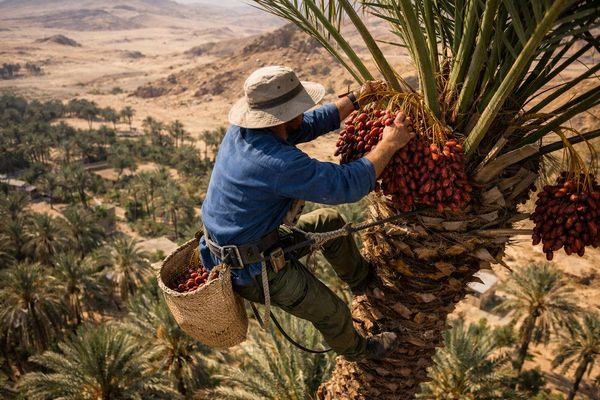
Australian dates remain a high-cost niche in a global market dominated by low-cost Middle Eastern and North African suppliers, leaving local growers exposed to intense price competition. Without continued diversification and focus on premium niches, the structural cost gap versus imports will likely widen further.
Australia’s domestic date industry is extremely small and structurally high-cost in a world market producing around nine million tonnes annually, mostly from cost‑efficient MENA origins. Local production of roughly 120 tonnes per year contrasts sharply with over 7,000 tonnes of imports, meaning retail shelves are shaped almost entirely by global pricing. Producers like Gurra Downs are therefore repositioning from pure commodity sales toward specialty varieties, value‑added processing, genetics, direct‑to‑consumer channels and agritourism in order to survive.
[cmb_offer ids=393,394,395]
📈 Prices & Competitiveness
Imported Medjool dates currently land in Australia at about AUD 12/kg (≈ EUR 7.20/kg), while Australian growers generally need around AUD 18/kg (≈ EUR 10.80/kg) just to cover costs, leaving a structural cost gap of roughly EUR 3–4/kg at the farm gate. Expectations of further investment and yield gains in key origins such as Egypt suggest imported offers could fall toward AUD 5/kg (≈ EUR 3.00/kg) over time, which would dramatically widen the competitiveness gap for standard-grade dates.
Premium dried date offers from Iran for Kabkab, Zahedi and Mazafati types currently indicate FOB levels around EUR 1.11–3.05/kg, underlining how far global bulk prices sit below Australian on-farm needs even before freight and retail margins. In export channels, Australian dates often sit up to three times above international competitors, effectively excluding local product from most volume-driven tenders and leaving only small, premium niches truly contestable.
🌍 Supply & Demand Balance
Globally, date supply is ample, with around nine million tonnes produced annually and ongoing capacity expansions in major origins such as Egypt, Saudi Arabia, Iran and North Africa. Recent wholesale indications from Egypt place dates around USD 1.71–3.26/kg (≈ EUR 1.60–3.05/kg), consistent with a well-supplied market and reinforcing downward pressure on import parity into Australia.
Australia’s domestic output of about 120 tonnes is dwarfed by imports exceeding 7,000 tonnes, so local demand is effectively benchmarked to global prices. Year‑round availability of fresh and semi‑dried dates from multiple hemispheres has eroded traditional seasonal advantages and reduced scope for price spikes that might otherwise support high‑cost producers. In this environment, shifts in Australian demand toward health snacks and natural sweeteners benefit dates overall, but most incremental volume growth is captured by imports.
📊 Fundamentals & Industry Structure
The Australian date sector is labour‑intensive, irrigation‑dependent and operates at far smaller scale than MENA producers, driving materially higher unit costs. Even where yields and orchard management improve, the fixed‑cost base and limited total area planted constrain any meaningful move toward global cost parity. Export opportunities are further restricted because many overseas buyers can source similar or preferred varieties at a fraction of Australian price levels.
To avoid direct competition with low‑cost Medjool and common dried types, growers such as Gurra Downs are developing specialty varieties like Barhee, marketed as fresh, crunchy fruit rather than traditional dried dates. These differentiated products have achieved some traction among curious and health‑conscious consumers, but adoption in the broader Australian market remains modest, limiting volume scalability. As a result, the industry is likely to remain structurally small and niche-focused rather than transitioning into a significant export-oriented horticultural sector.
🏭 Value Addition, Diversification & Niche Demand
Value‑added processing offers partial relief but is also exposed to import competition. Date paste for food manufacturers and retail applications must compete with much cheaper imported pastes, restricting achievable margins and scale. Nonetheless, integrating processing with fresh and dried date production helps spread overheads and can stabilise cash flow across seasons.
Alternative revenue streams are becoming increasingly important. Gurra Downs and similar operators are expanding into supplying date palm genetics to new plantings, building mail‑order and direct‑to‑consumer channels, and leveraging agritourism, where on‑farm experiences are combined with premium farm‑gate retail prices. A loyal consumer segment remains willing to pay more for Australian‑grown dates, driven by concerns over supply‑chain resilience, provenance and food security, but this segment is too small to offset the broader structural cost disadvantage without continued innovation and targeted marketing.
🌦 Weather & External Drivers
For Australia, local weather risks (heat stress, water availability in irrigated regions) remain critical to yield stability, but the primary market driver is still global oversupply rather than domestic crop size. In MENA, ongoing expansion and generally favourable production expectations into 2026 point toward continued abundant availability rather than tightness, keeping a lid on world price upside.
Geopolitical and macroeconomic factors, including logistics costs and currency volatility in key origins, can temporarily affect CIF levels into Australia. However, current wholesale benchmarks in Egypt and other exporters still sit well below Australian cost structures, suggesting that even with freight disruptions, imported dates will likely remain substantially cheaper at the Australian border than domestic fruit at farm gate.
📆 Outlook & Trading Guidance
Over the coming months, global date supply is expected to stay comfortable, with only modest demand growth and strong competition among exporters, especially from Egypt, Saudi Arabia, Iran, Israel and North African origins. Australian producers are therefore unlikely to gain relief from higher global prices and must instead focus on value‑driven niches, branding and diversified income streams to maintain viability.
- Importers/Retailers (Australia): Maintain or increase exposure to competitively priced MENA origins while selectively listing Australian specialty varieties as premium, provenance‑driven SKUs with clear storytelling.
- Australian Growers: Prioritise high‑margin channels (farm‑gate sales, agritourism, direct online) and continue shifting mix toward differentiated fresh varieties and value‑added products rather than bulk Medjool.
- Food Manufacturers: Lock in medium‑term contracts for imported date paste while prices remain historically low in EUR terms, but explore limited use of domestic dates for premium, locally sourced product lines.
📉 Short-Term Price Indication (3-Day View)
| Market / Product | Indicative Level (EUR/kg) | 3-Day Bias |
|---|---|---|
| Global bulk dried dates, MENA export (FOB equiv.) | ≈ 1.6 – 3.0 | Sideways to slightly soft on ample supply |
| Imported Medjool into Australia (CIF retail basis) | ≈ 7.0 – 9.0 | Stable; strong competition between origins |
| Australian premium dates (farm‑gate / specialty) | ≥ 10.5 | Firm; driven by costs and niche demand, not global benchmarks |
[cmb_chart ids=393,394,395]