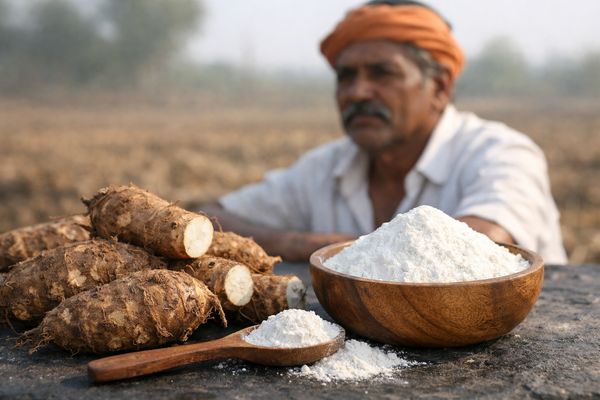
Indian organic arrowroot powder export prices from New Delhi are holding steady at the recent high range, with only modest week‑on‑week moves despite rising pre‑summer heat risks in key growing areas. Thin exportable surplus and steady specialty demand in Europe and North America keep a mild risk premium embedded in FOB offers.
Arrowroot sits within a broader Indian spices and starches complex that is currently well supplied but weather‑sensitive. Spot export quotes for clean‑label niche starches remain firm as buyers prioritise quality and traceability, while local reports highlight increasingly uncomfortable heat and humidity in parts of South India. With the India Meteorological Department (IMD) flagging above‑normal temperatures and heatwave conditions in several southern and coastal states, markets are monitoring any impact on root‑crop yields and processing margins over the coming weeks. Overall, the near‑term tone is cautiously firm rather than aggressively bullish.
[cmb_offer ids=90,90,90]
📈 Prices
Indicative export price levels for organic arrowroot powder (99% purity, FOB New Delhi) are currently around €2.00–2.05/kg, broadly in line with recent assessments that described the market as “slightly firmer to stable” on weather‑risk premium. A comparison with other Indian specialty ingredients, such as jaggery powder FOB offers updated on April 17, confirms that niche, value‑added products are maintaining resilient export pricing despite only moderate global demand.
| Product | Location / Term | Current Range (EUR/kg) | 1‑Week Trend |
|---|---|---|---|
| Arrowroot powder, organic 99% | New Delhi, FOB | 2.00–2.05 | Stable to slightly firm |
🌍 Supply & Demand
India remains a key emerging hub for organic arrowroot powder exports, supported by a rapidly expanding native starch sector that reached about 7.2 million tons in 2025 and is forecast to grow further across food and non‑food uses. Within this broader starch complex, arrowroot is a niche crop, so even small changes in planted area or weather can have an outsized price impact.
Recent spice‑sector commentary from India indicates that, while mainstream spices such as cumin and chilli are currently well supplied, the market environment is characterised by selective strength in higher‑value, clean‑label ingredients. For arrowroot, steady demand from gluten‑free, baby food and natural thickener applications in Europe and North America continues to absorb exportable volumes, with buyers showing limited price sensitivity for certified organic lots.
🌦️ Weather & Crop Conditions (India Focus)
The latest IMD guidance for the April–June 2026 hot‑weather season highlights a high probability of above‑normal temperatures and elevated heatwave days across much of India, including parts of peninsular states that host root‑crop and spice cultivation. Short‑term forecasts issued in mid‑April call for hot to very hot and humid conditions in coastal Karnataka, Kerala, Andhra Pradesh and Tamil Nadu, while North India (including Delhi) sees intermittent rain and thunderstorms.
Local accounts from South India point to an unusually intense and extended heat spell this pre‑monsoon season, with frequent reports of maximum temperatures exceeding 40–43°C, especially in Telangana, Andhra Pradesh and inland Tamil Nadu, and high humidity levels in Kerala. For arrowroot, which prefers moist, shaded conditions, this combination of heat and variable pre‑monsoon showers raises some risk for yield and starch content if soil moisture is not maintained, underpinning the current weather‑risk premium in prices.
📊 Market Fundamentals
Structurally, the Indian arrowroot market remains tight: acreage is limited compared with major starch crops, while global demand for clean‑label, allergen‑free starches continues to expand. Recent analytical work on the 2026 arrowroot market describes a “high‑growth, high‑volatility” phase, where modest weather disruptions in India, East Africa or Brazil can quickly translate into firmer export prices due to thin tradable volumes.
At the same time, India’s organised spice and specialty‑ingredient trade is gaining depth, with new sourcing intermediaries and expanded export platforms improving market access for small processors. This supports more consistent export flows but does not fully eliminate weather and logistics‑driven volatility, especially for organic products that must meet strict quality and residue standards in destination markets.
📆 Short‑Term Outlook & Trading Ideas
- Bias: Mildly bullish – With heat risks building into late April and structurally tight exportable surplus, the balance of risk for FOB New Delhi prices over the next few weeks tilts slightly to the upside.
- For exporters: Consider locking in forward sales on a rolling basis at current levels, while keeping some upside participation for May–June in case weather stress in South India intensifies and filters into raw‑material costs.
- For importers: Buyers in Europe and North America may wish to secure core Q2–Q3 volume now, diversifying suppliers within India but avoiding over‑reliance on spot purchases during peak heatwave periods.
- For processors in India: Monitor IMD updates closely and prioritise irrigation and shade management in arrowroot fields; securing raw‑root supply contracts early could protect margins if field‑level prices rise.
📉 3‑Day Price Direction (Region: IN)
- New Delhi, FOB arrowroot powder, organic 99%: Prices expected to remain in a narrow band around €2.00–2.05/kg over the next 3 days, with a stable to slightly firmer bias as markets track evolving heatwave signals and any disruptions to logistics from pre‑monsoon storms in North India.
[cmb_chart ids=90,90,90]