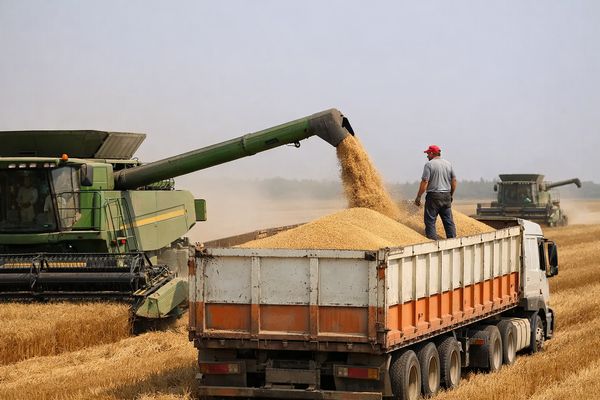
Indian wheat prices are drifting lower as sluggish government procurement and strong arrivals keep wholesale markets well supplied, while global benchmarks remain capped by heavy Black Sea export availability.
Wheat markets across India’s key wholesale centres softened again last week, with Delhi benchmarks slipping further as government buying lagged far behind last year. A shortage of jute sacks at procurement centres has diverted large volumes into open markets, where selling pressure is intensifying just as the rabi harvest advances. At the same time, stabilising freight conditions in the Strait of Hormuz and a pause in the recent rally in fine-grade rice have cooled overall grain sentiment. Internationally, improved US winter wheat conditions and ample Black Sea export supply offer a broadly bearish backdrop, pointing to range-bound to slightly softer wheat prices near term.
[cmb_offer ids=738,727,772]
📈 Prices & Benchmarks
In Delhi, mill-quality wheat eased by about EUR 0.10–0.20 per 100 kg equivalent, settling roughly around EUR 24.80–25.00 per quintal (converted from USD), as fresh arrivals met limited procurement support. Prices in primary producing markets fell even more sharply, by an estimated EUR 0.30–0.40 per quintal, before the weakness filtered through to northern consuming hubs. Old-crop wheat continues to trade at a modest premium over new-crop, reflecting quality preferences and tighter old-crop availability.
In value‑added segments, price pressure is more pronounced. Semolina prices dropped by around EUR 1.00 per 50‑kg pack, to the equivalent of roughly EUR 14.30–14.40, as both local and bulk demand virtually disappeared and mills turned aggressive sellers. Refined wheat flour (maida) also slipped by around EUR 0.10–0.20 per quintal. Internationally, physical FOB indicators echo this soft tone: recent offers show US 11.5% protein wheat around EUR 0.20/kg FOB, French 11% protein near EUR 0.28/kg, and Ukrainian 11% protein around EUR 0.18/kg, all slightly below levels seen earlier in April, indicating mild easing in export values.
| Market / Product | Latest level (EUR) | Change vs. prior period (EUR) | Comment |
|---|---|---|---|
| Delhi wheat, mill quality (100 kg) | ≈ 24.8–25.0 / qtl | −0.10 to −0.20 / qtl | Soft tone on weak procurement |
| India semolina (50 kg) | ≈ 14.3–14.4 / pack | −1.0 / pack | Demand from local & bulk buyers dried up |
| US wheat 11.5% FOB (kg) | 0.20 | ≈ −0.01 | Tracking slightly softer CBOT-linked levels |
| French wheat 11% FOB (kg) | 0.28 | ≈ −0.01 | Maintains premium to Black Sea |
| Ukrainian wheat 11% FOB Odesa (kg) | 0.18 | Flat to slightly softer | Heavy Black Sea supply caps rallies |
🌍 Supply & Demand Drivers
India’s domestic wheat balance is currently dominated by logistics and procurement dynamics rather than outright shortage. Weekly government buys were around 1.5 million tonnes, compared with nearly 5 million tonnes in the same week last season, leaving procurement at less than one‑third of last year’s pace. This gap is being felt directly in the physical market: farmers report that shortages of jute sacks at government centres are delaying official intake and forcing them to offload grain directly into wholesale mandis, deepening the supply overhang.
The rabi wheat harvest, sown in winter and harvested mainly from March to May, is well advanced, ensuring comfortable near‑term availability. With official procurement still lagging despite recent policy moves to relax quality norms in some northern states, private buyers and mills are cautious, preferring hand‑to‑mouth coverage in anticipation of further or at least stable price softness. The opening of the Strait of Hormuz and normalisation of shipping lanes have also reduced freight risk premiums, stalling the earlier rally in fine‑grade rice; this has contributed to a broader cooling in cereal sentiment across northern India, as cross‑commodity substitution pressure fades.
📊 Global Context & Fundamentals
Globally, the wheat complex is trending mildly bearish to sideways. US winter wheat crop ratings in several key states, including parts of the eastern Corn Belt, have improved compared with last season, reducing immediate production concerns and weighing on international prices. Recent USDA projections point to rising US wheat ending stocks for 2025/26, while March intentions data indicate a modest year‑on‑year reduction in total US wheat area but still adequate supply potential.
On the export side, Black Sea origins remain highly competitive. Russian wheat shipments in the current marketing year are running ahead of last season, and Ukrainian exporters continue to offer large volumes at discounts to EU and US origins, anchoring FOB benchmarks. CBOT wheat futures recently retreated after testing one‑year highs, reflecting profit‑taking and the weight of comfortable global stocks; daily data from mid‑April show sizeable but stable open interest and no sign yet of a sustained speculative squeeze. Overall, this international backdrop reinforces the domestic soft bias in India.
🌦️ Weather Snapshot
Weather in India’s main northern wheat belt has turned seasonally favourable after earlier unseasonal rains in some pockets, supporting harvest and post‑harvest operations. Reports of localised quality issues have prompted the government to relax procurement norms in states such as Haryana and Punjab, which should gradually improve official buying but have not yet tightened physical availability materially.
In other key producing regions, current conditions do not pose an immediate threat to the global balance. Parts of the US Plains and the eastern Corn Belt show generally adequate soil moisture and ahead‑of‑normal crop development, while Europe and the Black Sea have seen mixed but overall manageable weather. Barring a sudden adverse shift—such as late‑season heat in India or a deterioration in US or Black Sea conditions—weather is unlikely to be a major bullish driver in the coming few weeks.
📆 Short-Term Outlook & Trading Ideas
For the next two to three weeks, Indian wheat prices are expected to remain range‑bound to slightly soft. Delhi benchmarks are likely to trade roughly between EUR 24.70 and 25.10 per quintal (converted from USD 26.83–27.26 per 100 kg), assuming current arrival and procurement patterns persist. A meaningful rebound would require either a sustained acceleration in government purchases—supported by better bag availability—or a sharp reduction in daily mandi inflows.
Internationally, FOB offers from the US, EU and Black Sea are set to stay under pressure from large exportable surpluses and improving crop prospects, even if futures occasionally spike on short‑term weather scares. In this environment, the domestic Indian complex is more likely to key off procurement headlines and logistical factors than off global benchmarks, with semolina and maida particularly vulnerable to further downside if downstream demand remains lacklustre.
📌 Trading & Risk Management Pointers
- Flour mills in India: Consider extending coverage modestly within the projected Delhi range, but avoid over‑buying ahead of potential further softness; use price dips created by procurement delays to secure quality lots.
- Farmers in producing states: Where storage is available, stagger sales to avoid peak arrival periods, especially while jute sack shortages and procurement bottlenecks persist; monitor announcements on improved procurement logistics closely.
- Exporters & traders: Exploit the enduring Black Sea discount versus EU and US origins by diversifying origin mix, but hedge against sudden weather or geopolitical shocks using CBOT or Euronext futures where appropriate.
- Importing buyers: For destinations outside India, current FOB levels in the Black Sea and US look attractive for phased forward coverage, given the generally comfortable stock and production outlook.
📉 3-Day Directional View (Indicative, in EUR)
- India – Delhi wholesale wheat: Slight downside bias within ~EUR 24.7–25.1 per quintal as arrivals stay strong and procurement lags.
- CBOT-linked US wheat (FOB, 11.5% protein): Narrow range trade around EUR 0.20–0.21/kg, tracking consolidating futures after recent pullback.
- EU (French) wheat FOB: Stable to marginally softer near EUR 0.28/kg, maintaining premium over Black Sea but constrained by heavy global supply.
[cmb_chart ids=738,727,772]