
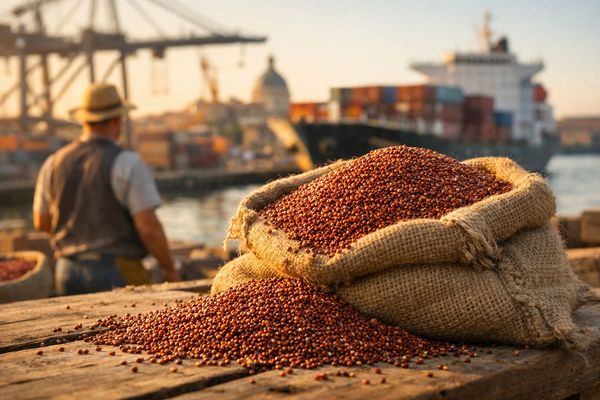
Red quinoa prices from Bolivia into Europe remain stable around EUR 2.50/kg FCA Dordrecht, with buyers in no rush as they await clearer signals from the upcoming Andean harvest and EU demand after Easter.
After several weeks of sideways moves, the Bolivian red quinoa market into Northwest Europe is trading in a narrow range with limited spot liquidity. Export supply from Bolivia is broadly adequate, and no acute weather or logistics shock has emerged in the past few days. At the same time, Europe’s quinoa demand remains structurally firm but not overheated, keeping buyers selective and price‑sensitive. The immediate focus is on new‑crop progress in the Bolivian Altiplano and how it will feed into European import programs for Q2–Q3 2026.
[cmb_offer ids=1120,1120,1120]
📈 Prices & Spreads
Recent offers for conventional red quinoa from Bolivia, delivered FCA Dordrecht in the Netherlands, are holding at about EUR 2.50/kg, unchanged over the last three weeks, indicating a balanced spot market with neither sellers nor buyers pushing aggressively. This level sits in the lower half of indicative wholesale price ranges for Bolivian quinoa reported for 2026 (equivalent to roughly EUR 2.60–3.90/kg at current FX), suggesting some discounting versus broader origin averages, likely reflecting product specification (non‑organic) and competition from Peru.
European import statistics still show robust quinoa demand, with Germany, Italy, France, the Netherlands, Spain, the UK and Belgium together accounting for over 70% of EU quinoa imports in 2024, underlining a solid demand base for Andean suppliers. However, higher‑priced organic and specialty segments are absorbing much of the growth, keeping conventional red quinoa under some competitive pressure.
🌍 Supply, Logistics & Weather
Bolivia remains a key quinoa exporter, supplying around a quarter of Czech imports in 2024 and maintaining a strong overall position in Europe’s quinoa sourcing mix. Export price indices for Bolivia rose into late 2025, pointing to structurally higher export values, but this has not yet translated into a sharp short‑term spike in red quinoa offers to the EU.
Weather in the Bolivian highlands during April is seasonally cool and relatively dry as the main rainy season tails off; current climatological data for La Paz in April point to average temperatures around 10–12°C with moderate precipitation and no abnormal extremes flagged in the last few days. No fresh reports of major weather‑related disruptions in the quinoa‑producing Altiplano have surfaced in the last three days, and recent political blockades have been localized, creating some domestic transport frictions but without clear evidence so far of sustained disruptions to bulk agricultural exports.
📊 Fundamentals & Demand
Europe’s quinoa market is on a medium‑term growth path, with forecasts pointing to steady expansion in value terms through 2035 as consumer interest in plant‑based proteins and gluten‑free staples continues to rise. Within this trend, demand is gradually shifting toward organic, fair‑trade and sustainably certified quinoa, which can cap upside for conventional Bolivian red quinoa unless accompanied by clear quality or traceability advantages.
Macroeconomic signals for Bolivia are mixed, with recent analysis pointing to weak growth prospects in 2026. In the near term, however, this is more likely to keep local producers price‑sensitive and export‑oriented than to constrain physical availability. For European buyers, the combination of adequate supply, stable offers around EUR 2.50/kg FCA and no immediate weather threat argues for a continued sideways fundamental bias.
📆 Short-Term Outlook & Trading Ideas
- For EU buyers: With FCA Northwest Europe offers stable and no acute supply shock visible, consider covering nearby Q2 needs on dips close to EUR 2.50/kg, while keeping some volume open for Q3 in case of further competition between origins.
- For Bolivian sellers: Given firm but price‑sensitive EU demand, maintaining competitive offers versus rival Andean origins is key; small price incentives or quality upgrades (cleaning, uniformity) could help secure forward contracts.
- For traders: The market currently favors range‑trading strategies; watch for any sudden weather or logistics headlines from Bolivia that could trigger a break out of the present narrow band.
📍 3‑Day Regional Price Indication (EUR)
| Region / Port | Product | Incoterm | 18–21 Apr 2026 | Direction (3 days) |
|---|---|---|---|---|
| Dordrecht (NL) | Quinoa Red, conv., origin BO | FCA | ≈ EUR 2.50/kg | Stable to slightly soft (–0.02 to 0 EUR/kg) |
| Northwest EU (spot, indicative) | Quinoa Red, conv., origin BO | Delivered bulk | ≈ EUR 2.65–2.75/kg | Stable |
[cmb_chart ids=1120,1120,1120]