
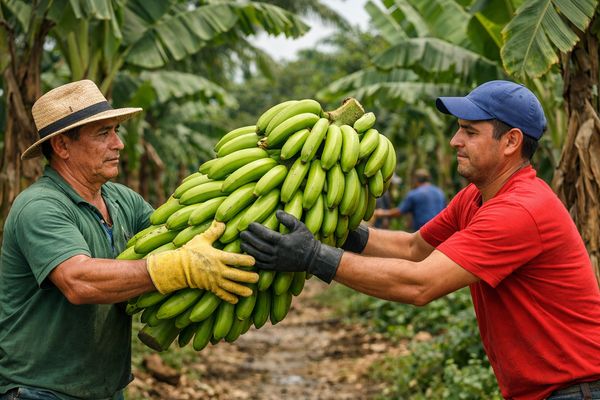
Costa Rica’s banana sector is emerging from a Sigatoka‑driven production dip and is now pairing a gradual volume recovery with an ambitious push to diversify export markets beyond Europe and the US. While disease management costs and high port charges cap margins, resilient demand for premium, sustainable bananas and steady processed‑product prices are underpinning overall price stability.
The country remains a mid‑sized but highly productive origin, with output projected to rebound to 122 million boxes in 2026 after falling to 112 million in 2025. Export flows are still heavily concentrated in Europe (64%) and the US (29%), but Corbana is actively targeting South America and Asian buyers to reduce commercial risk. In parallel, Costa Rican exporters must navigate costly Caribbean port logistics, biosecurity vigilance against Tropical Race 4, and rising labour costs, all while scaling technology and new acreage to reach a potential 170 million boxes by 2031.
[cmb_offer ids=91,785,784]
📈 Prices & Processed Product Signals
Spot data for processed banana products shows a broadly steady market. Conventional whole banana chips from Vietnam are offered around EUR 3.43/kg FOB Hanoi, while Philippine-origin whole chips in the Netherlands trade near EUR 2.37–2.90/kg FCA Dordrecht, and broken chips around EUR 1.87/kg FCA. These levels sit comfortably within the broader European dried‑chips range of roughly EUR 1.75–3.50/kg FCA/FOB reported for mid‑April, with only marginal week‑on‑week changes, indicating balanced supply and demand in the processed segment.
Fresh wholesale bananas in Europe also appear relatively stable. Recent Polish wholesale quotes cluster mostly between about EUR 0.84 and 1.78/kg, with many markets seeing flat week‑on‑week moves, suggesting that the rebound in Costa Rican export volumes has not yet translated into significant price pressure at European wholesale level. Instead, the main price stress globally is more localised, for example the sharp farm‑gate collapse in India’s Maharashtra due to disrupted Middle East demand, underscoring how route‑specific shocks can decouple producer and consumer prices.
| Product | Origin / Location | Delivery terms | Latest price (EUR/kg) | 1-week change |
|---|---|---|---|---|
| Banana dried chips, whole | VN / Hanoi | FOB | 3.43 | Stable |
| Banana dried chips, whole (conv.) | PH / NL (Dordrecht) | FCA | 2.37 | +0.02 |
| Banana dried chips, broken | PH / NL (Dordrecht) | FCA | 1.87 | +0.02 |
| Banana dried chips, whole (organic) | PH / NL (Dordrecht) | FCA | 2.90 | +0.02 |
🌍 Supply & Demand: Costa Rica’s Strategic Pivot
Costa Rica currently produces and exports about 125 million boxes of bananas annually from roughly 40,200 hectares, with the Atlantic province of Limón accounting for 98% of volumes and forming the economic backbone for an estimated 83% of the regional workforce. Production dropped to 112 million boxes in 2025 under heavy Black Sigatoka pressure, but Corbana expects a partial recovery to 122 million boxes in 2026 as agronomic controls and weather conditions improve.
Export flows are still heavily concentrated: about 64% of shipments go to Europe and 29% to the United States, leaving only 7% for other markets. That concentration is increasingly seen as a structural vulnerability. To mitigate demand‑side and geopolitical risk, Corbana is targeting South American buyers in markets traditionally dominated by Ecuador, as well as building commercial ties with China, Vietnam and other Southeast Asian destinations through active participation in trade fairs in Europe and the Americas.
Demand signals from these new destinations appear promising. During recent promotional visits, Costa Rican exporters reportedly found immediate interest from South American importers keen to diversify beyond a single‑origin supply model. Given that many major buyers prefer at least two reliable sources, Costa Rica’s higher per‑hectare productivity versus Ecuador positions it as a credible complementary origin, especially for buyers that value traceability, sustainability certification and stable year‑round shipping windows.
📊 Fundamentals: Disease, Logistics & Expansion
Disease pressure remains the central agronomic constraint. Black Sigatoka and Moko disease continue to drive elevated field‑level costs through fungicide applications, monitoring and yield losses, explaining much of the 2025 production dip. Looking ahead, the sector views Tropical Race 4 Fusarium as the key existential threat. Costa Rica has implemented strict biosecurity measures, including tight controls on farm visits and movement of planting material from affected countries such as Ecuador and Colombia, in order to keep TR4 out of its Cavendish plantations.
On the logistics side, the Caribbean port of Limón, run by APM Terminals, handles around two‑thirds of its movements in bananas but is considered one of the most expensive ports globally. These high handling costs compress exporter margins and slow the pace at which Costa Rica can rebalance flows toward new markets. Corbana is therefore advocating for the Pacific port of Caldera to be upgraded into a second banana hub, which would improve access to South America and the US West Coast and reduce dependence on a single, high‑cost export corridor.
Structurally, Corbana aims to expand banana area by about 40% over six years, adding roughly 15,000 hectares and potentially lifting annual output toward 170 million boxes by 2031, subject to manageable disease pressure and adequate labour. Rising wages and tight labour availability are accelerating investment in drones, mechanisation and automated packing plants, as well as a corporate venture capital fund to support innovation in production and logistics. If successful, these moves could reinforce Costa Rica’s positioning in premium European segments while also underwriting consistent deliveries to new South American and Asian clients.
🌦️ Weather & Short-Term Outlook
In the coming weeks, forecasts for Costa Rica’s Caribbean region around Limón point to typical humid tropical conditions with frequent showers but no immediate signs of extreme events. For producers, such weather can be a double‑edged sword: adequate moisture supports vegetative growth but sustained leaf wetness favours Black Sigatoka, keeping fungicide programmes intensive and costs high. Provided there are no major storms or flooding episodes, field conditions should allow the gradual production recovery projected for 2026 to stay on track.
Globally, supply growth from key origins such as Ecuador is likely to be tempered by higher official minimum box prices and persistent disease and climate risks, which collectively underpin a relatively firm floor for export prices into Europe. At the same time, regional disruptions such as the current Middle East‑related blockage of Indian exports highlight that localised gluts and price crashes can coexist with stable or even elevated prices in distant import markets, reinforcing the value of diversified logistics and market access.
📆 Trading Outlook & 3-Day Price Indication
Key trading implications for the next 1–3 months:
- Importers in Europe: With Costa Rican volumes recovering but still below 2024 peaks, expect broadly stable EUR‑denominated CIF prices, with modest downside limited by higher grower costs and firm retail margins. Use current stability to secure medium‑term contracts with quality‑focused suppliers.
- Retailers: Low farm‑gate prices in certain origins are not fully reflected at retail, suggesting room for margin compression if competitive pressure intensifies. Premium Costa Rican fruit, supported by sustainability and productivity narratives, is likely to retain a small price premium over undifferentiated origins.
- Processors & traders in dried chips: With EU chips offers currently around EUR 1.8–3.5/kg FCA/FOB and only minor week‑on‑week moves, near‑term price risk looks skewed sideways. Consider incremental cover rather than large speculative positions at today’s levels.
- Costa Rican exporters: Prioritise building track records in South American and Asian markets even at tight margins, as this diversification will reduce long‑term dependence on European supermarket buying power and mitigate single‑route risk.
3-day directional outlook (in EUR terms):
- Fresh bananas, Northwest Europe wholesale: Sideways to slightly firm; indicative range around EUR 0.90–1.40/kg as demand is steady and no major new supply shock is visible.
- Dried banana chips, EU warehouses (PH origin): Stable; whole conventional chips likely to trade in the EUR 2.30–2.50/kg band FCA, with broken chips around EUR 1.80–1.90/kg.
- Dried banana chips, VN origin FOB: Stable near EUR 3.40–3.50/kg, supported by firm export demand and limited immediate capacity growth.
[cmb_chart ids=91,785,784]