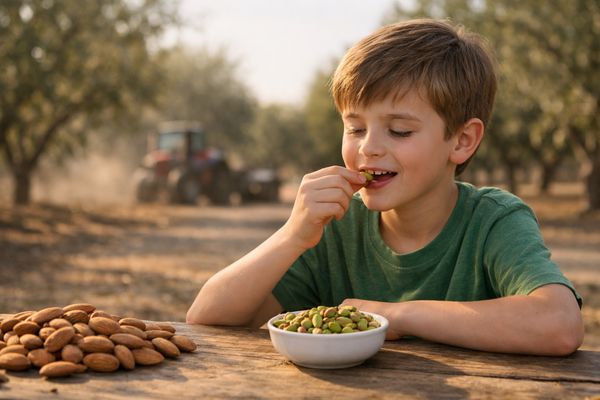
California’s tree nut market is splitting in two: almonds face softening demand and margin pressure, while pistachios gain from constrained Iranian supply and rising export interest.
California’s Central Valley is entering 2026 with unusually divergent conditions between its two flagship nut crops. Almond growers report weaker consumer demand, squeezed further by high fuel costs that raise production expenses and curb spending on perceived “luxury” food items. At the same time, pistachio producers are seeing stronger export inquiries as sanctions and conflict-related disruptions limit Iranian pistachio availability, pushing new buyers toward U.S. origins. The resulting shift in trade flows underscores how domestic cost inflation and geopolitical tensions are reshaping global nut markets, forcing producers to adapt marketing strategies, pricing expectations and risk management across almonds and pistachios.
📈 Prices & Market Sentiment
Almond market sentiment in early 2026 is subdued. Growers report weaker sales and increased uncertainty, with cooperative payments seen as an important barometer of underlying demand. A reduced quarterly payment from a major California almond cooperative in early 2026 has reinforced perceptions of softer prices and tighter margins, even though exact values have not been disclosed.
By contrast, pistachio sentiment is notably more positive. Export buyers are actively seeking non-Iranian supply, and California is well placed to respond. Stronger inquiries from destinations such as Dubai signal that buyers historically reliant on Iranian pistachios are testing U.S. product, supporting price resilience even as California’s pistachio crop expands.
🌍 Supply & Demand Dynamics
Almond demand currently appears highly sensitive to consumer purchasing power. Elevated fuel costs in the United States are eroding disposable incomes and weighing on demand for products seen as discretionary or premium. This is filtering back to farm level through weaker sales performance and cautious buyer behavior, particularly in retail and value-added segments.
Pistachios are experiencing the opposite effect, driven by global rather than domestic forces. Sanctions and conflict-related trade disruptions are constraining Iranian exports, creating supply gaps in traditional import markets. California, as the largest pistachio-producing region outside Iran, is stepping into this space. Exporters are targeting markets that previously relied heavily on Iranian origin, with Dubai and other Middle Eastern hubs cited as examples of growing interest.
📊 Structural Drivers & Policy Factors
For almonds, the key structural headwind is the linkage between fuel prices, production costs and consumer behavior. Higher fuel costs raise orchard operating expenses and transport costs while simultaneously reducing household purchasing power. As a result, any sustained period of high energy prices is likely to cap demand growth and limit the sector’s ability to pass through cost increases.
Pistachio demand strength, by contrast, is tied to external policy and geopolitical developments. Sanctions and conflict disruptions affecting Iran have reduced its effective export capacity, opening space for California pistachios. However, this advantage is policy-contingent: any easing of sanctions or stabilization of trade routes could gradually restore Iranian presence and intensify competition, particularly in price-sensitive markets.
🚢 Trade Flows & Market Development
The current environment is reshaping global nut trade flows. Importers in Europe, Asia and the Middle East that once balanced Iranian and U.S. pistachio purchases are now leaning more heavily on California supply. This shift is not only substitutive but also developmental, as U.S. producers target countries with historically low pistachio consumption to build new demand pools.
California pistachio growers emphasize the need for proactive market development, treating today’s disruption-induced demand as a platform for long-term growth rather than a temporary windfall. Efforts are focused on educating new consumers, expanding product formats, and embedding California pistachios into retail and food service channels in underpenetrated markets.
🌦 Weather & Crop Context
Weather in California’s Central Valley around Fresno for the coming week (20–26 April 2026) is forecast to be seasonally mild to warm, with highs mostly in the 18–29°C range and some short-lived showers and thunderstorms early in the period.
These conditions are generally supportive for ongoing orchard management and do not currently represent a major driver of price or yield risk. Market outcomes in the near term are therefore expected to be shaped far more by demand, costs and trade policy than by immediate weather shocks.
📆 Market Outlook
In the near term, almond growers face continued uncertainty. Persistently elevated fuel costs are likely to keep pressure on consumer demand and farm margins, while payment levels from major cooperatives over coming quarters will be closely watched for signals on whether the demand downturn is stabilizing or worsening. Any relief in fuel prices or improvement in consumer confidence would be the key catalysts for a more constructive almond outlook.
Pistachio producers can expect ongoing support from constrained Iranian supply in the short run. The central question for the medium term is how much of today’s incremental demand can be converted into durable relationships and brand loyalty before geopolitical conditions change. Successful penetration of new markets with limited historic pistachio exposure will be critical to sustaining demand once Iranian competition inevitably adjusts.
📌 Trading & Risk Management Considerations
- Almond growers: Prioritize cost control and cash-flow management while fuel prices remain high; consider hedging input costs where feasible and be conservative on price expectations pending clearer signals from cooperative payments.
- Almond buyers/processors: Current demand softness may offer room for tactical purchasing; monitor U.S. consumer indicators and export program activity for signs of a price floor.
- Pistachio growers: Use the current export window to lock in forward sales with new buyers; emphasize consistent quality and reliability to secure multi-season contracts.
- Pistachio traders/importers: Diversify origin exposure toward California while Iranian supply remains uncertain, but incorporate policy risk into contract tenors and pricing structures.
🔍 Short-Term Directional Outlook (Next 3 Days)
Given the dominance of demand and policy over short-run weather or supply shocks, no major price swings are expected purely from agronomic factors in the next three days. Instead, traders should focus on incremental signals from export inquiries and consumer spending data.
| Market | Product | 3-Day Directional View (EUR terms) |
|---|---|---|
| EU import market | California almonds | Slightly bearish to sideways (demand overhang, no new bullish catalysts) |
| EU import market | California pistachios | Sideways to slightly firm (continued interest amid Iranian constraints) |
| Middle East hubs | California pistachios | Firm tone, especially for consistent-quality export grades |