
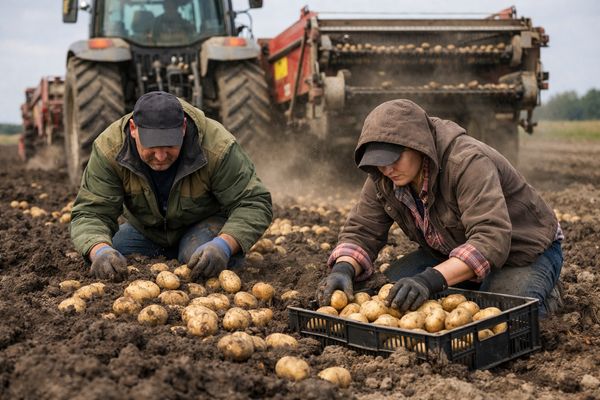
EU potato growers are heading into the 2026/27 season with reduced planting intentions as energy and input costs stay elevated, raising the risk that today’s oversupply flips into tighter availability later in the season. Near‑term fundamentals remain heavy, but the balance is clearly shifting in favour of gradually firmer prices if cuts in acreage materialise.
Spring planting takes place in a market still digesting oversupply and weak demand, yet producers face sharply higher fuel, fertiliser, storage and processing costs. This combination is pushing many to scale back acreage or renegotiate contracts, even as some are tempted by cheap seed and good field conditions. Processors and buyers need to prepare for a more volatile supply environment into 2026/27, with higher cost floors for both raw potatoes and derivatives such as potato starch.
[cmb_offer ids=910,910,910]
📈 Prices & Current Market Tone
Physical potato markets in the EU remain under pressure from lingering oversupply and soft demand, especially in processing segments. However, rising cost structures are starting to form a price floor, limiting further downside for growers.
In derivatives, recent offers for Polish potato starch (FCA Łódź) show a modest firming: prices moved from about EUR 0.82/kg in late March and early April to around EUR 0.85/kg by mid‑April 2026. This incremental increase, while still modest, signals that buyers are beginning to factor in higher production and energy costs.
| Date | Product | Location | Price (EUR/kg) |
|---|---|---|---|
| 23 Mar 2026 | Potato starch | Łódź, PL (FCA) | 0.82 |
| 30 Mar 2026 | Potato starch | Łódź, PL (FCA) | 0.82 |
| 7 Apr 2026 | Potato starch | Łódź, PL (FCA) | 0.82 |
| 13 Apr 2026 | Potato starch | Łódź, PL (FCA) | 0.85 |
🌍 Supply, Demand & Planting Decisions
The EU potato sector heads into the 2026/27 season with a clear shift in sentiment. Ongoing oversupply and subdued demand have already pressured free‑buy prices and contract levels, undermining grower profitability in the past season.
At the same time, growers are experiencing sharply higher input costs. Fuel and fertiliser expenses have surged following military escalation in the Middle East, while elevated natural gas prices in Europe are pushing up storage and processing costs via higher electricity prices. The loss of access to key Gulf export destinations further removes an outlet for surplus EU potatoes.
In this environment, many growers and market participants advocate reducing acreage to address chronic oversupply. Early indications suggest that planting intentions are indeed more cautious for 2026/27, with higher input costs and lower contract prices discouraging expansion, even where seed availability and field conditions might otherwise support larger areas.
📊 Cost Structure & Profitability Pressures
Energy markets have become a pivotal driver of potato economics. After U.S. and Israeli military action in Iran at the end of February, Brent crude jumped from roughly USD 72/bbl to around USD 118/bbl by late March before easing back but remaining volatile around USD 95/bbl. This sustains elevated diesel and logistics costs for growers.
Natural gas prices in Europe spiked by nearly 80% month‑on‑month at the end of March and, while off the peak, remain high. Because EU electricity generation still relies heavily on gas, storage and processing costs for potatoes and potato products have climbed significantly. For growers already squeezed by “rock bottom” free‑buy prices and weaker contract terms, another season at these levels would be severely damaging.
These cost dynamics raise the break‑even level for potato production and processing. Unless end‑product prices adjust higher, many growers will scale back investment and acreage, which in turn could tighten supply and ultimately support higher price levels into 2026/27.
📉 Risks, Weather & Trade Factors
The core downside risk remains that, despite calls for acreage cuts, favourable planting conditions and abundant low‑priced seed could tempt some growers to plant more than planned. This would prolong oversupply and keep free‑buy prices depressed, compounding financial stress.
On the demand side, any sustained loss of access to Gulf markets removes an important export outlet for EU potatoes and processed products. If this persists, more volume will need to be absorbed within Europe or redirected to alternative destinations, likely at lower netback prices.
Weather conditions during the growing season will be crucial: good yields on even a modestly reduced area could still generate comfortable supply, while weather‑related yield losses would amplify the effect of lower acreage and potentially trigger a sharper price recovery late in the season.
📆 Outlook & Trading Recommendations
Market balance for 2026/27 is pivoting away from today’s oversupply toward a tighter, cost‑driven environment. Actual planted area and in‑season weather will determine whether the market merely normalises or swings into clear deficit.
- Growers: Prioritise contracts with robust cost‑sharing or indexation where possible; avoid overexpansion based on cheap seed alone, as another year of very low free‑buy prices would be highly damaging.
- Processors: Consider gradually extending coverage for the 2026/27 season while cost‑related price floors are still forming, particularly for quality raw material and starch.
- Buyers/Users of potato starch: Use current still‑moderate prices (around EUR 0.85/kg FCA in Poland) to secure partial forward volumes, but retain flexibility in case oversupply lingers longer than expected.
📍 Short-Term Price Indication (Next 3 Days)
- Northwest EU raw potatoes: Sideways to slightly firmer in EUR terms, as planting risk and high costs limit further downside despite ongoing oversupply.
- EU potato processing sector: Stable with a mild upward bias, reflecting rising energy and storage costs being gradually passed through.
- Poland – potato starch (FCA Łódź): Mildly bullish tone around EUR 0.85/kg, with limited downside near term given the higher cost base.
[cmb_chart ids=910,910,910]
Related posts:
 Potato Oversupply Crushes Prices in Poland and Across the EU
 Polish Potato Starch Prices Firm Up on Tight Supply and Strong Processing Demand
 Pakistan’s Potato Exports to Russia Reopen: What It Means for Prices
 Greek Flooding Triggers Double-Digit Spike in Fresh Produce Prices, Reshaping Near-Term Import Needs
 Nigeria’s OFSP Nutrition Project Reshapes Local Sweet Potato Value Chain, Signals Niche Demand Shift
 New Ukrainian Import Control Rules Reshape Early-Season Onion and Potato Trade
 Polish Potato Starch Prices Hold Firm Amid EU Potato Oversupply