
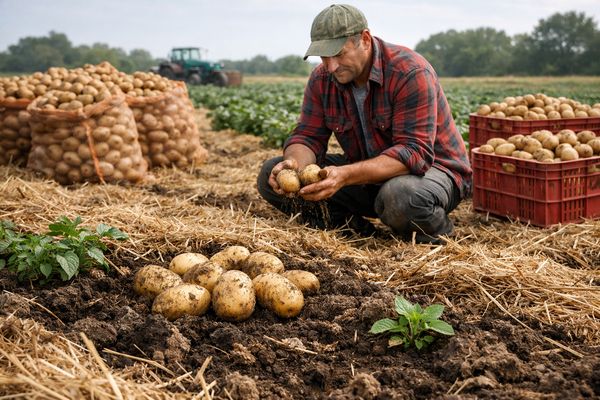
Poland’s potato market is under strong downward pressure as unsold stocks of up to 1 million tons weigh on farmers’ liquidity and bargaining power, while retail chains and processors use the oversupply to push prices lower.
A very large 2023 harvest, combined with additional potatoes from Germany, the Netherlands and Belgium, has created a structurally oversupplied market this season. Producers and authorities disagree on whether imports or domestic stocks are the main driver, but both sides acknowledge that current volumes are difficult to absorb. Against this backdrop, by-product prices such as potato starch are showing only modest firmness, while short-term weather in Poland is neutral for immediate supply but critical for planting decisions.
[cmb_offer ids=910,910,910]
📈 Prices
Physical table potato prices in Poland are under pressure from heavy stocks and aggressive purchasing strategies by retail chains, which are reportedly renegotiating contracts on the back of the surplus. Processors and retailers can select from abundant domestic and imported supply, limiting any upside in farm-gate prices in the short term.
In contrast, indicative prices for potato starch FCA Łódź show a slight upward move despite the surplus in raw potatoes. Recent offers rose from about EUR 0.82/kg in late March to around EUR 0.85/kg by mid-April, suggesting relatively stable to mildly firmer demand in industrial and food applications, or at least cost-related support on the processing side.
| Product | Location | Delivery terms | Latest price (EUR/kg) | 1-week change | Last update |
|---|---|---|---|---|---|
| Potato starch | Łódź (PL) | FCA | 0.85 | +0.03 | 2026-04-13 |
🌍 Supply & Demand
The Polish Potato Federation estimates that farmers are holding between 700,000 and 1 million tons of unsold potatoes that still need to find an outlet. Without additional demand, these volumes represent a significant financial risk for producers, especially those with limited storage or high debt. The Federation links the situation to a wider European surplus of roughly 2 million tons, amplified by the closure of a potato processing plant in Western Europe.
At the same time, Poland’s Ministry of Agriculture attributes the oversupply primarily to domestic factors. The 2023 harvest reached nearly 7 million tons, around 18% above the previous year, while imports allegedly remained broadly stable. From the ministry’s perspective, the high local harvest and remaining stocks from last season are sufficient to explain the current imbalance. The different narratives underline that both domestic and European surpluses are in play, tightening margins along the chain.
Retail chains are reportedly exploiting this environment to renegotiate or delay purchases, creating additional pressure on growers who must liquidate stocks before quality deteriorates. The combination of large on-farm inventories, stable imports and reduced processing capacity in parts of Western Europe is therefore keeping the Polish potato market firmly in surplus for now.
📊 Fundamentals & Weather
Fundamentally, Poland enters the new season with unusually high ending stocks, while European neighbors such as Germany, the Netherlands and Belgium also have ample supply. This reduces any incentive for early new-crop planting expansion and may trigger a partial area adjustment as farmers react to weak prices and liquidity stress.
Short-term weather in central Poland, including the Łódź region, is relatively mild and slightly improving over the next three days, with daytime highs rising from around 10–12°C to 15–16°C and a mix of clouds and sun. This pattern is broadly favorable for field work and planting but, given current stock levels, the key driver for the market remains demand absorption and policy or industry-led solutions for surplus disposal, rather than weather-related production risks.
📆 Forecast & Trading Outlook
In the near term, the large unsold stock (700,000–1,000,000 tons) will continue to cap any price recovery for table potatoes. Even if domestic demand remains solid, the market needs either stronger export flows, additional processing capacity, or targeted intervention to absorb the excess. Without such outlets, forced sales and potential quality losses could weigh further on farm-gate prices as the storage season progresses.
Potato starch prices, while slightly firmer recently, are unlikely to decouple completely from the underlying surplus in raw potatoes. However, as they reflect processed value and different demand segments, they may show more resilience than fresh market prices. Policy discussions between the Ministry of Agriculture and sector representatives are ongoing, but concrete measures are not yet visible in the short-term price structure.
📌 Key takeaways for market participants
- Growers (PL): Prioritise selling remaining stocks where storage risks and financing costs are high; consider forward contracting a limited share of 2026 crop if available, while carefully reassessing planting area in light of persistent surplus signals.
- Processors & starch industry: Exploit competitive raw material prices to secure supply for 2026/27; current modest firmness in starch prices justifies locking in input volumes, but maintain flexibility in case policy support lifts farm-gate prices later.
- Retail & traders: The current surplus provides strong negotiating leverage; however, reputational and supply-chain risks argue for transparent contracts and collaboration with domestic producers to avoid long-term damage to local supply.
📉 3‑day directional outlook (Poland)
- Table potatoes, PL (farm-gate): Sideways to slightly lower; heavy stocks and buyer dominance continue to limit any rebound.
- Potato starch, FCA Łódź: Mildly firm bias after recent uptick to about EUR 0.85/kg; limited additional upside expected over the next three days without new demand impulses.
- Spread fresh vs. starch: Likely to widen modestly as processed product remains relatively better supported than raw potatoes.
[cmb_chart ids=910,910,910]
Related posts:
 EU Potato Market: Cost Shock Triggers Cautious Planting and Tightening Risks
 Potato Oversupply Crushes Prices in Poland and Across the EU
 Polish Potato Starch Prices Firm Up on Tight Supply and Strong Processing Demand
 Pakistan’s Potato Exports to Russia Reopen: What It Means for Prices
 Nigeria’s OFSP Nutrition Project Reshapes Local Sweet Potato Value Chain, Signals Niche Demand Shift
 New Ukrainian Import Control Rules Reshape Early-Season Onion and Potato Trade
 Polish Potato Starch Prices Hold Firm Amid EU Potato Oversupply
 Polish Fried Onion Prices Ease While Dehydrated Demand Firms in EU