
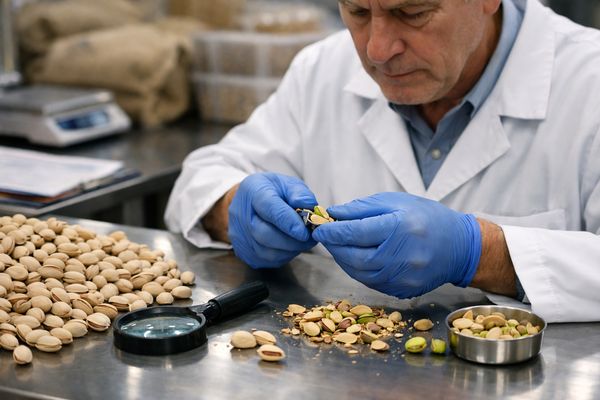
A targeted Salmonella-linked pistachio recall in Ontario is adding localized demand and reputational risk just as global pistachio prices trade near multi‑year highs and supply chains remain tight. Market impact is currently limited to Canadian retail and foodservice channels, but reinforces structural food‑safety and origin‑risk premiums for pistachios.
Global pistachio fundamentals remain firm: constrained supply from Iran, strong shipments from the U.S., and resilient demand in confectionery and bakery segments are keeping prices elevated. Against this backdrop, the Canadian recall of pistachio ingredients and ready‑to‑eat desserts underscores how food‑safety shocks can quickly reshape sourcing strategies and certification requirements, particularly in high‑value applications like baklava, kunafa and premium chocolate products. Buyers should expect continuing scrutiny of origin, stricter microbiological specifications, and a sustained quality premium for fully traceable product.
Exclusive Offers on CMBroker

Pistachio inshell
Ahmadaghaei, 24-26
FOB 9.50 €/kg
(from IR)

Pistachio inshell
Ahmadaghaei, 28-30
FOB 9.26 €/kg
(from IR)

Pistachio inshell
Ahmadaghaei, closed mouth, 24-26
FOB 7.01 €/kg
(from IR)
📈 Prices & Market Context
Global pistachio prices reached around eight‑year highs in mid‑April as disruptions to Iranian exports, including damage to storage infrastructure and sanctions, tightened international supply and shifted trade flows further toward U.S. origin. European price indications for bright green kernels and higher‑count Iranian grades are expected to remain elevated with a mild upward bias over the immediate trading horizon, reflecting both supply loss and strong industrial demand.
FOB offers for Iranian in‑shell Ahmadaghaei pistachios (24–30 count, Tehran basis) have been stable in recent months in the mid‑single‑digit EUR/kg range for closed‑mouth and high‑single‑digit EUR/kg for open‑mouth grades, indicating that existing quotations have not yet fully reset to the latest geopolitical and logistics risk. At the same time, record U.S. production and very strong export shipments are partially cushioning the global deficit, but inventory distribution remains uneven by grade and destination.
| Product | Origin | Location / Terms | Latest Offer (EUR/kg) |
|---|---|---|---|
| Pistachio in‑shell Ahmadaghaei 24–26 | Iran | Tehran, FOB | ≈ 9.50 |
| Pistachio in‑shell Ahmadaghaei 28–30 | Iran | Tehran, FOB | ≈ 9.26 |
| Pistachio in‑shell Ahmadaghaei closed‑mouth 24–26 | Iran | Tehran, FOB | ≈ 7.01 |
🌍 Supply, Demand & Food Safety
The latest Canadian recall centers on pistachio ingredients and ready‑to‑eat items sold in Ontario between January 29 and February 16, 2026, including chopped pistachios for baklava and kunafa (various grades), pistachio powder and paste, and Dubai‑style chocolate bars and brownies supplied by Kunafa’s Inc. The recall followed positive tests for potential Salmonella contamination, and authorities have reported illnesses that may be linked to the products while the investigation continues.
The Canadian Food Inspection Agency (CFIA) has classified the case as a Class 2 recall, indicating a risk of temporary or medically reversible health effects. All affected products are being pulled from the market, with consumers instructed not to consume, use, sell, or distribute the items and to discard or return them. This incident follows a broader tightening of Canadian import rules after a sequence of Salmonella‑related pistachio recalls, particularly for Iranian origin, culminating in licence conditions and, at periods, effective refusal of entry.
Globally, demand remains robust. Recent U.S. shipment data show 756 million pounds moved so far in the 2025/26 season, up more than 20% year‑on‑year, with exports leading the gains and inventories declining. Despite crop and logistics concerns in California, Turkey and Iran, consumption in snack, confectionery and bakery channels has held up, helped by pistachios’ premium, health‑linked positioning.
📊 Fundamentals & Risk Drivers
- Origin risk and structural shift: Sanctions and infrastructural damage in Iran, coupled with stricter food‑safety regimes in key importing markets like Canada and the EU, are accelerating a structural shift toward U.S. and alternative origins.
- Record U.S. production vs. China demand loss: The U.S. has harvested a record pistachio crop for 2025/26, exceeding 1.5 billion pounds, but early‑season exports to China have collapsed, rapidly redefining trade patterns toward Europe and Southeast Asia.
- Food‑safety premium: The Ontario Salmonella incident highlights ongoing challenges in preventing contamination in complex nut supply chains. Processors able to demonstrate robust HACCP systems, validated kill‑steps and comprehensive traceability are likely to command a growing price premium.
- Reputational risk in RTE channels: Because the recall also hits high‑profile ready‑to‑eat desserts, it may temporarily dampen pistachio usage in similar products in affected regions, as retailers and QSR chains reassess recipes and supplier lists.
🌤️ Weather & Production Outlook
Weather‑related risks are emerging for the upcoming 2026 crop. Industry reports flag record heat during bloom in some producing regions, raising concerns about nut set and yield potential for next season, particularly in parts of California and the Mediterranean belt. Combined with prior stress on Iranian orchards and storage, this supports expectations that supply growth will slow even as farmgate values remain strong over the medium term.
For now, orchards in the main Northern Hemisphere origins are entering the critical development window with mixed conditions: adequate soil moisture in some U.S. regions offsets heat episodes, while parts of Turkey and Iran face ongoing water and infrastructure constraints. Any further weather shock into nut fill would quickly translate into higher premiums for large, bright kernels.
📆 Trading & Risk Management Outlook
- For importers & roasters: Maintain at least partial forward coverage for Q2–Q3 needs, prioritizing origins and suppliers with strong microbiological controls and clear CFIA/EU compliance documentation. Use current offers in the 7–10 EUR/kg FOB Tehran range for Ahmadaghaei as a reference when negotiating alternative origins with similar specs.
- For industrial buyers (confectionery, bakery, ice cream): Diversify origin exposure (U.S., Turkey, Greece) and product form (kernels vs. paste) to reduce dependence on any single supply chain. Consider pre‑approving multiple suppliers to shorten response time to future recalls or border holds.
- For retailers & foodservice in Canada: Expect short‑term gaps and reformulations in pistachio‑containing desserts and snacks. Communicate clearly on recall management and replacement sourcing to protect brand trust; prioritize SKUs with validated roasting/kill‑steps and third‑party certifications.
- For producers: In a market where prices are high but safety expectations are rising, investment in post‑harvest sanitation, monitoring and traceability can yield both risk reduction and a tangible price premium.
📉 3‑Day Price Direction View (EUR)
- Europe (import basis, kernels & premium in‑shell): Elevated with slight upward bias as buyers reassess coverage after Iran disruptions and amid continued strong export pull from the U.S.
- Middle East hub (Iran‑linked grades, FOB/CIFFOT): Firm to slightly higher for exportable lots due to logistics and infrastructure constraints; domestic pricing remains volatile but internationally traded volumes command a clear risk premium.
- North America (wholesale, U.S. origin): Generally firm but more balanced, with high inventories from the record crop partly offsetting global tightness; near‑term moves likely sideways to modestly higher pending clearer signals on 2026 yield impacts and ongoing food‑safety developments.
Related posts:
 Iranian Pistachio Gap Keeps Europe Tight Despite Diplomatic Hopes
 Bright Green Gap: How Iranian Pistachio Disruptions Are Reshaping Europe’s Market
 Spain Opens Door to China: What the New Pistachio Protocol Means for Prices
 India’s Peanut Market: Steady Supply Growth Meets Firm Multi-Sector Demand
 Almonds: Export-Driven Rebound Meets Cautious Price Optimism