
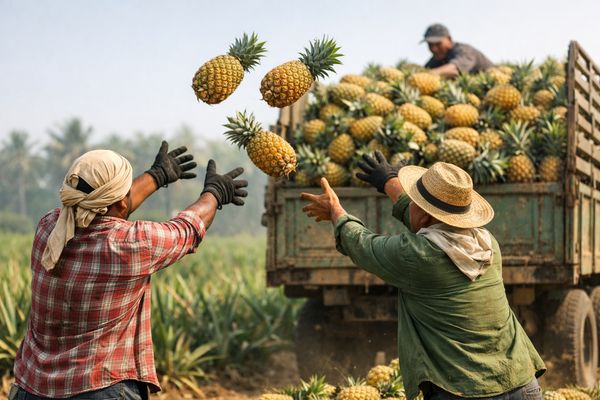
Indian pineapple growers are heading through an unusually difficult summer, with farm-gate prices falling well below production costs as extreme heat curbs yields and weak downstream demand limits offtake. Without a recovery in hospitality and juice-sector demand, pricing pressure and grower margins are likely to remain under strain in the near term.
India’s pineapple season typically benefits from strong summer consumption and supportive prices, but this year the market is misaligned. Prolonged high temperatures in Kerala and neighbouring regions are damaging crop development, shrinking fruit size and yields, while also deterring field workers. At the same time, consumption linked to hotels, restaurants and juice outlets is underperforming, resulting in a sharp drop in farm-gate prices and exposing the sector’s vulnerability to both climate and demand shocks.
Exclusive Offers on CMBroker

Pineapple dried
FOB 6.75 €/kg
(from VN)

Pineapple dried
normal sugar, 5-7 mm
FCA 4.00 €/kg
(from NL)

Pineapple dried
normal sugar, 8-10 mm
FCA 3.90 €/kg
(from NL)
📈 Prices
Farm-gate pineapple prices in key Indian producing areas such as Vazhakkulam have fallen to about US$0.30–0.36/kg, roughly EUR 0.28–0.34/kg at current exchange rates, versus more than US$0.72/kg (around EUR 0.67/kg) in previous seasons. At the same time, growers estimate that sustainable production requires approximately US$0.42–0.48/kg, equivalent to around EUR 0.39–0.45/kg, putting current returns clearly below cost levels.
This domestic fresh-fruit weakness contrasts with relatively stable but mildly softening prices in processed segments. Recent offers for dried pineapple from Vietnam and Thailand into Europe show slight week‑on‑week easing, with Vietnamese dried pineapple around EUR 6.25–6.30/kg FOB Hanoi and Thai dried pineapple in the Netherlands edging down to about EUR 3.70–3.80/kg FCA for normal-sugar cuts, suggesting modest downstream price pressure but no collapse.
| Product | Origin / Location | Latest Price (EUR/kg) | 1–2 Week Change |
|---|---|---|---|
| Fresh pineapple (farm-gate, Kerala, est.) | India | 0.28–0.34 | Sharp drop vs. prior season (>0.65) |
| Pineapple dried, bulk | Vietnam, FOB Hanoi | ≈6.25 | Slightly softer over April |
| Pineapple dried, normal sugar 5–7 mm | Thailand, FCA NL | ≈3.75–3.80 | Gradual decline in April |
| Pineapple dried, normal sugar 8–10 mm | Thailand, FCA NL | ≈3.65–3.70 | Gradual decline in April |
🌍 Supply & Demand
On the supply side, Indian production—particularly around Vazhakkulam—is being constrained by heat-related stress. Pineapple performs best at around 32–33°C, but current temperatures in Kerala have repeatedly pushed towards 39–40°C, according to recent state heat alerts and meteorological advisories, amplifying evapotranspiration stress and limiting fruit growth. This is translating into smaller fruit and lower marketable yields per hectare.
Despite this constrained supply, prices are weak because demand has fallen even more sharply. Pineapple sales in India are tightly linked to hospitality, catering and juice vendors. Softer activity and cautious buying in these segments have reduced offtake, leaving farmers with limited bargaining power despite seasonal timing that would normally favour sellers. The imbalance highlights a demand-led downturn: lower output has not been sufficient to offset the contraction in consumption, leading to the current price slump.
📊 Fundamentals & Weather
The fundamental squeeze on growers is driven by a combination of cost inflation and heat stress. Labour shortages have intensified as workers either migrate or avoid field work in extreme temperatures, raising hiring costs and causing delays in harvesting operations. These delays risk further quality losses and uneven ripening, which can depress realised prices even more.
Weather outlooks for the coming days indicate that heat stress remains a key risk factor. National meteorological updates point to ongoing hot conditions across much of India through at least April 26, with Kerala facing a mix of high temperatures and only patchy relief from thunderstorms, keeping humidity and perceived heat particularly high. Global assessments from FAO and WMO also underscore that extreme heat episodes are becoming more frequent and are already associated with measurable yield losses and worker health risks across agricultural systems, a trend consistent with the challenges now visible in Indian pineapple fields.
📆 Outlook & Trading Guidance
In the short term, the Indian fresh pineapple market is likely to remain under pressure as long as hospitality and juice-sector demand stays subdued and temperatures remain above optimal levels for crop development. Any sustained shift in weather towards more moderate temperatures, or a rebound in institutional buying (for example from hotels and catering linked to events and tourism), would be the main triggers for price stabilisation at farm level.
- Buyers (fresh and processed): Use current weakness in Indian farm-gate prices to secure medium-term supply contracts where possible, but incorporate clauses reflecting potential weather and labour disruptions.
- Growers and cooperatives: Prioritise cost control and coordinated marketing to improve bargaining power; consider staggering harvests and exploring processing channels to capture more value from sub‑optimal fresh grades.
- Importers of dried pineapple: With European dried prices easing slightly, avoid over-extending long positions; maintain flexible coverage into early summer, watching for any further heat-related disruptions in Asian origins that could tighten supply.
Over the next three days, Indian farm-gate prices are expected to remain broadly flat at depressed levels, with limited upside given weak local demand. In European hubs, dried pineapple quotations in EUR are likely to trade sideways to slightly softer, reflecting adequate stocks and only modest spot buying interest.
Related posts:
 Pineapple markets: firm prices under logistics strain and tight Costa Rican supply
 Tight Supply, Firm Demand: Malaysia Shapes the Pineapple Trade
 Dried Papaya Prices Hold Steady as Thai Heat Meets Stable Vietnam Supply
 Dried Pineapple Prices Ease Slightly as Heat Stresses Thai Crop Outlook
 Chinese Dried Apple Prices Hold Flat as Freight Costs Edge Higher
 Pineapple Market Tightens as Supply Drops and Prices Climb
 Raisin prices steady to firm as India faces heat and Turkey stays stable
 Dried Pineapple Prices Soften Slightly as Thai Heatwave Meets Stable VN Supply