
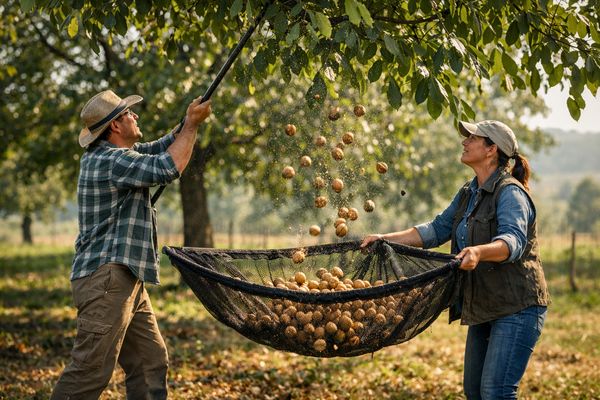
Climate change is nudging walnut production northward in Europe, with Germany and the UK emerging as new origins. However, current output remains far too small to move international walnut prices, which are broadly stable, while structural bottlenecks in processing and site selection cap near‑term growth.
German growers in Rheinhessen and the Palatinate are replacing traditional stone fruit with walnuts and other nuts as warmer, drier summers improve economic viability. Similar temperature trends support small but growing walnut areas in the UK. For now, these domestic volumes are niche and primarily relevant for branded, provenance-driven segments rather than the mainstream kernel trade.
Exclusive Offers on CMBroker

Walnut kernels
light quarter
FOB 3.35 €/kg
(from CN)

Walnut kernels
light amber pieces, 8-12 mm
FOB 2.30 €/kg
(from CN)

Walnut kernels
light pieces, 8-12 mm
FOB 2.85 €/kg
(from CN)
📈 Prices & Current Market Tone
International walnut kernel prices are steady, with no significant week‑on‑week moves in the last three weeks across key origins in our reference set. Chinese light halves and pieces remain the benchmark for competitively priced conventional kernels, while organic US and Indian product continues to command a premium. Recent market commentary also highlights aggressive Chinese supply into price‑sensitive destinations such as India, which is reinforcing a soft to sideways tone on bulk kernel values.
| Product | Origin | Location / Term | Price (EUR/kg FOB) | Trend (past 3 weeks) |
|---|---|---|---|---|
| Walnut kernels, light quarters | China | Dalian, FOB | ≈ 3.10 | Stable |
| Walnut kernels, light pieces 8–12 mm | China | Dalian, FOB | ≈ 2.65 | Stable |
| Walnut kernels, light amber pieces 8–12 mm | China | Dalian, FOB | ≈ 2.15 | Stable |
| Walnut kernels, light halves, organic | US | London, FOB | ≈ 4.20 | Stable |
| Walnut kernels, light halves, organic | India | New Delhi, FOB | ≈ 4.95 | Stable |
Note: Prices converted to EUR using an indicative rate of 1 USD ≈ 0.93 EUR. The flat price structure, combined with evidence of discounted Chinese kernels reshaping reference levels in India, suggests continued margin pressure for higher‑cost origins in commodity channels.
🌍 Supply & Demand: Emerging Northern European Origins
In Germany’s Rheinhessen and Palatinate regions, growers are structurally shifting from sour cherries, plums, and mirabelles to walnuts and other nuts. One key operation in Wolfsheim now manages around 50,000 trees (approximately 20,000 walnut and 30,000 almond trees) and has just achieved its first significant harvest. Another farm in the southern Palatinate has developed a 17‑hectare nut portfolio, but opted for hazelnuts over walnuts because of spotted wing drosophila pressure and waterlogging risks.
Despite this momentum, the current footprint of walnut production in Rhineland‑Palatinate is tiny: about 44 farms on roughly 90 hectares versus 3,500 hectares of total fruit area, implying under 3% of the regional fruit surface. Domestic output therefore has no material impact on Germany’s import dependence; more than 99% of nuts and almonds consumed in the country are still imported from the US, Spain, Turkey, Iran, and other origins.
In the UK, growers are also expanding small walnut plantings as summer temperatures increasingly reach the ~25°C threshold needed for productive growth. A British farm cultivating around a dozen walnut varieties is already processing part of the crop into oil, underscoring the move into value‑added applications. This confirms that climate‑enabled walnut production now extends beyond traditional continental zones and is likely to spread gradually across Northern Europe over the next decade.
📊 Fundamentals & Structural Constraints
A key agronomic driver behind this shift is water demand. Compared with stone fruit, walnuts and almonds require less irrigation in increasingly dry summers, while relying more on spring moisture. Spring rainfall in Rheinhessen remains adequate, allowing farms to operate without irrigation in many sites and to position their product as ‘rain‑fed’ German‑origin nuts. That creates a differentiated sustainability and provenance story for premium retail and organic channels.
However, the sector’s growth path is constrained by site suitability and processing infrastructure. High‑performing almond (and, by extension, walnut) sites largely overlap with quality wine or apricot areas, limiting scalable expansion. Post‑harvest, growers face bottlenecks in cleaning, drying, storage, cracking, sorting, and packaging; insufficient drying capacity in particular can cap the share of the crop reaching commercial quality and exportable shelf life. Pest pressure from spotted wing drosophila adds further risk, prompting experimentation with more tolerant species such as pecans.
Pilot programmes with German research and extension services, in cooperation with Spanish institutes, are testing new almond and pecan varieties planted since 2023. Their performance over the coming seasons will heavily influence whether nut cultivation can move beyond niche status toward a commercial scale that matters for processors and traders. Until then, Germany’s walnut sector remains a story of structural potential rather than immediate volume.
🌦️ Weather Outlook for Key Growing Regions
For late April and May, medium‑term forecasts for Rhineland‑Palatinate point to seasonally mild temperatures, with daily highs in the upper‑teens to low‑20s °C and no indication of extreme heat spikes in the immediate 10–14 day window. This is broadly supportive for early vegetative growth, while moderate rainfall should help meet the spring moisture needs of walnuts without triggering serious waterlogging on well‑sited orchards.
In California, which remains a major supplier to global walnut markets, recent risk and input‑cost bulletins highlight ongoing weather variability but no short‑term shock comparable to previous drought episodes. While around 20% of the 2025/26 California walnut crop has been flagged as at risk from adverse conditions, current assessments still point to an adequately supplied export pipeline rather than a severe shortage scenario.
📆 Market Outlook (30–90 Days & 6–12 Months)
Near Term (30–90 days)
- German walnut growers will concentrate on post‑harvest processing, drying, and early marketing of the 2025 crop, but available volumes remain too small to influence wholesale pricing in Europe.
- Stable Chinese and US kernel quotations, combined with aggressive low‑priced Chinese flows into Asia, suggest a sideways price pattern for standard qualities barring unexpected weather or logistical disruptions.
- Premium German and UK product is likely to trade in niche health‑food, organic, and regional retail channels at a significant markup to global benchmarks, driven by provenance and low‑input narratives rather than commodity fundamentals.
Medium Term (6–12 months)
- Sector growth in Germany will hinge on how rapidly processing capacity—especially drying and cracking—is built out at regional scale.
- The commercial success of new almond and pecan varieties in pilot programmes will inform further investment decisions in mixed nut orchards, indirectly shaping walnut area as growers assess relative profitability.
- Consumer willingness to pay a premium for domestically grown, non‑irrigated nuts will determine whether niche production can be scaled sustainably without subsidies, but even optimistic growth scenarios imply limited impact on import demand before the early 2030s.
🧭 Trading & Procurement Recommendations
- Importers & EU traders: Continue to base core procurement strategies on established origins (US, Chile, China), but begin tracking German and UK walnut projects as potential future suppliers for regional, organic, and short‑supply‑chain programmes.
- German processors & retailers: Explore long‑term offtake or co‑investment agreements in drying and cracking facilities to secure early access to domestic volumes and to lock in provenance‑based premiums.
- Growers in Northern Europe: Prioritise rigorous site selection—favouring well‑drained, wine‑suitable locations—and build business models around higher‑margin branded channels rather than expecting near‑term gains from bulk kernel markets.
📍 3‑Day Directional Price Indication (EUR, FOB)
- China, Dalian – light pieces and quarters: Sideways bias around 2.1–3.1 EUR/kg; no fresh catalysts visible in the next three trading days.
- US, organic halves (FOB EU ports): Stable around 4.1–4.3 EUR/kg; premiums maintained but unlikely to widen in the short term.
- Domestic German/UK niche product: Indicative retail‑level premiums expected to remain firm, supported by limited supply and strong marketing emphasis on local origin and low‑input cultivation.
Related posts:
 Smuggled Chinese Walnuts Upend India’s Market and Squeeze Global Origins
 Iranian Pistachio Gap Keeps Europe Tight Despite Diplomatic Hopes
 War-Driven Supply Shock Pushes Pistachios to Eight-Year Highs
 Walnuts: Export Boom Meets Middle East Bottleneck
 Peanut Butter Drives a Structural Shift in the Global Peanut Market
 Moldovan Walnuts Under Pressure as Costs Rise and Competition Intensifies
 Almonds: Export-Driven Rebound Meets Cautious Price Optimism
 Australian Almonds: Strong Season, Weather Risks and Quality-Driven Pricing