
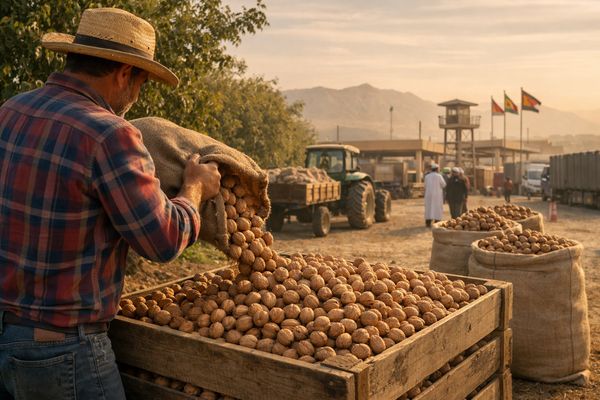
U.S. walnuts are enjoying a strong export season driven by booming Middle East demand, but the Iran war and logistics disruptions around Dubai have rapidly turned this success into a major risk for prices and flows. Europe remains soft, Asia mixed, and competition from China and Chile is intensifying.
Global walnut trade is currently defined by a sharp divergence: structurally strong demand for U.S. product in the Middle East and North Africa versus weakening appetite in Europe and uneven trends in Asia. Recent shipment data confirm robust export growth, especially into Turkey and wider MENA, yet the closure and disruption of key Gulf routes have stranded cargoes and raised uncertainty about the rest of the 2025/26 marketing year. With Chinese and Chilean supply also in the mix, the balance between bullish export data and mounting geopolitical risk will be decisive for prices in the coming weeks.
[cmb_offer ids=654,650,652]
📈 Prices & Differentials
Spot kernel indications show a relatively stable but competitive landscape. Chinese walnut kernels FOB Dalian are currently around EUR 3.35/kg for light quarters, EUR 2.85/kg for light pieces (8–12 mm), and EUR 2.30/kg for light amber pieces, with light broken (4–8 mm) at about EUR 2.95/kg. U.S. organic light halves offered FOB London are near EUR 4.55/kg, while Indian organic light halves ex New Delhi are around EUR 5.35/kg, underscoring a clear quality and origin premium versus Chinese material.
Over the last four weeks, Chinese kernel prices in these main categories have been broadly flat after a small uptick in late March, suggesting that the market has not yet fully priced in the latest logistics shock. The relatively narrow price range, combined with robust U.S. shipment growth, points to still-solid underlying demand, but any prolonged export blockage into the Middle East could trigger discounting or re-direction pressure toward Europe and Asia later in the season.
🌍 Supply & Demand Dynamics
Latest shipment figures highlight a strong export-led season for U.S. walnuts. In February 2026, total shipments climbed to about 221.9 million pounds from 125.0 million pounds a year earlier, driven by an export surge of nearly 80% and domestic growth of roughly 30%. Monthly performance was also robust: February shipments alone rose 23% to 54.9 million pounds, with exports up 27% and domestic movement up 10%. Cumulatively, total kernel shipments for the season are about 7% higher, supported by a 16% increase in exports.
The Middle East is the undisputed growth engine. Seasonal shipments to the region have reached roughly 131 million pounds, compared with just 32 million pounds last year, and Turkey has emerged as one of the largest single destinations with volumes nearly tripling. By contrast, Europe is clearly underperforming: exports to Spain are down about 39%, and Germany is off 63%, leaving total European shipments around 13% lower year-on-year. Asia is mixed, with India down 12% but some Southeast Asian buyers such as Vietnam increasing imports, resulting in broadly flat regional totals.
⚠️ Geopolitics, Logistics & Concentration Risk
The rapid build‑up of U.S. walnut exports into the Middle East has created a new vulnerability just as the Iran war has severely disrupted regional logistics. The closure or severe restriction of traffic through the Strait of Hormuz and the suspension or curtailment of operations at key Gulf hubs, particularly Dubai’s Jebel Ali, have stranded containers of California nuts and forced diversions to alternative ports in Europe and North Africa. Reports from logistics providers confirm widespread port and airspace closures across the Gulf, emergency freight surcharges, and inconsistent customs operations, all of which are inflating costs and lengthening lead times.
Dubai’s traditional role as a central redistribution hub for U.S. walnuts into surrounding markets is under direct threat. With walnut shipments into the broader Middle East reportedly at a near-standstill in recent weeks and vessels rerouted to ports such as Fujairah, Algeria or the Netherlands, exporters face delayed payments, rising credit risk and uncertainty on final destinations. If these conditions persist, the region could temporarily lose its hub status, forcing a re‑routing of trade flows toward Europe, North Africa or alternative hubs, which in turn would weigh on prices and spreads in those markets.
📊 Fundamentals & Competition
Global walnut fundamentals remain broadly adequate, with U.S. supplies comfortable but not excessive and other origins continuing to expand. Recent industry data suggest that world production in 2025/26 is only marginally above last season, but ending stocks are projected to increase as a result of logistics‑driven carry‑over, especially if Middle East demand cannot be physically served in the short term. This potential stock build is a key medium‑term bearish element even against the backdrop of solid underlying consumption.
Competition from China and Chile is intensifying, especially in price‑sensitive segments. Chinese kernels, as reflected in FOB Dalian offers, currently undercut U.S. organic halves by roughly EUR 1.20–2.50/kg depending on grade, providing buyers with affordable alternatives should U.S. shipments be delayed or discounted. At the same time, trade policy uncertainty in India and softer demand in Europe limit the ability of U.S. exporters to swiftly re‑direct volumes away from the Middle East, increasing the risk of basis pressure or promotional activity later in the marketing year.
🌦️ Weather & Short-Term Outlook
Weather conditions in California’s main walnut‑growing areas are seasonally mixed but not currently the primary driver of the market. Recent reports focus far more on logistics and geopolitical disruptions than on any major weather shock affecting the 2026 crop. For now, yield expectations remain largely in line with recent averages, suggesting that near‑term price movements will be dictated by trade flows rather than production surprises.
Looking ahead to the next few weeks, the key watchpoints are the duration of shipping restrictions through the Strait of Hormuz and operational status at Dubai and other Gulf ports. Any tangible improvement in vessel access and clearance times could quickly unlock the current export backlog and stabilize sentiment. Conversely, a prolonged standstill risks creating localized oversupply in origin markets and additional pressure in alternative destinations such as Europe, where demand is already soft.
📆 Trading Outlook & 3-Day Price View
- Exporters (U.S.): Avoid over‑committing new sales into the Middle East until logistics corridors normalize; prioritize diversified destinations (North Africa, Southeast Asia, selective European buyers) and consider flexible delivery terms to share freight risk.
- Importers (EU & Asia): Use current relative stability in kernel prices to secure short‑term coverage, but avoid excessive forward buying given the risk of discounted U.S. volumes if Middle East blockages persist.
- Traders: Monitor differentials between U.S. and Chinese kernels; any widening discount on U.S. origin driven by re‑routing could offer short‑term arbitrage opportunities into under‑served secondary markets.
| Product | Origin / Term | Current Level (EUR/kg) | 3-Day Direction |
|---|---|---|---|
| Walnut kernels, light pieces 8–12 mm | CN, FOB Dalian | ≈ 2.85 | Sideways to slightly soft |
| Walnut kernels, light quarters | CN, FOB Dalian | ≈ 3.35 | Sideways |
| Walnut kernels, light halves (organic) | US, FOB London | ≈ 4.55 | Sideways, risk of mild pressure if re‑routing intensifies |
Over the next three days, prices on key reference markets are expected to remain broadly stable in EUR terms, with only modest downside risk for U.S. origin if additional diverted cargoes start competing more aggressively in Europe and other alternative destinations.
[cmb_chart ids=654,650,652]
Related posts:
 India’s Peanut Market: Steady Supply Growth Meets Firm Multi-Sector Demand
 Moldovan Walnuts Under Pressure as Costs Rise and Competition Intensifies
 Almonds: Export-Driven Rebound Meets Cautious Price Optimism
 Australian Pistachios Gain Ground as Middle East Supply Falters
 South Africa’s Nut Export Boom Reshapes Global Tree Nut Trade Flows