
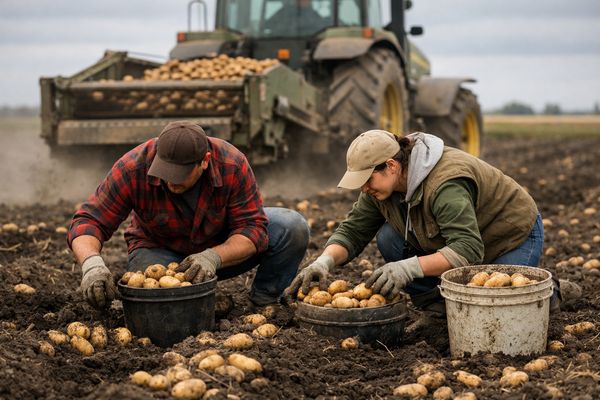
European potato markets are currently shaped less by field yields and more by where and how value is captured after harvest. Farm-gate prices remain under pressure amid regional surpluses, while processed segments like starch and frozen products show more resilience, underlining the growing importance of contracts, storage and differentiation for returns.
European potato pricing in spring 2026 reflects a clear split: oversupplied bulk fresh markets with weak spot prices versus relatively stable, contract-driven processing and starch streams. Growers still receive only a small share of final retail value, with most margin accruing in storage, processing, packaging and retail. In this environment, supply chain positioning, contract alignment and premium product strategies are far more decisive for profitability than marginal gains in field productivity.
Exclusive Offers on CMBroker

Potato starch
powder
FCA 0.85 €/kg
(from PL)
📈 Prices & Market Structure
Recent data from the United States show growers typically receive just 15–18% of the retail potato price, with the remainder generated post-harvest through storage, processing, packaging and retail channels. This highlights a structural shift: production efficiency alone no longer secures attractive returns for growers and traders, especially when crops are sold as undifferentiated bulk volume.
In Europe, this picture is visible in the divergence between weak fresh-market prices and relatively firmer processed streams. Wholesale table potatoes in parts of Central Europe have traded in low double‑cent ranges per kilogram, while European processing potato futures for mid‑2026 have been broadly flat around the equivalent of mid‑teens EUR cents/kg in recent weeks, signalling a market that is well supplied but largely cushioned by contracts rather than spot volatility.
🌍 Supply, Demand & Value Capture
Across the potato chain, value is added at each post-harvest stage: storage, grading, transport, processing, packaging and retail. However, the financial benefit of these steps accrues mainly to processors, packagers and retailers, not to the original producer. A grower delivering a high-quality crop may still face compressed margins if the product enters the market as bulk volume without differentiation or downstream alignment.
By contrast, the same physical crop can generate significantly higher returns when channelled into premium fresh categories, frozen fries, chips, starch or specialist ingredients. Processing effectively transforms potatoes from a commodity into a functional ingredient, requiring investment in technology and logistics but increasing the share of value retained within the integrated supply chain. This also reduces exposure to raw commodity price swings, as contracts and product brands increasingly determine revenue streams.
🏭 Processing, Contracts & Regional Examples
End markets for potatoes – fresh table, frozen fries, crisps, starch and flour – each carry distinct margin structures. Comparing a bulk commodity return with a branded or processed return therefore understates the true spread in value capture along the chain. Current global data on potato starch underline this point: benchmark offers in Europe around EUR 0.85/kg FCA Łódź in late April 2026 are modestly firmer than late March levels, indicating that processed-starch margins remain relatively supported despite raw potato surpluses.
Canada illustrates how contract-aligned systems can stabilise returns. Most Canadian potatoes are grown under contracts that link growers directly to processors, with storage used to ensure year‑round supply. Contracting secures both volumes and varieties and has underpinned expansion: Canadian potato production reached about 125.8 million hundredweight in 2025, with area at its highest since 2007 – growth driven by processor demand rather than speculative planting. This model reduces grower exposure to spot market slumps and strengthens incentives to invest in storage and quality management.
🇪🇺 European Dynamics: Surplus vs. Processing Demand
European markets currently exhibit similar structural patterns. The frozen and processed potato sector, concentrated in Belgium, the Netherlands, Germany and France, mostly operates on contract-based procurement, aligning farm production with downstream demand. Recent industry data confirm the scale of this processing footprint, with EU frozen potato products valued in the billions of euros and capacity still expanding to serve export and quick‑service demand.
Yet a significant proportion of European output still flows into fresh wholesale channels as undifferentiated volume. This segment is now acutely exposed to surplus conditions: reports from late March 2026 describe a “significant surplus” across north‑western Europe, with some farmers resorting to giving potatoes away or even paying for disposal. Large harvests following several good seasons – encouraged in part by strong processing contracts – have combined with weakening demand growth to depress open‑market prices and highlight how little bargaining power exists at the commodity end of the chain.
🚚 Storage, Logistics & Weather
Storage and logistics have become central commercial levers rather than mere cost centres. Maintaining quality over extended storage supports reliable deliveries to processors and retailers and helps capture premiums for specification compliance. Inadequate storage or poor handling, by contrast, erodes value even in high‑yield seasons as cull rates rise and more product is downgraded or written off.
Short‑term, European weather into early May 2026 features alternating warm spells and frontal systems across northern and western regions, with above‑normal temperatures in parts of western Europe interrupted by bouts of rain and storms. This pattern is broadly favourable for early fieldwork and emergence but has limited immediate impact on the late‑season storage potatoes that still dominate supply. The more pressing issue remains the pace at which existing stocks can be cleared or processed before quality deteriorates further.
📊 Current Processed Product Price Signals
| Product | Location | Terms | Date | Price (EUR/kg) |
|---|---|---|---|---|
| Potato starch (conventional) | Łódź, PL | FCA | 2026-04-20 | 0.85 |
| Potato starch (conventional) | Łódź, PL | FCA | 2026-04-13 | 0.85 |
| Potato starch (conventional) | Łódź, PL | FCA | 2026-04-07 | 0.82 |
| Potato starch (conventional) | Łódź, PL | FCA | 2026-03-30 | 0.82 |
This modest upward move in starch prices since late March suggests that, even in a context of heavy raw potato supply, well‑positioned processed segments can maintain or slightly improve margins. It reinforces the central theme of the current market: value pools sit primarily in processed and differentiated products, not at the undifferentiated farm gate.
📆 Outlook (30–90 Days & 6–12 Months)
Over the next 30–90 days, European potato pricing will mainly reflect late‑season storage dynamics and early indications from new‑crop plantings in northern regions. Abundant carry‑over stocks and constrained fresh demand are likely to cap any near‑term price recovery in bulk markets, while contract‑linked processing flows and starch prices should remain comparatively stable, barring a sharp demand shock.
Looking 6–12 months ahead, structural factors dominate. Market participants that invest in differentiation (e.g. creamer potatoes, convenience packs), processing alignment and storage coordination will be better placed to retain value regardless of the direction of headline commodity prices. Those remaining concentrated in undifferentiated fresh wholesale channels will continue to capture the smallest share of final retail value and remain most vulnerable to further surpluses or demand shifts.
🧭 Trading & Strategy Recommendations
- Prioritise processing contracts: For the 2025 harvest cycle, growers and traders should aim to secure or expand contract volumes with processors and starch manufacturers to lock in more predictable margins and reduce exposure to depressed spot markets.
- Develop premium fresh segments: Invest in grading, packaging and branding for creamer, speciality and convenience‑pack potatoes to move product out of bulk categories and closer to the consumer, where value capture is higher.
- Optimise storage and quality: In surplus regions, focus capital and management attention on storage and logistics to minimise losses and extend the marketing window, rather than chasing further area expansion.
- Hedge with processed products: Consider using processing potato futures and long positions in starch or frozen products as partial hedges against low fresh‑market prices, recognising the growing disconnect between raw and processed price dynamics.
📍 3‑Day Regional Price Indication (Direction)
- North‑west Europe fresh (wholesale, ware potatoes): Sideways to slightly softer in the next 3 days, with ample stocks and limited demand providing no clear catalyst for a rebound.
- EU processing potatoes (futures benchmark): Largely stable; recent Jun ’26 prices have been flat, reflecting a well‑contracted market and balanced near‑term expectations.
- EU potato starch (FCA central Europe): Stable around EUR 0.85/kg in the very short term, after a modest firming in April and with no immediate trigger for sharp moves either way.
Related posts:
 Tighter Spring Window Supports Firm Potato Prices as California Leads
 San Luis Valley Potato Surplus Puts Structural Pressures in Focus
 Taiwan’s New Potato Import Rules Support Trade While Oversupply Caps Prices
 Polish Potato Market under Heavy Pressure from Surplus Stocks
 EU Potato Market: Cost Shock Triggers Cautious Planting and Tightening Risks
 Potato Oversupply Crushes Prices in Poland and Across the EU
 Polish Potato Starch Prices Firm Up on Tight Supply and Strong Processing Demand