
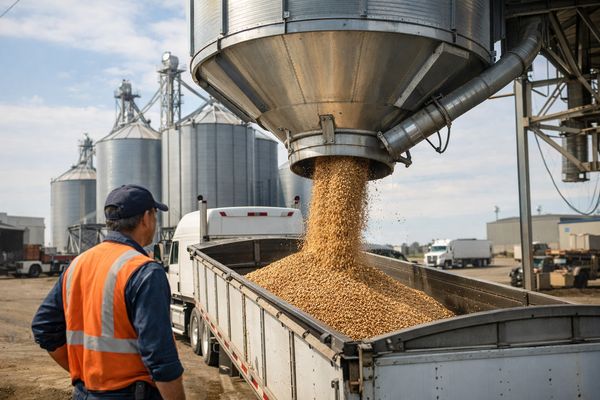
India’s black gram (urad) complex is range‑bound as dal mills buy only on a necessity basis while firm import offers and limited domestic arrivals prevent a deeper correction. The standoff between cautious processors and resistant importers keeps price risks skewed slightly upward into the early summer harvest window.
India’s black gram market, a key pulse alongside lentils in global trading baskets, is drifting mildly lower domestically but underpinned by rising international import values. Wholesale prices across major Indian hubs have eased by about $0.26 per quintal in several locations, yet remain comfortably above the domestic Minimum Support Price, leaving farmers under margin pressure and mills hesitant to restock aggressively. At the same time, Myanmar and Brazil export offers are firm and Myanmar market closures at the turn of the month inject short‑term supply uncertainty. For European and Asian buyers of processed dal and related pulse products, the current calm may be temporary with summer harvest and monsoon developments set to reset the balance.
Exclusive Offers on CMBroker

Lentils dried
Red football
FOB 2.57 €/kg
(from CA)

Lentils dried
Laird, Green
FOB 1.74 €/kg
(from CA)

Lentils dried
Eston Green
FOB 1.64 €/kg
(from CA)
📈 Prices & Spreads
Black gram FAQ in Delhi is broadly steady around $87.6–87.9 per quintal, with SQ slipping marginally by $0.26 to roughly $93.9–94.1 per quintal. Other key hubs such as Mumbai, Guntur and Chennai report similar fractional declines of $0.26 per quintal, signalling gentle softening rather than a clear downward trend. Domestic prices still trade below the government’s Minimum Support Price of about $82.24 per quintal for the 2025–26 season, leaving little comfort for producers but also limited incentive for mills to chase additional volume.
On the import side, Myanmar FAQ for May shipment has firmed by $10 to $845 per tonne (CFR Chennai), with SQ up $5 to $930 per tonne. Brazil‑origin offers for June–July are steady at $890 per tonne CFR. The result is a narrow and uncomfortable import arbitrage: higher dollar‑denominated offers, combined with domestic prices that have only inched lower, erode landed margins and keep importers reluctant to discount aggressively.
🌍 Supply & Demand Balance
Dal processing mills are operating on a hand‑to‑mouth basis, reflecting uncertainty about near‑term direction and resistance to paying up for higher CFR values. While spot demand for both processed dal and whole black gram has improved modestly compared with earlier sessions, it remains insufficient to absorb all available supply at current offers. This leaves trade volumes thin and price discovery heavily dependent on small shifts in mill buying interest.
On the supply side, rabi‑season arrivals from Andhra Pradesh remain steady, ensuring that nearby availability is not constrained. At the same time, summer crop sowing of black gram has increased year‑on‑year in Madhya Pradesh and Gujarat, with the first new‑crop arrivals expected from late May. This prospective inflow limits the willingness of domestic buyers to build large stocks now and helps cap upside in the immediate term, even as import offers strengthen.
📊 Fundamentals & External Drivers
The core fundamental tension lies in the divergence between international and domestic markets. Myanmar black gram prices have shown a mixed pattern recently but remain elevated enough to lift CFR India offers for May. Brazil’s stable but firm quotations reinforce the floor under global values. At the same time, Myanmar wholesale markets are scheduled to close on April 30 and May 1, temporarily constraining visibility on export flows and adding a layer of short‑term risk for import‑dependent buyers.
Domestically, current prices below MSP for the 2025–26 season continue to pressure farmer economics. Yet the year‑on‑year increase in summer sowings signals that acreage decisions have already been made, so any supply response will come later, through marketing behaviour and potential stockholding rather than planted area. Any disruption to the upcoming monsoon or further escalation in Myanmar offer prices could quickly flip sentiment from mildly bearish to supportive.
🌦️ Weather & Crop Outlook
Rabi black gram harvesting in Andhra Pradesh is well advanced, with weather no longer a major threat for this segment of supply. Focus now shifts to summer‑sown areas in Madhya Pradesh and Gujarat, where crop conditions through May and early June will be critical ahead of harvest. While no immediate weather shock is reported, the market is acutely sensitive to early monsoon signals that could affect yields and quality.
Given increased summer sowing and the relatively short lead time to harvest, even minor weather‑related setbacks could reduce the expected boost in supplies and lend support to prices. Conversely, benign conditions and smooth harvesting from late May onward would reinforce the current range‑bound bias and reduce import dependence into Q3.
📆 Trading Outlook & Strategy
- Short‑term (next 2–4 weeks): Prices likely stay range‑bound, with mild downside limited by firm CFR offers and tight import margins. Mills can maintain hand‑to‑mouth buying but should be prepared to step in on any weather‑ or Myanmar‑related scare.
- Medium‑term (late May–June): Arrival of increased summer crop from Madhya Pradesh and Gujarat is the key swing factor. Strong, timely harvests would cap rallies and possibly pressure domestic prices, while any delay or yield loss could trigger a quick rebound.
- Importers: Given the current tug‑of‑war between domestic buyers and overseas sellers, staggered coverage rather than large single‑lot purchases is advisable, with close monitoring of Myanmar market re‑opening in early May.
- European buyers of processed dal: The present lull offers a window to secure partial coverage, but leaving some volume open for post‑harvest pricing may capture potential downside if Indian arrivals materialise as expected.
📍 3‑Day Directional Outlook (Indicative)
- Indian wholesale hubs (Delhi, Mumbai, Guntur): Slightly softer to sideways in EUR terms, with moves likely confined within a narrow band as mills continue need‑based buying.
- Import parity (Myanmar/Brazil CFR India): Firm to marginally firmer in EUR as overseas offers remain elevated and any USD or freight volatility is quickly reflected in landed costs.
- European delivered dal prices: Largely stable, with a mild upward bias if import differentials into India tighten further and compete for origin supplies.
Related posts:
 Lentil Market Steady While Indian Black Gram Tightens Import Arbitrage
 India’s Lentil Market Splits as Domestic Prices Firm and Imports Soften
 Tightening Indian Lentil Supply Lifts Masoor While Import Benchmarks Stay Flat
 Chickpeas: Indian Market Trapped Between MSP Floor and Import Ceiling
 Lentil Market Holds Firm as Pulse Complex Tightens Supply Cushion
 Indian Lentil Market Holds Firm as Tight Domestic Supply Offsets Import Cap
 Lentils Market: Firm Pulse Demand Meets Import Headwinds and Flat Export Values
 Canadian Lentil Prices Hold Firm as Dry Prairie Start Raises New-Crop Risk