
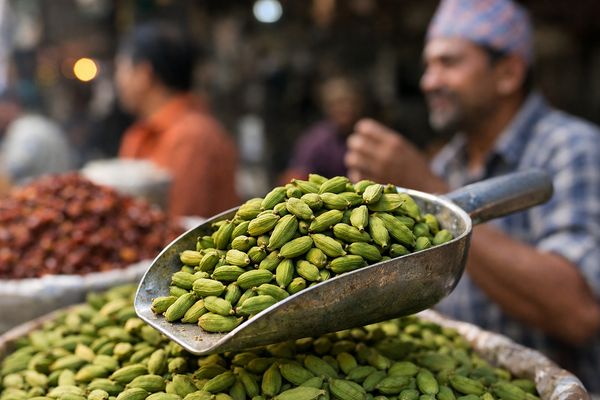
Indian cardamom prices have slipped as small cardamom arrivals rise in key producing states and large cardamom sheds its recent speculative premium from Nepal. With demand subdued from both domestic processors and export buyers, the market has turned supply-sensitive and is likely to stay soft in the short term.
Indian small and large cardamom markets moved lower last week, signalling that the previous rally had outpaced underlying consumption. Fresh supply from Kerala and Tamil Nadu is arriving smoothly, easing earlier tightness, while cross-border flows of large cardamom from Nepal have normalised after a brief speculative spike. In this context, European and international buyers reliant on Indian-origin cardamom may find a short window to secure premium grades at more competitive levels before either export demand improves or harvest arrivals taper.
Exclusive Offers on CMBroker

Cardamom whole
green,7.5-8 mm
FOB 17.85 €/kg
(from IN)

Cardamom whole
green 6.0-6.5 mm
99%
FOB 16.05 €/kg
(from IN)

Cardamom whole
green, 8 mm
FOB 24.24 €/kg
(from IN)
📈 Prices & Market Tone
Small cardamom in India fell by about ₹1,000 per quintal as arrivals increased, with the benchmark munhkhula variety now quoted around ₹24,000–₹25,000 per quintal, versus higher levels a week earlier. Converted into export-equivalent terms, this aligns with modest recent declines in New Delhi FOB offers, where whole green cardamom grades currently indicate roughly EUR 16–24/kg depending on size and specification. Large cardamom (kanchikat grade) eased by about ₹15/kg to ₹1,625–₹1,635/kg, reflecting a correction from the prior week’s speculative highs rather than a structural collapse in fundamentals.
| Product (India, New Delhi) | Delivery | Latest price (EUR/kg) | 1-week change (EUR/kg) |
|---|---|---|---|
| Cardamom whole, green 6.0–6.5 mm, organic | FOB | ≈16.05 | -0.10 |
| Cardamom whole, green 7.5–8 mm, organic | FOB | ≈17.85 | -0.10 |
| Cardamom whole, green 7–7.2 mm, conventional | FOB | ≈21.98 | -0.09 |
| Cardamom whole, green 8 mm, conventional | FOB | ≈24.24 | -0.10 |
🌍 Supply & Demand Drivers
The key driver on the small cardamom side is supply. Harvest progress in Kerala and Tamil Nadu is described as normal, with increased arrivals at wholesale markets easing the earlier squeeze. Even a modest increase in inflows was sufficient to pressure prices because demand from domestic blenders, food manufacturers and exporters is currently lacklustre. The absence of major Indian festive demand further reduces episodic support, leaving prices more exposed to day-to-day shifts in arrivals.
For large cardamom, the adjustment has been driven more by the unwinding of speculation than a sudden oversupply. Earlier, aggressive buying for Nepal-origin cardamom pushed offers sharply higher, but as cross-border logistics normalised and additional lots reached the market, that speculative premium eroded. With prices now closer to levels justified by actual supply-demand balance, the downside risk appears more limited unless there is another wave of speculative activity or a renewed disruption in Nepalese or Northeastern Indian supply chains.
📊 Fundamentals & Short-Term Outlook
The common thread across both small and large cardamom is weak demand. Market participants report subdued procurement interest from domestic processors and limited fresh export inquiries, suggesting that end-user coverage is comfortable for now. In such an environment, the market reacts quickly to any incremental supply, magnifying the impact of otherwise moderate changes in arrivals. This explains why the recent price decline has been relatively sharp compared with the scale of the harvest progression.
Over the next 2–4 weeks, small cardamom prices are likely to remain on the softer side as long as arrivals in Kerala and Tamil Nadu stay at or above current levels. A more durable recovery would require either a noticeable pickup in export demand—particularly from Middle Eastern and European buyers—or a visible tapering of the harvest flow. Large cardamom is expected to stabilise close to its current range now that speculative excess has been cleared. However, the market remains sensitive to any new disruption in Nepal’s geographically fragile supply corridor, which could quickly reinstate a risk premium.
📆 Weather & Crop Conditions
Current narratives from the producing belt indicate that the small cardamom harvest in southern India is progressing normally, without major reported weather shocks. This supports the view that the latest price softness is largely a function of seasonal supply rather than yield loss or quality concerns. In the high-altitude large cardamom regions of Nepal and Northeastern India, no acute new weather-related constraints have been highlighted in the latest trading week, aligning with the observed recovery in cross-border flows.
📌 Trading Recommendations
- European buyers and food manufacturers: Consider using the current arrival-driven dip in Indian small cardamom as a near-term procurement window, especially for high-cineole grades that typically command a premium.
- Importers and blenders: Stagger purchases over the coming 2–4 weeks rather than front-loading; prices may remain soft while arrivals stay high and demand muted.
- Large cardamom users: Treat current levels as broadly fair value after the speculative correction, but maintain some flexibility to accelerate coverage if new disruptions emerge in Nepalese supply routes.
- Producers: Be cautious with holding back stocks in expectation of an immediate rebound; without a clear catalyst from export or festive demand, the market may trade sideways to lower in the near term.
📉 3-Day Directional Outlook (EUR-based)
- India FOB small cardamom (New Delhi, various green grades): Slightly lower to sideways over the next three days, reflecting ongoing healthy arrivals and soft demand.
- India FOB large cardamom (Nepal/Northeast-linked supply): Broadly stable around current levels, with only limited downside after the recent speculative unwind.
- Export offers into Europe: Mild downward bias or discounts achievable on volume negotiations, particularly for Indian-origin small cardamom where sellers are facing rising physical stocks.
Related posts:
 Indian Turmeric Prices Flat as Arrivals Rise Ahead of Kharif Sowing
 Cumin Prices Ease as Indian Arrivals Rise and Demand Stays Cautious
 Indian Green Cardamom Eases From Peaks But Bulls Still in Control
 Cardamom under Heat Stress: Tightening Supply Keeps Prices Firm
 Indian Mustard Seed Under Harvest Pressure but Supported by Strong Edible Oils
 Indian Green Cardamom Prices Edge Higher on Tight Supply and Firm Export Interest