
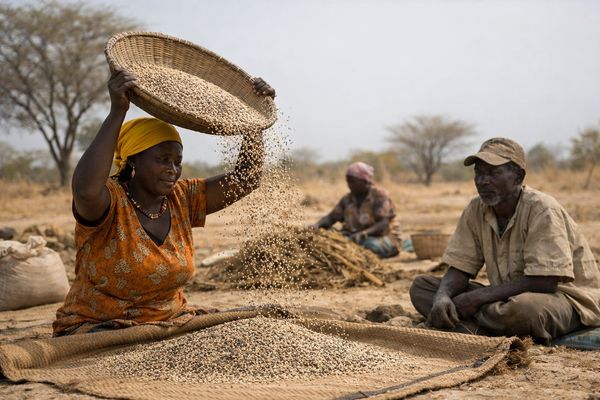
Indian sesame oil prices are holding steady despite softer rival vegetable oils, as tight til seed supply and solid export demand keep the market underpinned. Hulled seed offers in India and Egypt are edging slightly lower in EUR terms, but the scope for a deeper correction in oil looks limited without a clear improvement in arrivals.
India’s sesame complex is currently characterised by a rare decoupling: domestic sesame oil has remained firm week-on-week, while soya oil and several competing seed origins have seen mild price pressure. For European buyers of sesame oil and tahini-grade seeds, this translates into a short-lived window where seed offers are fractionally easier, yet the underlying oil market signals tightening into the second half of the year. Freight and risk premia linked to the ongoing Hormuz crisis remain a watchpoint but have not yet translated into a structural squeeze for Indian sesame exports.
Exclusive Offers on CMBroker

Sesame seeds
hulled
99.90%
FOB 1.41 €/kg
(from IN)

Sesame seeds
hulled, EU-Grade
99.98%
FOB 1.48 €/kg
(from IN)

Sesame seeds
hulled, EU-Grade
99.97%
FOB 1.46 €/kg
(from IN)
📈 Prices & Spreads
India’s sesame oil market held firm last week at around ₹15,600 per quintal, roughly EUR 173 per 100 kg at current FX, even as soya oil slipped by ₹200 per quintal to ₹15,700. This has narrowed the traditional premium of soya over sesame oil to almost parity. Mustard, rice bran and cottonseed oils all traded higher, underscoring the relative resilience of the broader edible oil basket in India.
On the seed side, Indian FOB/New Delhi offers for conventional hulled sesame are currently around EUR 1.30–1.48/kg for EU-grade qualities, with the latest quotes showing a marginal week-on-week easing of about EUR 0.01/kg for several items. Premium black sesame from India remains significantly higher, around EUR 2.04–2.34/kg, while Egyptian natural sesame is offered near EUR 1.50–1.98/kg FOB. Overall, seed prices are softening at the margin, in contrast to flat-to-firm domestic oil values.
| Product | Origin | Spec | Price (EUR/kg) | WoW Change (EUR/kg) |
|---|---|---|---|---|
| Sesame oil (ex-mill) | India | Refined | ≈1.73 | Stable |
| Sesame seeds hulled, EU-grade | India FOB | 99.95–99.98% | 1.30–1.48 | -0.01 |
| Sesame seeds natural | India FOB | ≈99–99.95% | 1.14–1.29 | Mixed |
| Sesame seeds black (regular–super Z) | India FOB | ≈99.9–99.95% | 2.04–2.34 | -0.02 to -0.04 |
| Sesame seeds natural / golden | Egypt FOB | ≈99–99.5% | 1.50–1.98 | -0.02 to 0 |
🌍 Supply & Demand Drivers
The key driver behind sesame oil’s stability is restricted til seed supply at Indian producing centres in Gujarat, Rajasthan, Madhya Pradesh and Uttar Pradesh. Arrivals into wholesale markets are tighter than usual for the current season, forcing oil millers to pay elevated raw material prices. With sesame oil pricing far less exposed to large international futures than palm or soya, this domestic supply squeeze is directly translating into firm ex-mill values.
Demand remains robust both domestically and abroad. In India, sesame oil’s premium positioning—anchored in its flavour profile, high smoke point and cultural role—gives it more inelastic demand compared with commodity oils. Internationally, steady buying from Europe’s tahini, hummus, snacks and Asian cuisine segments continues to underpin offtake for both seeds and oil. This dual domestic–export pull is limiting the downside risk for oil prices even as some seed grades and rival oils show mild softness.
📊 Fundamentals & External Factors
Fundamentally, India retains its position as one of the top global exporters of sesame seed and oil, competing with East African origins (Ethiopia, Sudan, Tanzania) for raw seed and with China in value-added oils. European buyers are increasingly quality-sensitive, favouring high-purity hulled and EU-grade lots, which is reflected in the relatively firm EUR spreads for these categories vs. standard natural seeds.
Externally, the escalating US–Iran conflict and the partial blockade of the Strait of Hormuz have injected additional uncertainty into freight and insurance costs on Gulf-related routes. While current disruptions mainly affect crude and oil products, container and breakbulk logistics also face higher risk premia and longer transit times. For now, this has only added a mild cost uncertainty to Indian sesame export flows from western ports; physical sesame export volumes have not seen a marked drop, but any further escalation could tighten CIF Europe costs through higher freight and war-risk surcharges rather than through origin price changes.
🌦️ Weather & Crop Outlook (India)
Near-term weather in India’s northwestern belt is seasonally warm and mostly dry, with pre-monsoon conditions broadly in line with recent years. This helps avoid immediate harvest disruptions but also underscores the importance of a timely and well-distributed southwest monsoon for the next sowing cycle in Gujarat and Rajasthan. Any delay or deficit in early monsoon rains from June onward would likely reinforce the current tightness in seed supply and keep oil prices supported into Q3.
Given the already restricted arrivals reported at producing centres, even a normal monsoon would only gradually ease supply constraints later in the year. In the two- to four-week horizon relevant for current procurement decisions, the dominant factor remains existing low pipeline stocks rather than new-crop prospects.
📆 Price Outlook (2–4 Weeks)
- Sesame oil, India: Base case is stable to slightly firmer, with a bias toward small gains if seed arrivals fail to improve. A meaningful correction below about ₹15,000 per quintal (≈EUR 166/100 kg) appears unlikely without a sharp, unexpected rise in market arrivals.
- Sesame seed, India FOB: Mild downward adjustment has already occurred in many hulled and black categories. Further downside looks limited as origin margins tighten; prices are more likely to stabilise near current EUR levels.
- Sesame seed, Egypt FOB: Offers are steady to slightly softer, but competitiveness vs. India will hinge on freight differentials and quality preferences in Europe and the Middle East.
🧭 Trading & Procurement Recommendations
- European food manufacturers: Treat the current combination of firm but stable Indian sesame oil and slightly easier hulled seed offers as a favourable near-term buying window. Forward-cover core Q3 requirements now, especially for tahini-grade and high-purity hulled material.
- Importers & traders: Consider building moderate nearby positions in Indian origin, focusing on EU-grade hulled and black sesame where discounts vs. recent peaks have opened. Avoid overextending long exposure given freight and Hormuz-related geopolitical risks.
- Indian crushers & millers: With seed supply tight and domestic oil demand resilient, maintain disciplined selling; lock in margins on forward export and domestic contracts rather than chasing volume, especially if arrivals remain constrained.
- Risk management: Monitor freight markets and war-risk surcharges closely. Where possible, negotiate flexible shipment windows and diversified routing to mitigate potential disruptions linked to Gulf shipping bottlenecks.
📍 3-Day Directional Outlook (EUR-Based)
- India, sesame oil ex-mill: Sideways; traded range expected to hold near current EUR-equivalent levels.
- India, hulled sesame FOB (EU-grade): Slightly softer to flat; any further moves likely limited to a few cents per kg.
- Egypt, natural & golden sesame FOB: Stable; minor downside possible if Black Sea vegoil complex weakens further, but no sharp moves anticipated.
Related posts:
 Palm oil futures ease but curve stays firm on tight nearby supply
 Sesame Prices Ease in India and Egypt as Demand Stays Cautious
 Black Sea Sunflower Prices Edge Higher on Tight Seed and Oil Supply
 Indian Sesame Softens as Sowing Surges; Egypt FOB Holds Firm
 Sesame Market: Edible Oil Weakness Meets Firm Niche Support
 Firm MDEX Palm Oil Curve as Tight Malaysian Balance Supports Prices
 Palm Oil Futures Ease Slightly But Stay Firm on Tight Malaysian Balance
 Palm Oil Futures Ease But Stay Firm as Biofuel Demand Offsets Supply Risks