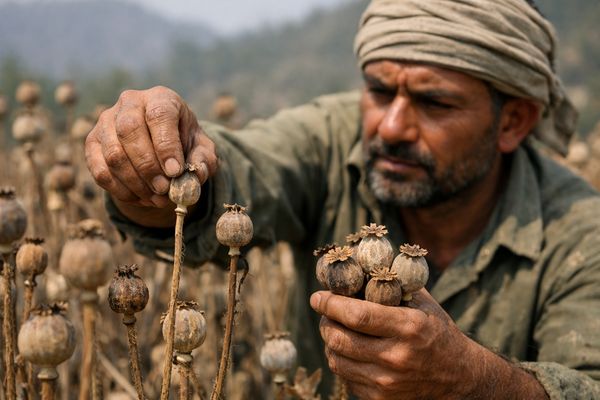
Indian poppy seed prices are firming as a severe production shortfall in Himachal Pradesh collides with steady domestic and export demand. Shimla quality has moved higher in a typically narrow trading band, and the structural nature of the supply loss suggests elevated price levels are likely to persist into the coming weeks, with limited domestic or import-based relief.
Exclusive Offers on CMBroker

Blue poppy seeds
morphin < 20 ppm
99,9
FCA 1.90 €/kg
(from CZ)

Blue poppy seeds
morphin < 20 ppm
99,9
FCA 1.88 €/kg
(from CZ)

White Poppyseeds
morphin < 20 ppm
99,9
FCA 3.15 €/kg
(from CZ)
📈 Prices & Market Mood
India’s food-grade poppy seed market (khaskhas) saw Shimla quality rise by ₹20 per kg last week to around ₹840–₹860 per kg, roughly EUR 9.10–9.30 per kg at current FX levels. This is a meaningful move for a market that usually trades in a tight range and reflects genuine concern over supply security rather than short-term speculation. Traders report a firm tone in consuming wholesale centres in western and northern India, with buyers willing to pay up to secure near-term coverage.
In Europe, indicative FCA offers for Czech-origin blue poppy seeds remain comparatively low at around EUR 1.88–1.90 per kg for conventional blue and about EUR 3.15 per kg for white poppy seeds, underscoring that the current tightness is most acute in the Indian-origin segment rather than in European supply. The widening premium of Indian food-grade material over Central European origins may persist if Indian shortages deepen.
🌍 Supply & Demand Balance
The core driver of the recent price strength is a severe production decline in Himachal Pradesh, India’s key licensed poppy seed region. Current output in both forest areas and supervised cultivation zones has dropped to less than half of last year’s level, a reduction of more than 50%. This is a structural disruption, not a marginal seasonal miss, and there are no obvious domestic regions able to compensate given strict licensing and geographical limits on cultivation.
On the demand side, usage in Indian consuming regions has stayed robust. Poppy seed remains an essential thickening and flavouring ingredient in curries, confectionery and regional cuisines, supporting stable baseline demand. Export flows to Europe and the Middle East, where Indian poppy seed is used in breads, pastries and sweets, add another layer of offtake, leaving very little slack in the system to absorb a sudden supply hit.
📊 Fundamentals & Trade Flows
India’s poppy seed market operates under tight regulation, with cultivation authorised and supervised by government agencies, and food-grade poppy seed clearly separated from opium poppy grown for pharmaceutical use. This regulatory framework restricts rapid acreage expansion in response to higher prices, which in turn makes supply shocks like the current Himachal shortfall more potent and longer lasting. With output in the main producing state halved versus last year, inventories are expected to draw down through the current crop year.
Import options exist in theory but face practical hurdles. Many jurisdictions treat poppy seed trade as sensitive due to narcotic concerns, creating documentation burdens and slowing customs clearance. As a result, rapid import substitution to cover India’s internal shortfall is unlikely, even if Central European material appears competitively priced in euro terms. For European and Middle Eastern buyers relying on Indian origin, this combination of constrained Indian supply and regulatory frictions argues for a more proactive procurement stance.
📆 Short-Term Outlook (2–4 weeks)
Given the scale of the supply loss in Himachal Pradesh and firm offtake from consuming centres, Indian poppy seed prices are expected to stay elevated over the next two to four weeks. If demand from western and northern wholesale markets remains active, Shimla quality could plausibly test around ₹900 per kg (about EUR 9.60 per kg) without attracting much producer selling pressure, as farmers and traders recognise that the fundamental balance has shifted in their favour.
For European bakers and confectioners using Indian-origin poppy seed, the current disruption should be viewed as structural within this crop year rather than a brief seasonal wobble. Substitution into alternative origins, where allowed by product specifications and regulations, may help temper cost escalation, but logistics and regulatory constraints will limit how quickly such switches can occur. Overall, downside risk to Indian-origin prices appears limited in the very near term.
🧭 Trading & Procurement Recommendations
- Indian domestic buyers: Consider forward-covering a portion of Q2–Q3 needs at current levels, as the greater-than-50% supply decline argues for continued firmness rather than a quick reversion lower.
- European and Middle Eastern users of Indian origin: Lock in volumes for the current crop year where possible; treat current pricing as a new, higher floor rather than a spike to fade.
- Buyers flexible on origin: Evaluate partial substitution into Central European poppy seed, which currently trades at a substantial discount in EUR terms, while accounting for quality and regulatory requirements.
- Sellers with Indian stock: Maintain a firm offer stance; the market imbalance and regulatory limits on new supply justify holding out for higher bids in the coming weeks.
📍 3-Day Directional Outlook
| Market / Origin | Quality | Indicative Level (EUR/kg) | 3-Day Bias |
|---|---|---|---|
| India (Shimla-equivalent) | Food-grade poppy seed | ≈ 9.1–9.3 | Firm to slightly higher |
| Czech Republic (Vysoke Myto) | Blue, conv., FCA | ≈ 1.90 | Mostly stable |
| Czech Republic (Chropyne) | White, conv., FCA | ≈ 3.15 | Slightly firm |