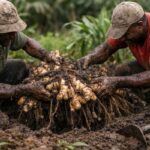
Indian dried ginger prices have jumped sharply as tight fresh ginger supplies squeeze processors, lifting saunth values to multi‑month highs and keeping the global ginger balance uncomfortably tight. European buyers face elevated replacement costs across origins and should focus on timely coverage rather than waiting for a rapid correction.
India’s dried ginger market is in a supply‑driven rally, triggered by a shortfall in fresh rhizomes from key growing states like Kerala, Karnataka, Meghalaya and Himachal Pradesh. Processors are paying more for raw material and passing those costs through the value chain, while international buyers find limited relief from other origins amid broader global tightness. With demand from domestic spice users and European health‑focused applications remaining resilient, near‑term downside in prices looks shallow.
Exclusive Offers on CMBroker

Ginger dried
whole
FOB 3.16 €/kg
(from IN)

Ginger dried
slices
FOB 2.80 €/kg
(from IN)

Ginger dried
Powder
FOB 3.60 €/kg
(from IN)
📈 Prices & Market Structure
Domestic saunth prices in India have surged by about ₹2,000 per quintal in a single week, reaching roughly ₹29,500–₹30,000 per quintal for average quality, equivalent to about €346–€357 per tonne at current exchange assumptions. This marks a significant year‑on‑year increase and signals that the Indian ginger complex has moved to a higher structural price plateau.
Export‑oriented dried ginger offers from New Delhi for organic grades currently sit around €2.80–€3.60/kg FOB depending on cut and quality, with whole and powder at the upper end and slices trading slightly lower. These levels show only marginal week‑on‑week easing in export quotes compared with earlier April indications, and remain well above last year’s averages, reflecting strong cost‑push pressure from domestic raw material markets.
| Product | Origin/Term | Latest Price (EUR/kg) | 1-week Change (EUR/kg) |
|---|---|---|---|
| Dried ginger whole, organic | India FOB New Delhi | 3.16 | -0.04 |
| Dried ginger slices, organic | India FOB New Delhi | 2.80 | -0.04 |
| Dried ginger powder, organic | India FOB New Delhi | 3.60 | -0.04 |
| Dried ginger nugc 99%, conv. | India FOB New Delhi | 3.25 | -0.05 |
🌍 Supply & Demand Drivers
The core driver of the rally is a shortfall in fresh ginger production in India’s main growing belts, reducing the flow of rhizomes into drying and processing channels. Processors cannot easily switch to imported fresh ginger because saunth production requires specific varietal and quality attributes, limiting substitution in the short run. As a result, wholesale buyers are competing aggressively for limited dried ginger, reinforcing the price uptrend.
On the demand side, dried ginger holds an entrenched position in India’s spice blends, chai masala, medicinal formulations and Ayurvedic preparations, creating a relatively sticky domestic base. Internationally, European buyers favour Indian dried ginger for herbal teas, biscuits, confectionery and functional foods due to its higher gingerol content and pungency compared with milder Chinese or Peruvian origins. With multiple origins facing some degree of supply tightness, buyers have few low‑cost alternatives, keeping import demand for Indian material firm even at higher price levels.
📊 Fundamentals & Global Context
The current rally in Indian saunth is occurring against a backdrop of broader global ginger tightness, particularly production variability in China, which remains the key volume supplier to world markets. Recent industry intelligence continues to highlight elevated price benchmarks for fresh and semi‑dried ginger versus last year, confirming that the market is operating on a higher cost base rather than experiencing a short‑lived spike.
At the same time, consumer demand for immune‑supporting and health‑positioned products using ginger as a key ingredient remains structurally strong in Europe and North America. This demand resilience limits the scope for a rapid demand‑side correction, although some rationing is likely among price‑sensitive buyers and lower‑margin applications. Domestic Indian retail prices for fresh ginger in major urban markets have been relatively stable in recent days, suggesting that the sharpest tightness is concentrated in processing‑grade supply chains rather than in everyday household demand.
🌦️ Weather & Regional Outlook
Weather patterns across southern and northeastern India are transitioning into the pre‑monsoon phase, with forecasts pointing to above‑normal temperatures in parts of Karnataka through May, which could add stress to already constrained ginger fields and delay any meaningful recovery in fresh arrivals. Historical climate data indicate that May is typically hot and humid in Kerala and the wider Western Ghats, with rainfall gradually increasing as the southwest monsoon approaches, potentially complicating harvest and post‑harvest handling if precipitation arrives early.
Given the lead times inherent in ginger cultivation, these near‑term weather conditions are unlikely to resolve the current tightness quickly. Instead, they may reinforce cautious planting and harvesting decisions, keeping the fresh ginger pipeline to processors thin into early summer and prolonging the period of elevated saunth prices.
📆 Price & Trading Outlook (Next 2–4 Weeks)
Over the coming two to four weeks, dried ginger prices in India are expected to remain elevated at or above current saunth levels, with a bias to the upside if fresh arrivals into key markets fail to improve. The magnitude of the recent ₹2,000 per quintal weekly increase suggests that the market is in a strong cost‑push phase rather than a speculative spike, and there is limited natural downward pressure in the near term.
European buyers of Indian dried ginger should anticipate sustained high replacement costs in euro terms, especially for higher‑pungency whole and powder grades. Any modest softening in New Delhi FOB quotes, as seen recently, is likely to be shallow and short‑lived without a clear improvement in Indian fresh ginger supply or a visible loosening of global availability from China and other origins.
🎯 Trading Recommendations
- European herbal tea and food manufacturers: Secure at least 2–3 months of forward coverage for critical ginger‑based SKUs at current levels, prioritising high‑pungency whole and powder grades where substitution risk is lowest.
- Blenders and traders: Consider incremental purchases on dips rather than waiting for a deep correction; focus on staggered buying to average costs while maintaining minimum safety stocks.
- Price‑sensitive users: Explore partial reformulation and origin diversification, but recognise that alternative suppliers (e.g. China, Peru) are also operating in a tighter market and may offer only limited savings.
- Domestic Indian buyers: Given strong structural fundamentals, use any short‑term easing linked to improved arrivals or demand lulls as an opportunity to rebuild inventories rather than aggressively de‑stocking.
📍 3‑Day Regional Outlook (Directional)
- India domestic saunth (mandi level): Sideways to slightly firmer as processors and traders continue to compete for limited raw material; further spikes possible if arrivals disappoint.
- India FOB New Delhi (dried ginger, all cuts): Broadly stable in EUR with a mild upward bias; small intra‑week adjustments likely driven by currency and freight but no major softening expected.
- EU import market (CIF main ports): Firm to slightly higher as exporters attempt to pass through domestic cost increases and buyers move to lock in coverage ahead of potential further tightening.