
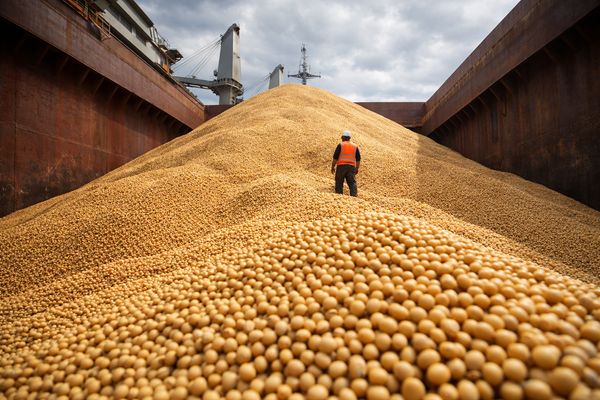
Soybean futures are trading slightly firmer while soybean oil and meal show only marginal day‑to‑day changes, leaving the overall complex broadly stable but with a gently softer oil forward curve into 2027–29. Physical FOB soybean prices in EUR remain flat across key origins, signaling a balanced nearby market with limited directional conviction.
The soybean complex currently reflects a re-pricing along the value chain rather than a strong trend move: beans are modestly higher across the 2026–27 CBOT strip, oil is off recent highs with a clear contango into 2028–29, and meal is broadly sideways after a prior up‑leg. Rising US acreage and good crop progress in Brazil are cushioning supply risks, while biofuel policies and steady feed demand underpin medium‑term consumption. For physical buyers this translates into a window of relative price stability to extend coverage on dips rather than chase rallies.
Exclusive Offers on CMBroker

Soybeans
No. 2
FOB 0.59 €/kg
(from US)

Soybeans
sortex clean
FOB 0.97 €/kg
(from IN)

Soybeans
FOB 0.33 €/kg
(from UA)
📈 Prices & Spreads
CBOT soybean futures are modestly higher on the day, with May 2026 around 1,193 US¢/bu and July 2026 at 1,208.5 US¢/bu, both up about 0.4%. The forward curve into late 2027–29 remains only slightly discounted versus nearby, indicating that the market does not yet price a major oversupply despite higher intended US plantings.
Soybean oil is trading around 76.4 US¢/lb for May 2026, with a gently declining curve toward roughly 60–61 US¢/lb by late 2028–29. This marks a noticeable softening from last month’s peak near 70 US¢/lb but still reflects structurally strong demand from the biodiesel and renewable diesel sector. Soybean meal sits close to 319–320 USD/short ton for nearby contracts, following beans higher but without a clear breakout tendency.
| Product | Reference contract | Approx. futures level | Indicative flat price (EUR/t) |
|---|---|---|---|
| CBOT Soybeans | Jul 2026 | 1,208.5 US¢/bu | ≈ 400–410 EUR/t |
| CBOT Soybean Oil | Jul 2026 | 75.3 US¢/lb | ≈ 1,500–1,550 EUR/t |
| CBOT Soybean Meal | Jul 2026 | 319.4 USD/st | ≈ 320–330 EUR/t |
FOB cash indications in EUR remain broadly unchanged over the last two weeks: US No.2 soybeans around 0.59 EUR/kg, Indian soybeans (sortex clean) near 0.97 EUR/kg, Ukrainian origin roughly 0.33 EUR/kg, and Chinese yellow beans about 0.74–0.82 EUR/kg depending on quality and organic status. This confirms that futures volatility has not translated into strong cash market moves so far.
🌍 Supply & Demand Drivers
On the supply side, higher intended US soybean acreage for 2026 alongside favorable weather in key Brazilian states continues to underpin expectations of comfortable global availability. USDA’s recent planting intentions show US area rising to around the mid‑80 million acre range, the highest in two years but still only slightly above market expectations, which limits bearish pressure from the acreage headline.
In South America, recent reports point to largely favorable late-season conditions in Brazil’s main soybean regions, with timely rains supporting yields and accelerating harvest in parts of Mato Grosso do Sul and neighboring states. China’s domestic soybean futures on the DCE are holding in a narrow 4,900–5,000 CNY/t range for nearby contracts, which signals stable local demand and an absence of immediate import panic. Against this backdrop, the gently upward‑sloping soymeal curve into 2027–29 indicates that the market sees no near‑term shortage in protein meal but expects steady consumption growth.
On the demand side, soybean meal continues to benefit from firm livestock and poultry feed demand in key consuming regions. Recent industry commentary highlights growing soybean meal usage in Mexico and other Latin American markets as poultry and egg production expand, while US and Asian feed producers focus on supply security rather than aggressive spot buying. Overall, the meal segment appears structurally supported but not tight, consistent with today’s sideways price action.
📊 Fundamentals: Oil vs. Meal Balance
The most notable adjustment within the complex is in soybean oil. After approaching multi‑year highs on the back of US biofuel policy and geopolitical risk premia earlier this year, nearby soyoil values have eased slightly, and the futures curve now shows a clear downward slope from mid‑2026 into 2028–29. This softening suggests that markets are reassessing the pace of renewable diesel expansion and the degree to which additional feedstock supply (soy, canola, used cooking oil) will meet mandated demand.
Nevertheless, structural drivers remain supportive: fresh US biofuel blending mandates for 2026–27 continue to anchor long‑term demand, and renewed interest in biodiesel as a hedge against fossil fuel volatility keeps a solid floor under soyoil. Soybean meal fundamentals, by contrast, are relatively more balanced. Stocks of soybean products are reported below last month but still above year‑ago levels, reflecting robust crush and stable demand rather than acute tightness. This internal rebalancing—marginally weaker oil, steady meal—narrows crush margins somewhat but remains supportive of ongoing processing.
🌦️ Weather & Risk Outlook
Weather risk for the soybean market in early May 2026 is more about the upcoming US growing season than immediate South American concerns. The latest US crop bulletins point to generally favorable planting conditions for soybeans, with limited delays so far. For Brazil, the fading influence of the recent La Niña episode into early 2026 has left most key soybean states with adequate moisture, although pockets of volatility in southern regions remain a watch point.
Going forward, key risks for the complex include: (1) potential US weather shocks during June–August that could tighten new‑crop supply; (2) any setback in biofuel policy support that would weigh disproportionately on soyoil; and (3) macro‑driven demand destruction in animal protein sectors should global economic conditions deteriorate. For now, none of these risks is fully priced, which helps explain the relatively narrow trading ranges across beans, oil and meal.
📆 Trading Outlook & 3‑Day Indications
- Producers: Consider layering in additional 2026–27 hedge coverage on rallies above current CBOT levels, as the combination of higher acreage and solid South American supplies caps upside while still offering historically decent forward prices.
- Crushers: The softer forward soyoil curve and relatively firm meal suggest maintaining crush rates but being cautious with forward oil sales; locking in favorable oil‑meal spreads into 2027 may be attractive on modest rebounds.
- Feed buyers: With soybean meal holding in a relatively tight range and no immediate supply stress visible, use small price dips to extend coverage rather than chase short‑term spikes driven by weather headlines.
- Importers: Flat EUR‑denominated FOB prices across the US, India, Ukraine and China indicate room to diversify origin without a significant cost penalty; basis and freight differentials will remain key levers in the next weeks.
Over the next three trading days, we expect soybean futures on CBOT to remain in a sideways to slightly firmer band, with July 2026 beans likely oscillating within roughly ±1–2% of current levels in EUR terms. Soybean oil should trade with a mild downward bias in the front months as biofuel enthusiasm cools from recent highs, while soybean meal is expected to hold near present prices, tracking beans and oil but with a slightly firmer relative tone due to steady feed demand.
Related posts:
 Soybeans edge higher as oil leads gains while meal softens
 Indian Soybean Supply Shock Lifts Global Soy Complex and Meal Values
 Sunflower Market: Firmer Oilseed Complex Supports Stable Seed Prices
 Soybean complex softens as soymeal drifts and distant CBOT structure weakens
 Rapeseed Market Holds Firm as Futures Curve Softens into New Crop
 Soybean Complex Edges Lower While Meal Firms on Feed Demand
 Soybean Complex Firms as Futures Curve Steepens and FOB Values Ease