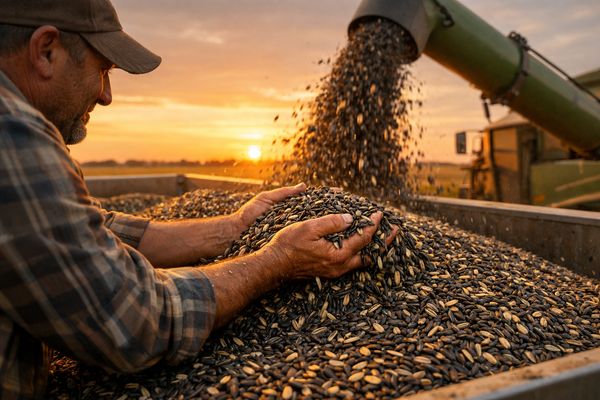
Sunflower prices are holding slightly firmer, supported by a stronger global oil complex and tight old-crop seed availability, while forward positions remain relatively well supplied.
Sunflower markets currently trade in the slipstream of broader oilseed and energy dynamics. Rising crude oil prices amid ongoing tensions in the Persian Gulf are lifting vegetable oil values and underpinning sunflower seed and oil pricing. At the same time, physical sunflower seed supply in Europe is tight, mirroring the rapeseed complex, while Ukrainian and Black Sea offers keep export parity competitive. In North America, rapid soybean planting and firm soyoil futures add a mixed backdrop: oil is supportive, but ample protein crops cap rallies. Weather risks in Canada and parts of the Black Sea remain a latent bullish factor for 2026 crops, but have not yet translated into a sharp risk premium.
Exclusive Offers on CMBroker

Sunflower seeds
Black with stripe
98%
FOB 1.45 €/kg
(from CN)

Sunflower kernels
hulled, confection
99.95%
FOB 1.19 €/kg
(from CN)

Sunflower kernels
hulled, bakery
99.95%
FOB 1.18 €/kg
(from CN)
📈 Prices & Spreads
South African SAFEX sunflower futures on 28 April 2026 showed a slightly firmer structure across the curve. The nearby May 26 contract settled at around ZAR 8,786/t, up 0.10% day-on-day, while July 26 closed near ZAR 9,006/t, gaining 0.23%. Further out, December 26 traded close to ZAR 9,346/t and March 27 firmed by 1.36% to about ZAR 9,225/t, indicating a modest carry but no aggressive inverse.
In the physical trade, sunflower seed and kernel offers in the Black Sea and Europe remain broadly stable to slightly higher in late April. Ukrainian black sunflower seeds FCA Kyiv and Odesa are quoted around EUR 0.66/kg (EUR 660/t), with meals near EUR 0.58/kg FOB Odesa. Bulgarian black seeds stand near EUR 0.44/kg FCA, while bakery-grade hulled kernels from Bulgaria and Moldova are mostly around EUR 0.97–1.09/kg FCA, underscoring a steady premium for processed product versus raw seeds.
| Product | Origin / Term | Latest Price (EUR/kg) | 1–3 week trend |
|---|---|---|---|
| Sunflower seeds, black, 98% | UA, FCA Kyiv/Odesa | 0.67 | Sideways to slightly up |
| Sunflower seeds, black, 98% | BG, FCA Sofia | 0.44 | Stable |
| Sunflower kernels, hulled, bakery | UA, FCA Dnipro | 0.96 | Stable |
| Sunflower kernels, hulled, bakery | BG/MD → DE, FCA | 1.08–1.09 | Marginally firmer |
| Sunflower seeds, black with stripe | CN, FOB Beijing | 1.45 | Slightly firmer |
🌍 Supply & Demand Drivers
Old-crop oilseed supply in Europe is tight, with crushers reporting only slight increases in cash prices despite stronger futures. Similar dynamics apply to sunflower: physical seed availability is limited, particularly for high-spec kernels, and buyers still show ongoing demand. Lower rapeseed and oilseed imports into the EU signal an overall tighter balance sheet and support sunflower crush margins.
In the Black Sea, Ukrainian sunflower seed and meal offers around EUR 0.58–0.67/kg remain competitive and help cap stronger rallies in Western Europe. However, constrained logistics and geopolitical risks keep some risk premium in freight and execution. Demand from European crushers and snack producers is steady, with buyers selectively extending coverage but avoiding large forward commitments while new-crop weather risk is still unfolding.
📊 Fundamentals & External Influences
The broader oilseed complex is currently driven by energy markets and competing crops. Crude oil prices are trending higher as shipping disruptions in the Strait of Hormuz curb supply from the Persian Gulf, lifting the entire vegetable oil complex and indirectly supporting sunflower oil values. This translates into firmer crush margins and resilient sunflower seed bids, even if physical seed availability is uneven.
In the United States, the USDA reported soybean planting at 23% complete, above both expectations and the five-year average. Rapid soybean seeding weighs on Chicago soybean futures but soyoil prices have posted contract highs in response to stronger energy markets. Canadian canola futures also firmed as cold weather and the risk of planting delays in parts of Western Canada fuel concern about the 2026 harvest potential. These factors collectively underpin sunflower market sentiment through cross-commodity linkages in vegetable oils.
🌦 Weather & New-Crop Outlook
Weather risks are emerging but not yet decisive for sunflower. In Western Canada, temperatures remain below normal and farmers are preparing to plant canola and other oilseeds; significant additional rainfall could slow work and add to concerns about the 2026 harvest. Although this is primarily a canola story, any sustained reduction in global oilseed output would be supportive for sunflower oil and seed values.
In the Black Sea region and parts of Eastern Europe, early-season fieldwork is progressing, but markets will closely watch May–June rainfall and temperature patterns during sowing and emergence. For now, no major sunflower-specific weather shock is priced in, but risk premiums could expand quickly if persistent dryness or excessive moisture threatens yield potential in key producing regions.
📆 Trading Outlook & 3-Day Price Indication
- Producers: Consider incremental hedging of old-crop sunflower seeds at current levels, as strong crude and vegetable oil prices support crush demand, but ample global protein crops could cap further upside in the short term.
- Crushers: Maintain balanced coverage for May–July; nearby tightness argues for securing minimum volumes, while competitive Black Sea offers and rapid US soybean planting limit the need for aggressive forward buying.
- Industrial and food buyers: Use any short-term dips linked to soybean or macro corrections to extend sunflower kernel and oil coverage into Q3, while keeping flexibility for potential weather-driven rallies later in the season.
Over the next three trading days, sunflower seed prices on key exchanges are expected to trade slightly firmer to sideways in EUR terms, tracking strong energy and vegetable oil markets. SAFEX sunflower futures are likely to consolidate near current ZAR levels, translating into a mildly supportive tone for global sunflower values when converted to EUR, barring a sharp reversal in crude oil or macro sentiment.