
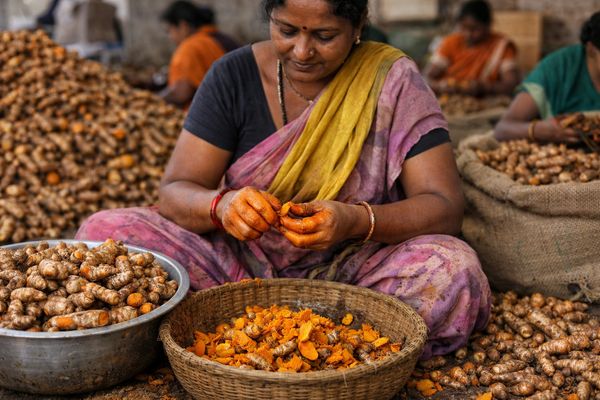
Turmeric prices are grinding higher in India’s key wholesale markets as tight physical arrivals meet steady processor and export demand, with a weak rupee adding an extra layer of support. The tone is one of cautious optimism: traders broadly believe a near‑term floor is in place, but see limited room for a sharp rally without fresh supply or export shocks.
Physical trade in Erode and Jaipur, alongside firmer wholesale quotes in Delhi, points to a market in consolidation rather than breakout. Farmers and primary traders are holding back stock, arrivals are below normal, and grinders as well as export‑oriented processors are selectively building coverage at what they regard as attractive levels relative to recent highs. Futures on NCDEX are reflecting the same narrative of mildly firmer prices and modest short‑term upside risk.
Exclusive Offers on CMBroker

Turmeric whole
FOB 2.45 €/kg
(from IN)

Turmeric powder
FOB 3.30 €/kg
(from IN)

Turmeric dried
finger salem,double polished, grade A
FOB 1.57 €/kg
(from IN)
📈 Prices & Market Tone
Turmeric prices edged up by about ₹100 per quintal in Delhi’s wholesale spice markets on Tuesday, extending the firmness seen earlier in Erode (Tamil Nadu) and Jaipur (Rajasthan). In these hubs, demand from processors and grinders was the main driver of the day’s gains, rather than any sudden shift in fundamentals.
Benchmark Erode gatta (finger‑grade turmeric widely used for export and processing) traded around $158.36–159.41 per quintal, while Salem fali, a longer and more uniform variety, commanded a higher $169.00–210.77 per quintal. Jaipur wholesale markets also reported a ₹100 per quintal rise, with quotes at roughly $174.07–189.84 per quintal as grinders and processors stepped up buying at what they see as a discount to earlier peak prices.
📊 Spot & Export Parity (in EUR)
Recent export‑oriented offers from India, combined with domestic price action, confirm a stable to slightly firmer structure. Using an approximate rate of 1 EUR = 90 INR and 1 EUR = 1.07 USD, spot and offer indications can be summarised as follows:
| Product / Market | Location / Basis | Price (EUR/tonne) | Comment |
|---|---|---|---|
| Erode gatta (finger) | Erode, benchmark quality | ≈ 1,485–1,495 EUR/t | Converted from $158.36–159.41/qtl |
| Salem fali (processor grade) | Erode/Salem region | ≈ 1,585–1,980 EUR/t | Converted from $169.00–210.77/qtl |
| Turmeric dried, finger Salem, grade A | Telangana, FOB/FCA export | ≈ 1,300–1,340 EUR/t | Based on recent offers around 1.57–1.59 EUR/kg |
| Turmeric dried, finger Nizamabad, grade A | Telangana, FOB/FCA export | ≈ 1,240–1,275 EUR/t | Based on offers near 1.42–1.44 EUR/kg |
| Organic turmeric whole | New Delhi, FOB | ≈ 2,450 EUR/t | Stable vs. late April, indicating steady premium |
| Organic turmeric powder | New Delhi, FOB | ≈ 3,300 EUR/t | Flat in recent updates, reflecting stable end‑user demand |
On the futures side, NCDEX turmeric (farmer‑polished contract, May 2026 expiry) recently settled near ₹15,988 per quintal, up about 0.35% day‑on‑day, with a daily range around ₹15,710–16,048. This aligns well with the slightly firmer physical trend but still sits comfortably below the 52‑week highs, underlining that current levels are seen as reasonable value rather than overheated.
🌍 Supply, Demand & Currency Drivers
Arrivals from key producing states—Tamil Nadu, Andhra Pradesh, Maharashtra, and Telangana—are below normal for this stage of the season. Farmers and primary traders are deliberately pacing sales, retaining part of their stocks in the hope of firmer prices into the kharif planting window. This controlled selling is limiting spot availability in major mandis and supporting prices despite only moderate end‑user demand.
Downstream, demand is described as steady rather than strong. Dal mills using turmeric as a colouring and flavouring agent, consumer‑facing wholesale channels, and export‑oriented processors are all present in the market, but buying is focused and price‑sensitive. Grinders and processors in Delhi and Jaipur view current price levels as attractive compared with recent highs, prompting incremental restocking whenever intraday dips appear.
Exports add a constructive layer. Official data for the first ten months of India’s 2025–26 financial year are not fully available in the latest industry commentary, but trade sources indicate a still‑active export pipeline. Parallel analysis suggests that exports over April–February 2026 have grown modestly year‑on‑year, while imports have fallen sharply, tightening the overall balance and reinforcing India’s position as the dominant global supplier.
The currency backdrop is clearly supportive. With the rupee trading weakly around 95.35 against the dollar on a trade‑weighted basis as cited in domestic commentary, Indian turmeric is incrementally more competitive in international markets. This FX advantage is increasingly factored into procurement strategies of large processors and export houses, encouraging them to lock in forward coverage when local physical offers align with export parity.
⛅ Weather & Kharif Outlook
The next significant fundamental trigger will be the 2026 south‑west monsoon outlook and its implications for kharif turmeric planting in Maharashtra, Telangana, Karnataka, and Tamil Nadu. Early seasonal projections for the Indian monsoon point to broadly normal to slightly above‑normal rainfall for much of central and southern India, though detailed intra‑seasonal distribution remains uncertain at this stage.
For now, the market is not pricing in a strong weather premium. However, traders note that any material downward revision in turmeric area—whether driven by farmers shifting to more remunerative crops or localised rainfall concerns—could tighten the 2026/27 balance. Conversely, a smooth, timely onset of monsoon and stable acreage would reinforce the current consolidation theme and limit upside beyond moderate gains.
📉 Risks & Key Watchpoints
- Domestic arrivals: A sudden acceleration in farmer selling, for example to raise cash ahead of sowing, could temporarily weigh on prices, especially for lower‑grade material, even if premium grades remain better supported.
- Export demand swings: A fresh spike in buying from key destinations in the Middle East, Europe or North America would quickly tighten the pipeline, while any slowdown due to high inventories or macro headwinds would cap rallies.
- Currency & policy: A sharper rupee rebound would erode India’s export edge, while any changes in domestic stock limits or trade policy on spices could alter near‑term flows and volatility.
- Weather & acreage: Deviations from normal monsoon patterns or a noticeable cut in turmeric area during the upcoming kharif season would be the clearest catalyst for a more pronounced bull phase.
📆 2–4 Week Price Outlook
Market participants across Delhi and Jaipur are aligned around a cautiously optimistic baseline: turmeric appears to have carved out a near‑term floor, with patient buying emerging on dips. At the same time, the lack of a clear, bullish supply or export shock is keeping expectations for a runaway rally in check.
Over the next two to four weeks, prices are likely to trade in a stable to mildly firm band. The combination of below‑normal arrivals, steady but unspectacular downstream demand, and an export‑friendly rupee creates a supportive backdrop. A more significant upside move would likely require confirmation of reduced new‑crop area or a sharp, synchronised increase in export enquiries, neither of which has yet materialised with sufficient clarity.
📌 Trading & Procurement Guidance
- Importers & industrial users (EU/US): Current Indian offers, especially for Salem and Nizamabad finger grades, look attractive in EUR terms relative to last year’s highs. Consider layering in coverage for Q3–Q4 2026 rather than waiting for further dips, especially for high‑curcumin or organic segments.
- Exporters & Indian processors: The weak rupee and firm overseas interest justify maintaining moderate long physical positions, but avoid over‑extension until there is clearer evidence of lower 2026/27 acreage or weather‑related stress.
- Speculative participants: With NCDEX futures near the middle of their 3‑month range and spot arrivals constrained, the risk‑reward currently favours buy‑on‑dips strategies with tight downside stops, rather than aggressive momentum longs.
📍 3‑Day Directional Outlook (EUR Terms)
- Delhi (wholesale, export‑linked grades): Mildly firmer bias as buyers continue to absorb limited arrivals; local quotes likely to hold or increase slightly in EUR after FX conversion.
- Erode & Salem (Tamil Nadu): Stable to slightly higher, particularly for Salem fali and higher‑curcumin lots as processors compete for quality stock.
- Jaipur (Rajasthan): Sideways to modestly firm, with grinders’ restocking needs expected to underpin prices near current levels, barring an abrupt jump in arrivals.
Related posts:
 Indian Organic Rosemary FOB Edges Softer but Holds Firm Trend
 Indian Nutmeg FOB New Delhi Edges Softer Amid Peak Arrivals and Rains in Kerala
 Egyptian Hibiscus FOB Cairo Edges Higher Amid Weather Volatility and Shipping Risks
 Indian Coriander Edges Softer as Heat, Peak Arrivals Test Buyers
 Indian Turmeric Inches Higher as Futures Hold Firm and Heatwave Looms
 Egyptian Sage FOB Cairo Edges Higher on Firm Costs and Stable Weather
 Egyptian Peppermint FOB Cairo Edges Higher on Costs and Steady Demand