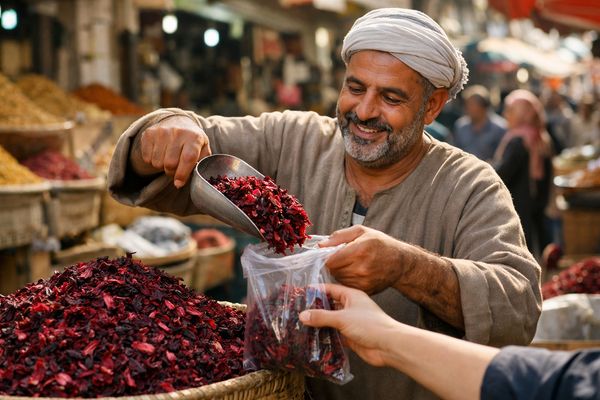
Egyptian hibiscus FOB Cairo is trading slightly higher in early May, with dried flower prices firming by roughly 1–1.5% over the past week in EUR terms. The market is supported by steady export demand and lingering freight uncertainties linked to Red Sea and Suez traffic, while short‑term weather volatility in Egypt has not yet translated into major supply disruptions.
After several weeks of sideways movement, hibiscus prices from Egypt have nudged higher as international buyers return to replenish stocks ahead of the summer beverage season. Export interest from Europe and the Middle East remains solid, helped by the popularity of karkadeh and hibiscus-based herbal blends. At the same time, logistics through the Red Sea and Suez remain fragile: although Suez transit volumes have recently improved, major carriers are still adjusting routings and surcharges, keeping freight costs elevated and supporting FOB price ideas from Egyptian suppliers. Short-term weather risks—sandstorms and changing temperature patterns—are worth monitoring but currently look more like a logistical than a yield story.
Exclusive Offers on CMBroker

Hibiscus flower dried
tbc
FOB 2.30 €/kg
(from EG)

Hibiscus flower dried
slices
FOB 2.35 €/kg
(from EG)
📈 Prices & Short-Term Trend
FOB Cairo offers for conventional dried hibiscus flowers from Egypt have inched up over the last reporting week, with both tea-cut/bulk and slice grades showing modest gains. In EUR terms (approximate conversion), current levels are in the low‑to‑mid €2.10s/kg range for bulk/tea‑cut and a few euro‑cents higher for slices, reflecting a slight quality premium. The pattern points to a firm but not explosive market, consistent with early‑season restocking rather than a supply shock.
| Product | Origin | Location / Term | Latest Price (EUR/kg, approx.) | 1‑week Change |
|---|---|---|---|---|
| Hibiscus flower dried, bulk/tea‑cut | Egypt | Cairo, FOB | ~€2.12 | ▲ ~1–1.5% |
| Hibiscus flower dried, slices | Egypt | Cairo, FOB | ~€2.17 | ▲ ~1–1.0% |
Export market intelligence indicates that Egyptian dried hibiscus continues to trade at a competitive discount to organic and niche origins, supporting steady flows into Europe and the Middle East. Recent market overviews highlight Egypt among the key global hibiscus suppliers, with unit export prices in a comparable band to current spot offers, suggesting that the latest uptick mainly reflects freight and currency factors rather than a structural tightening in physical availability.
🌍 Supply, Weather & Logistics
On the supply side, there are no reports of significant crop damage or area loss for hibiscus in Egypt at the start of May. Broader Nile Basin outlooks for the March–May 2026 season point to generally near‑normal hydrological conditions, with no major deviations flagged for irrigated agriculture in Egypt, supporting stable production prospects for specialty crops such as hibiscus.
Short‑term, however, weather has turned unstable. Egyptian meteorological agencies and local media warn of active sand and dust storms across parts of Upper Egypt, combined with scattered rainfall and a temperature drop over northern regions, including Cairo and northern Upper Egypt. This may temporarily disrupt harvesting, drying and transport—particularly for sun‑dried botanicals and road movements to Cairo export hubs—but the events are episodic rather than season‑ending. For now, they are more likely to create timing issues and localized quality concerns (dust contamination, uneven drying) than to significantly alter national output.
Logistics remain the key external driver. While the Suez Canal Authority reports that canal transits have recovered from the deepest lows seen at the height of earlier Red Sea security disruptions, overall traffic patterns remain volatile. Recent shipping and logistics updates describe ongoing instability in Red Sea routes and elevated freight and insurance costs into Q2 2026, despite partial resumption of traffic by major carriers. For Egyptian hibiscus exporters, this means that FOB Cairo prices embed not just product value but also a risk premium linked to routing choices and potential delays.
📊 Demand & Fundamentals
Structurally, demand for dried hibiscus calyces from Egypt remains underpinned by the strong position of Egyptian karkadeh and herbal teas in key destination markets. Trade data and market overviews continue to highlight Egypt as a competitive and high‑quality origin for hibiscus, especially for tea‑cut material destined for beverage and nutraceutical applications.
Seasonally, consumption in Europe and the Middle East typically shifts toward cold infusions and ready‑to‑drink formulations as temperatures rise, which can boost short‑term drawdowns of supplier and importer inventories. With recent shipping disruptions in both the Red Sea and the neighboring Strait of Hormuz driving higher global freight and energy costs, importers remain cautious about running lean stocks, preferring to secure volumes earlier where pricing is predictable. This combination of cautious inventory management and firm end‑use demand helps explain why hibiscus FOB prices in Egypt are holding a mild upward bias despite the absence of clear supply stress.
📆 Short-Term Outlook & Trading Guidance
Over the next 3–7 days, the Egyptian hibiscus market is expected to stay firm to slightly higher. Weather forecasts point to a continuation of unstable conditions—cooler temperatures in northern Egypt and intermittent sand/dust events farther south—through the immediate term, which could slow field operations and road logistics without severely impacting yields. At the same time, Red Sea and Suez traffic remains sensitive to geopolitical headlines, sustaining a freight risk premium baked into offers from Cairo.
- Importers (EU, MENA): Consider covering near‑term hibiscus needs on current dips, especially for high‑color tea‑cut lots, as FOB Egypt appears supported by logistics costs and firm demand. Delaying purchases risks incremental price gains if freight or weather issues intensify.
- Packers and beverage blenders: Lock in core volumes but retain some flexibility for later top‑ups. Focus on origin and quality differentiation rather than trying to time minor price moves of €0.02–0.03/kg, as quality spreads can outweigh short‑term market noise.
- Egyptian exporters: Maintain offer discipline, particularly for consistent, export‑grade lots. Use current shipping volatility to negotiate freight clauses and lead times, rather than aggressively discounting FOB values.
📍 3‑Day Directional Price Indication (FOB Cairo, EUR)
- Dried hibiscus flower, bulk/tea‑cut: Stable to slightly firmer; expected range roughly flat to +€0.02/kg versus current levels, assuming no major new shipping shock.
- Dried hibiscus flower, slices: Similar bias; modest premium over bulk likely to persist, with bids and offers clustering within a narrow band of today’s indications.