
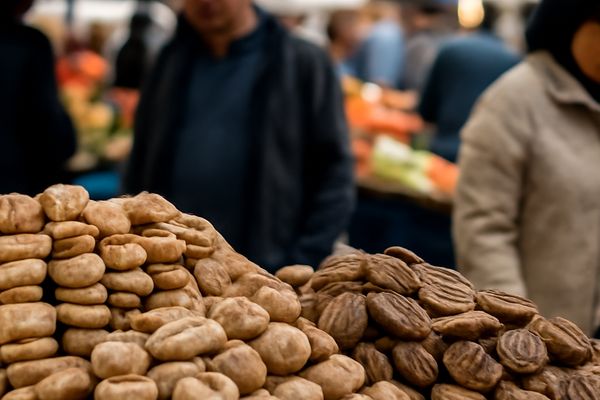
Turkish dried fig prices are broadly stable on a FOB Malatya basis, with only marginal easing in selected Lerida grades, as exporters navigate weak European demand and lingering quality concerns. The market remains balanced by cautious selling from growers and exporters, keeping a floor under prices despite reduced contract activity.
Demand in key EU markets is still sluggish following last season’s high prices and quality‑related rejections, and buyers remain selective in volume and specification. Turkey, however, retains its dominant position in global dried fig trade, and firm interest from non‑EU destinations is helping to stabilize price levels. Near‑term, weather in producing regions is cool and wet but not yet a threat to the coming crop, leaving short‑term pricing primarily driven by export demand rather than fundamentals.
Exclusive Offers on CMBroker

Figs dried
no: 7, lerida
FOB 7.60 €/kg
(from TR)

Figs dried
no: 6, natural
FOB 7.80 €/kg
(from TR)

Figs dried
no: 5, natural
FOB 8.20 €/kg
(from TR)
📈 Prices & Short-Term Moves
Recent offers for Turkish dried figs (FOB Malatya, converted approximately to EUR) indicate a flat price structure versus mid-March, with a modest softening in some Lerida sizes and unchanged natural grades. EU import demand has roughly halved since 2021, creating a sluggish spot market and limiting upside momentum in prices despite Turkey’s strong export position.
| Product | Grade / Type | Indicative Price (FOB Malatya, EUR/kg) | 1–2 Week Trend |
|---|---|---|---|
| Dried figs | No. 7 Natural | ≈ 7.0–7.1 EUR | Stable |
| Dried figs | No. 4–5 Natural | ≈ 7.6–7.9 EUR | Stable |
| Dried figs | No. 1–2 Natural | ≈ 8.3–8.6 EUR | Stable |
| Dried figs | No. 6–7 Lerida | ≈ 7.0–7.7 EUR | Slightly softer |
| Dried figs | No. 1–3 Lerida | ≈ 8.1–8.8 EUR | Stable to slightly softer |
Quotes for Turkish Lerida No. 2 around USD 11,900/mt earlier in the season imply an EUR/kg level broadly consistent with current Malatya offers once recent lira, dollar and euro moves are factored in, underscoring that the market has shifted from last year’s sharp spikes to a sideways, demand‑driven phase.
🌍 Supply, Demand & Quality
Turkey remains the clear global leader in dried fig exports, shipping roughly 60–70 thousand tonnes annually and accounting for close to half of world trade in recent years. Despite this structural strength, the 2025/26 export season, which opened on 15 October 2025, started slowly as exporters reacted to last season’s quality rejections and stricter aflatoxin and ochratoxin controls, especially for EU-bound lots.
EU buyers have sharply reduced imports of Turkish dried figs since 2021, with volumes reported down by about 50%, reflecting both high prices and heightened quality scrutiny. Exporters are therefore relying more on diversification into markets in Asia and other regions, while keeping procurement from growers cautious; estimates suggest around 10% of the current crop still sits with producers, supporting today’s floor in farmgate prices.
📊 Fundamentals & Weather
Sector meetings in Aydın and work by the Aegean Exporters’ Association indicate that Turkey’s dried fig production in 2024/25 was around 41,000 tonnes, with the broader fig sector strongly oriented toward export markets. While exact final figures for 2025/26 are still being consolidated, international statistics confirm Turkey’s continuing dominance, even as other producers such as Iran and Mediterranean EU origins modestly expand capacity.
Weather in Malatya over the next three days (20–22 March 2026) is forecast to be cool with showers and periods of cloud, with highs around 9–11°C and lows near 2–3°C. This pattern is typical for late winter/early spring and does not currently pose a direct threat to fig orchards, as the main fig belt is concentrated further west around Aydın; nonetheless, the moisture profile is supportive for soil conditions ahead of the coming season and does not justify any weather‑driven price premium at this stage.
📆 Trading Outlook (Next 1–2 Weeks)
- For buyers: With FOB Malatya prices stable and EU demand subdued, nearby coverage can be taken selectively on dips in Lerida grades, but there is no strong urgency to chase volumes unless specific sizes or certifications are required.
- For sellers/exporters: The combination of slow EU offtake and lingering quality perceptions argues for disciplined offer strategies and strict toxin management; maintaining price discipline on premium large sizes while conceding slightly on small Lerida may help keep throughput without undermining the overall price structure.
- Risk watch: Any renewed headlines on aflatoxin/ochratoxin issues or logistics disruptions into Europe could weigh further on demand and basis levels, whereas signs of restocking from EU retail or robust Ramadan/Religious holiday demand in third markets would provide limited upside support.
📉 3‑Day Regional Price View (FOB Malatya, EUR)
- Dried figs, Natural (No. 3–6): Sideways; expected range ≈ 7.2–8.0 EUR/kg, with narrow bid–offer spreads and low trade volume.
- Dried figs, Lerida (No. 3–7): Slightly soft bias; expected range ≈ 7.0–8.2 EUR/kg as buyers negotiate small discounts on lower and mid sizes.
- Premium large sizes (No. 1–2, all presentations): Firm within ≈ 8.3–8.8 EUR/kg, supported by limited availability and exporters’ reluctance to discount top grades.
Related posts:
 Stable Chinese Dried Apple Prices While Turkish Apricots Stay Firm
 Raisin Prices Steady to Softer as Turkish FOB Edges Higher, Asia Eases
 Dried Papaya Prices Steady as Thai and Vietnamese Supply Holds Firm
 Turkish Dried Apricots Ease Slightly But Stay Historically Tight
 Tight Turkish dried fig exports keep prices elevated
 Dried Apricots Hold Firm as Malatya Enters Critical Bloom Window
 Turkish Dried Apricots Stay Firm as Malatya Weather Turns Critical
 Chinese Dried Apple Prices Hold Flat as CN Weather Turns Cooler