
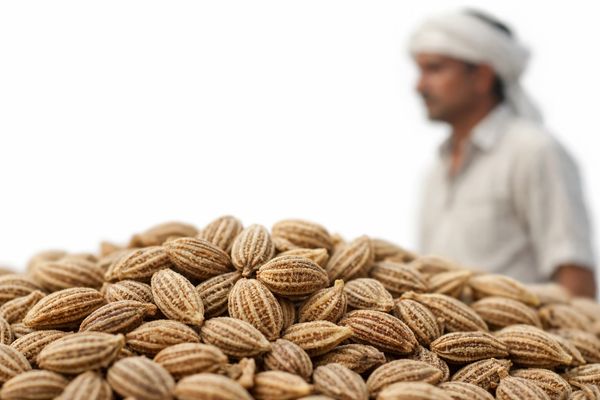
Ajwain export prices from New Delhi are drifting marginally lower in late April, tracking a softer tone across parts of India’s seed‑spice complex while demand remains broadly steady. Mild easing in related seeds such as cumin and caraway and adequate domestic arrivals keep upside limited in the short term.
India’s wider seed‑spice basket is entering Q2 with a firm‑to‑sideways bias, but jeera and other seeds show selective softening on improved supplies, tempering any aggressive bullish narrative for ajwain. Export interest in Indian-origin seed spices is resilient, yet buyers remain price‑sensitive and inclined to cover nearby needs only. At the same time, a developing heatwave over North India raises cost and logistics risks more than immediate crop damage, suggesting a market that is gently offered today but vulnerable to weather‑headline spikes if conditions worsen.
Exclusive Offers on CMBroker

Ajwain
Seed, grade - A
99%
FOB 3.30 €/kg
(from IN)

Ajwain
Powder, grade - b
99%
FOB 3.60 €/kg
(from IN)
📈 Prices & Recent Trend
Indicative New Delhi FOB offers for organic ajwain (carom seed) are currently around EUR 3.05–3.10/kg for Grade A whole seed and about EUR 3.30–3.35/kg for standard powder, after a small week‑on‑week decline of roughly 1% in euro terms following modest softening in INR‑denominated quotes and a stable EUR/INR rate. This mirrors the broader pattern in Indian seed spices, where caraway and cumin have recently traded in narrow to slightly easier ranges as export demand pauses or shifts to hand‑to‑mouth coverage.
Domestic mandi data up to 21 April show average ajwain prices near INR 12,400/quintal (about EUR 1.35/kg), with notable dispersion between low‑quality arrivals and premium Gujarat markets, underlining that New Delhi export offers sit at a justified premium for cleaned, organic grades. Overall, price action since late March points to a gently softening but still historically firm market, with buyers able to negotiate small discounts on volume but not deep cuts.
🌍 Supply, Demand & Trade Flows
India remains the dominant global exporter of ajwain seeds, supplying more than half of recorded world shipments, with Pakistan and China trailing at some distance. Recent export intelligence indicates that while seed‑spice demand from Europe, the Mediterranean and nearby Asian markets is intact, purchasing is disciplined: buyers prioritize quality, residue compliance and reliable logistics, often splitting volumes across multiple origins and shipment windows.
On the supply side, India’s 2025/26 spice export season has started from a position of adequate stocks across many seed spices, even if farmer holding is a bit higher than average for some higher‑value organic grades as growers await better prices. Cross‑commodity signals are mixed: fennel and mustard are stable‑to‑firm, but cumin has eased on higher arrivals and muted exports, which indirectly caps how far ajwain can rally without its own distinct supply shock.
🌤 Weather & Regional Context (India)
The India Meteorological Department has flagged a developing heatwave across North India, including Delhi NCR and adjoining Rajasthan belt, with maximum temperatures in the low‑to‑mid‑40s °C. For ajwain, much of the main rabi crop is already harvested, so direct yield risk from this specific heat episode is limited. However, elevated temperatures can affect cleaning, bagging and transport conditions, increasing handling losses and energy costs for processors.
Looking three days ahead for the North Indian seed‑spice corridor (Delhi, eastern Rajasthan and parts of Gujarat), forecasts point to persistently hot, dry weather with no meaningful rainfall relief and daytime highs remaining well above seasonal norms. This pattern tends to keep farmer selling measured—neither panic‑driven nor aggressive—since stored stocks are not immediately threatened, helping maintain the current gently offered but not oversupplied tone in ajwain.
📊 Fundamentals & Price Drivers
- Stocks and arrivals: Mandi data up to 21 April indicate diverse price bands and continuing arrivals across Gujarat and Andhra Pradesh, suggesting that pipeline stocks are comfortable. Lower arrivals versus last year reported for some organic seed spices nonetheless give sellers confidence to resist sharp discounts.
- Cross‑spice signals: Caraway and cumin have both shown either steady or mildly softer pricing in recent days, with jeera in particular adjusting down on higher supply and subdued overseas buying. This reduces substitution‑driven buying pressure on ajwain and encourages some buyers to negotiate harder.
- Export demand: Trade commentary around India’s seed‑spice basket confirms continued, though not exuberant, export demand, especially from residue‑sensitive and quality‑driven segments such as Europe and the Mediterranean. Buyers increasingly seek traceable, processed ajwain lots integrated into broader spice programs, which underpins premiums for well‑documented organic batches even in a slightly soft market.
- Macro and freight: While freight and energy costs remain elevated in the background, there have been no fresh disruptive spikes in the past few days; logistics constraints are largely priced in and not a new bullish driver this week.
| Product | Market | Incoterm | Current price (EUR/kg) | 1‑week change | 1‑month bias |
|---|---|---|---|---|---|
| Ajwain seed, organic Grade A | New Delhi (IN) | FOB | ≈ 3.05–3.10 | ▼ ~1% | Slightly softer, range‑bound |
| Ajwain powder, organic Grade B | New Delhi (IN) | FOB | ≈ 3.30–3.35 | ▼ ~1% | Slightly softer, range‑bound |
📆 Short‑Term Outlook & Trading Ideas
- For importers/users: The next 1–2 weeks look tactically favorable for booking nearby ajwain seed and powder needs on dips, as India’s broader seed‑spice complex shows only selective firmness and jeera/ caraway weakness caps upside. Consider staggering purchases rather than going fully long, given heat‑related event‑risk later in the season.
- For Indian exporters/stockists: With export demand steady but not aggressive, maintaining offer discipline on clean, certified organic lots while being flexible on standard grades can help protect margins. Using soft jeera and steady fennel as reference, a mildly offered stance is reasonable, but avoid large destocking unless weather or policy headlines turn clearly bearish.
- For processors and blenders: Given current mandi diversity and the premium for traceable bulk export‑grade ajwain, there is scope to secure raw material at competitive prices in inland markets, then capture added value through cleaning, grading and blending for industrial customers.
📍 3‑Day Regional Price Indication (IN)
- New Delhi FOB, whole ajwain seed: Bias slightly soft; expected range about EUR 3.00–3.15/kg over the next three trading days, assuming no abrupt weather or freight shock. (Direction: mildly lower to sideways.)
- New Delhi FOB, ajwain powder: Directionally similar, with offers likely to hold around EUR 3.25–3.40/kg; processors may trim quotes marginally to stimulate export interest if cross‑spice softness persists. (Direction: sideways with slight downside risk.)
Related posts:
 Indian Black Pepper Prices Ease Slightly as Heat Builds in Southern Belts
 Indian Dill Seed: Slightly Firmer New Delhi Prices as Heat Builds
 Indian Nigella Prices Ease Slightly as Heat Builds in North India
 Indian Dried Ginger FOB Softens Slightly as Heat Builds into Monsoon Watch
 Indian Fenugreek Steady to Slightly Firmer as Heat Builds in North India
 Indian Dill Seed Prices Ease Slightly as Heat Builds in Key Belt
 Indian fennel prices ease slightly as summer heat builds in key growing belts
 Indian Dill Seed Prices Ease Slightly as Heat Builds into Peak Summer