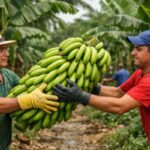
South Korea’s banana imports remain structurally strong, with roughly 360,800 tons brought in last year and no signs of near-term demand erosion. Stable dried banana chip prices in Europe reinforce the picture of a broadly balanced market with modest upside risk if Asian import growth accelerates.
South Korea continues to anchor regional demand for bananas, far ahead of other fruits in its import basket. Oranges and pineapples follow at much lower volumes, while mangoes are gaining momentum in line with broader East Asian trends toward premium tropical fruit. The country’s heavy reliance on Philippine supply makes it a key destination market for exporters planning volumes and logistics. With no major policy shifts reported and retail channels well established, the banana trade into Korea looks set to remain robust, even as grapes and lemons lose share in the fruit mix.
Exclusive Offers on CMBroker

Banana dried chips
Chips, whole
FOB 3.40 €/kg
(from VN)

Banana dried chips
Chips, whole
FCA 2.90 €/kg
(from NL)

Banana dried chips
Chips, whole
FCA 2.37 €/kg
(from NL)
📈 Prices
Available offer data for banana dried chips points to a sideways market in April 2026. Conventional whole chips from Vietnam (FOB Hanoi) are indicated around EUR 3.43/kg, unchanged over several weekly postings. In the Netherlands, Philippine-origin whole chips are quoted near EUR 2.37–2.90/kg FCA Dordrecht, while broken chips trade closer to EUR 1.87/kg, also broadly stable over the month.
The very limited price movement suggests that upstream green banana supply and processing margins are currently well balanced. Slight earlier upticks in some organic and conventional offers have not followed through into a broader rally, indicating that buyers still have sufficient optionality across origins and product qualities.
🌍 Supply & Demand
South Korea’s imports of around 360,800 tons of bananas last year firmly cement the fruit as the country’s leading import category by a wide margin. Oranges, at roughly 97,400 tons, and pineapples, near 67,000 tons, trail far behind, underlining the structural depth of Korean banana demand. This hierarchy has remained broadly stable, with only moderate shifts among secondary fruits.
Bananas, oranges, and mangoes all show upward momentum compared with earlier average levels, highlighting growing consumer preference for tropical varieties. The increase in mango imports, in particular, aligns with rising incomes, more sophisticated retail formats, and stronger interest in premium fruit. By contrast, grapes and lemons have slipped from previous averages, hinting at gradual substitution within the fruit basket rather than an overall demand slowdown.
📊 Trade Flows & Policy
South Korea relies heavily on the Philippines for its banana needs, with long-established supply chains and trade relationships. This tight integration means any production or logistics disruption in key Philippine growing regions would disproportionately affect Korean import availability and costs. Other exporters, including Ecuador, compete for shelf space but remain secondary to the dominant Philippine flow.
Current tariff and phytosanitary regimes for fresh fruits appear stable, with no specific changes reported that would materially alter banana import economics in the short term. As a result, consumer demand patterns and retailer procurement strategies remain the primary drivers of volumes. The recent decline in grape and lemon imports may reflect price competitiveness, availability of substitutes, or domestic competition, and should be monitored for potential feedback effects on the broader fruit mix.
🌦️ Weather & Production Outlook
Near-term weather conditions in major Philippine banana-growing regions are being closely watched, but no widespread, acute disruptions have emerged in the last few days. Localized rainfall variability and storm risks remain a seasonal concern, yet current reports point more to normal management of field operations than to structural production losses.
Given these conditions, exporters are likely to maintain planned shipment programs into Asia, including South Korea, unless a significant weather event develops. Any shift toward more extreme rainfall or typhoon activity would quickly tighten supply for premium Asian destinations, potentially pushing both fresh banana and processed product prices in Europe modestly higher.
📆 Market Outlook (30–180 days)
In the next 30–90 days, South Korea’s banana imports are expected to remain close to current levels, supported by entrenched consumer habits and efficient distribution networks. Mango shipments are likely to continue their gradual growth trajectory as retailers promote variety and premium offerings. Oranges should stay solid but secondary, while the recovery prospects for grapes and lemons will depend on pricing and alternative sourcing.
Over a 6–12 month horizon, structural growth in tropical fruit consumption points to incremental gains in mango and avocado imports. Still, bananas are set to retain their dominant position in Korea’s fruit import mix unless there is a major price shock, policy change, or notable shift in consumer preferences. For processed banana products like dried chips, the current flat price structure suggests only limited upside pressure unless fresh fruit costs rise or logistical constraints intensify.
💡 Trading Outlook
- Importers in East Asia: Maintain baseline banana procurement programs, with a slight bias to secure volumes from the Philippines given Korea’s strong pull and potential competition from other Asian buyers.
- European buyers of dried banana chips: Use the current price stability (EUR 1.87–3.43/kg range by quality and origin) to cover near-term needs, but avoid overcommitting far forward while weather and freight risks in origin are still seasonally sensitive.
- Exporters in the Philippines and Ecuador: Treat South Korea as a priority destination with steady demand, while monitoring Korean mango and orange growth as potential indicators of broader tropical fruit diversification.
📍 3‑Day Directional Outlook (EUR)
| Product | Location / Term | Indicative Level (EUR/kg) | 3‑Day Bias |
|---|---|---|---|
| Banana dried chips, whole, non‑organic | FOB Hanoi (VN) | ≈ 3.43 | Sideways |
| Banana dried chips, whole, non‑organic | FCA Dordrecht (NL, PH origin) | ≈ 2.37 | Sideways |
| Banana dried chips, whole, organic | FCA Dordrecht (NL, PH origin) | ≈ 2.90 | Sideways |
| Banana dried chips, broken, non‑organic | FCA Dordrecht (NL, PH origin) | ≈ 1.87 | Sideways |