
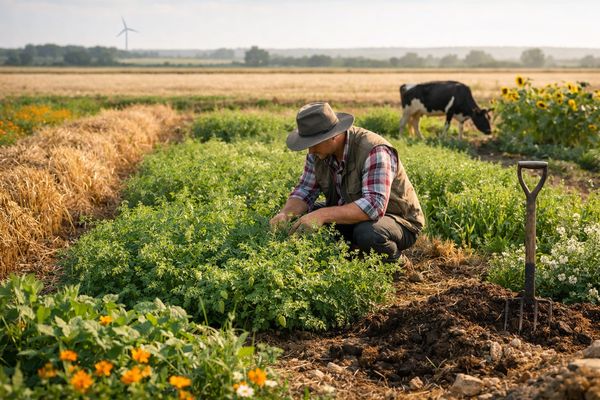
India’s chickpea market is trading sideways under the shield of state price support, while drought-hit Australia and soft private demand globally are keeping any strong rally in check over the next few weeks.
The near-term chickpea outlook is defined by an unusual combination of abundant Indian supply, large state procurement and weak buying interest from dal mills and traders. Prices in India are hovering close to the government’s Minimum Support Price (MSP), which effectively puts a floor under the market and prevents a deeper correction. At the same time, a tighter forward production outlook in drought-affected parts of Australia, plus steady import flows into India and Europe, should keep global users reasonably well supplied but wary of downside complacency.
Exclusive Offers on CMBroker

Chickpeas dried
count 42-44, 12 mm
FOB 0.98 €/kg
(from IN)

Chickpeas dried
count 44-46, 11 mm
FOB 0.95 €/kg
(from IN)

Chickpeas dried
count 46-48, 10 mm
FOB 0.92 €/kg
(from IN)
📈 Prices & Short-Term Trend
India’s wholesale chickpea prices are holding close to the MSP of about EUR 630 per tonne (converted from USD 63.08 per 100 kg), leaving limited room for further decline without additional government intervention. State procurement is actively mopping up supplies, especially in Andhra Pradesh, where sanctioned purchases have been raised to 113,250 tonnes. In parallel, spot export indications from New Delhi for conventional dried chickpeas are broadly stable to slightly firmer compared with early April, with FOB levels for 42–44 count around EUR 0.98/kg and smaller sizes trading down to roughly EUR 0.86/kg.
| Origin | Type | Delivery | Latest price (EUR/kg) |
|---|---|---|---|
| India (New Delhi) | Chickpeas 42–44, 12 mm | FOB | 0.98 |
| India (New Delhi) | Chickpeas 44–46, 11 mm | FOB | 0.95 |
| India (New Delhi) | Chickpeas 60–62, 8 mm | FOB | 0.86 |
| Mexico (Mexico City) | Chickpeas 42–44, 12 mm | FOB | 1.24 |
Mexican origin remains noticeably more expensive, with large-calibre 42–44 count offered around EUR 1.24/kg FOB, preserving India’s competitiveness for price-sensitive buyers in Europe and the Middle East. The modest uptick in Indian offers since early April suggests a cautiously firm undertone, but not the start of a sustained bull run.
🌍 Supply & Demand Dynamics
India currently sits on comfortable chickpea availability, yet private-sector participation is muted. Dal processing mills are covering only immediate needs and traders are refraining from building sizeable stocks, signalling a lack of conviction in near-term upside. Seasonal demand linked to weddings and religious festivals is expected to add some incremental offtake in the coming weeks, but this looks insufficient on its own to ignite a sharp rally.
Government procurement is the key balancing force. Beyond Andhra Pradesh’s enlarged allocation, the extension of the pigeon pea procurement window in Karnataka underscores New Delhi’s broader intent to support pulse growers and buffer national stocks. Meanwhile, imports from Australia and Africa continue to arrive, adding to domestic availability and reinforcing the current rangebound price pattern.
📊 Global Fundamentals & Australian Weather Risk
Australia, a critical supplier to India and European hummus and snack manufacturers, faces a more uncertain production outlook. Severe drought conditions in parts of northern New South Wales and southern Queensland are discouraging expanded chickpea planting for the upcoming season. At roughly EUR 6.25 per tonne at Brisbane bulk delivery (about USD 6.76/tonne), prevailing local price indications are widely viewed by Australian growers as unattractive, weakening incentives to sell residual stocks or commit to larger acreage.
Input constraints add to the pressure. Reports of urea and diesel shortages in parts of Australia are further eroding planting economics, making any rapid supply response to future price spikes less likely. For European buyers dependent on Australian and Indian origins, this combination of constrained Australian forward supply and India’s state-backed price floor suggests reduced downside risk but also restricted upside as long as demand growth stays moderate.
🌦 Weather & Short-Term Outlook
In India, current weather is not the primary driver for spot chickpea prices; the harvested crop and policy decisions dominate near-term dynamics. In Australia’s chickpea belt, however, ongoing drought in key areas of New South Wales and Queensland remains the major watchpoint for 2026/27 output prospects. Without a clear improvement in rainfall expectations, forward supply risks will persist even if immediate export availability is adequate.
Over the next two to four weeks, the most probable scenario is a continuation of the present equilibrium: government procurement and festival-related demand lend stability, while steady imports and cautious mill buying prevent a breakout rally. Only a meaningful strengthening in private demand or a fresh deterioration in Australian crop expectations would be capable of pushing prices decisively higher in the short run.
📆 Trading & Procurement Outlook
- Importers & food manufacturers: Use the current MSP-anchored stability to secure nearby coverage from Indian origin, especially for standard calibres, but avoid overextending beyond 2–3 months given still-soft mill demand.
- Dal mills and local traders in India: Maintain hand-to-mouth procurement strategies while tracking government procurement pace; a sudden slowdown in state buying would be the main downside risk to current price levels.
- European buyers reliant on Australia: Diversify origin mix toward India where quality allows, while monitoring Australian weather and input markets for early signs of a tighter 2026/27 balance.
- Producers: Indian farmers remain relatively protected by the MSP and buffer stock programme, whereas Australian growers face tougher planting economics and may delay sales in expectation of better prices later in the year.
📉 3-Day Regional Price Indication (Directional)
- India – New Delhi FOB (all main calibres): Sideways to slightly firm; MSP and state procurement underpin a narrow trading range in the coming 3 days.
- Mexico – Mexico City FOB (large calibre): Slightly soft bias as prices remain at a premium to Indian origin, limiting demand at the margin.
- Australia – Brisbane bulk delivery: Nominally steady but with limited liquidity; farmers’ reluctance to sell at current levels supports a mildly firmer tone if export interest improves.
Related posts:
 Indian Chickpeas Steady as State Procurement Sets Floor, Imports Cap Upside
 Chickpeas Stay Sub-MSP but Attractive for EU Buyers as India Remains Well Supplied
 Guar Seed Holds Steady as Oil-Linked Upside Risk Builds
 Indian Chickpeas Stay Range-Bound but Offer Rare Value for EU Buyers
 Pigeon Pea Market Turns Sideways as Indian Prices Slip Below Support
 Guar Complex Holds Steady as Markets Watch Monsoon Risk and Demand Signals
 Indian Chickpeas Hold Firm Near Recent Highs as Heat Builds in North India
 Chickpeas Flat but Firm: India–Mexico Price Update and Short-Term Outlook