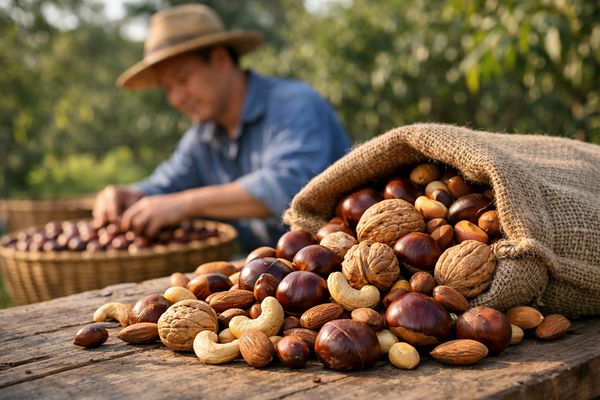
China’s 2025 chestnut crop is significantly larger and of better quality than last season, supporting firm prices for premium grades while standard fruit faces more pressure. Export demand remains solid, especially for value‑added kernels and ready‑to‑eat formats, but downstream consumer demand is cautious, reinforcing a clear “quality and branding first” market structure.
China’s main chestnut regions in Hebei and Shandong are now in a key phenological stage, with sprouting and flowering underway ahead of a harvest window concentrated between early September and early October. Processors report a sharp improvement in yield, size uniformity and premium‑grade share versus 2024, helped by ample sunshine and stable ripening weather last season. Against this backdrop, exporters are preparing for a demanding September–December peak shipping phase where inventory discipline, cold‑chain capacity and certification will decide who captures the best margins.
Exclusive Offers on CMBroker

Brazil nuts
medium
FCA 6.50 €/kg
(from NL)
📈 Prices & Market Tone
Farmgate purchase prices for Chinese chestnuts are slightly higher than a year ago despite the larger crop, indicating resilient upstream confidence and buyers’ willingness to pay up for quality. At the same time, cautious end‑user demand is enforcing stricter differentiation: high‑grade fruit and well‑processed kernels command clear premiums, while mid‑range product sees stronger competition and discounting pressure.
Export offers for Chinese chestnuts into Europe and Asia broadly track this pattern, with tight spreads for top‑spec fresh in‑shell and IQF kernels and wider discounts for standard grades. Parallel nut markets, such as Brazil nuts in Europe holding around 6.5 EUR/kg FCA Netherlands since late March, underline a generally stable but selectively firm tone across the wider nut complex, where quality and reliability are being priced more aggressively than volume.
🌍 Supply & Demand Balance
Core producing areas like Tai’an and Linyi in Shandong entered the 2025 season with favorable climate conditions during ripening, supporting higher yields and better sugar accumulation. Industry feedback points to a notable increase in total production versus 2024, alongside more uniform calibers and an expanded share of premium‑grade nuts. This strengthens China’s position as a leading global chestnut supplier at a time when many overseas buyers are seeking consistent, year‑round sources.
On the demand side, export channels remain the main growth engine. Chestnut shipments typically start when the new crop enters the market in early September and run through the Lunar New Year, with September to December being the critical window for fresh and frozen product movement. While household consumption in some destination markets is still price‑sensitive, structural demand is supported by health‑focused eating trends and wider use of chestnuts in baking, desserts, stews and convenient snacks.
📊 Product Mix, Trade Flows & Competitiveness
Chinese exporters are steadily moving up the value chain, shifting from bulk in‑shell exports toward frozen peeled kernels and ready‑to‑eat formats. Growth has been fastest in processed segments, reflecting both higher margins for suppliers and a preference among overseas buyers for labor‑saving ingredients and branded snack concepts. Tai’an and Hebei origins have built strong reputations in key markets such as Japan, South Korea, Southeast Asia, the Middle East, Europe and North America, where sweetness, powdery texture and ease of peeling are key differentiators.
Competition between exporters increasingly centers on supply‑chain strength rather than price alone. Companies with direct access to orchards, standardized production systems and extensive cold storage are better positioned to keep product quality stable from harvest through late‑season shipments. At the same time, tightening food safety and compliance rules in many destination countries mean that firms with FDA, HACCP and ISO‑certified operations are more likely to secure long‑term contracts with importers, retailers, bakery chains and foodservice buyers.
🌦️ Weather & Seasonal Outlook
Major Chinese chestnut regions are currently in the critical sprouting and flowering period that will set the potential for the 2025/26 marketing year. Following last season’s largely favorable ripening conditions, growers will watch closely for any episodes of late frost, heavy rainfall or heat stress that could affect fruit set. For now, there is no broad signal of severe weather disruption, but volatility during late spring and early summer remains a key risk to watch.
Given the strong starting point in terms of orchard health and last year’s high sugar accumulation, even near‑normal weather through June–July would likely be sufficient to sustain above‑average production. Any localized weather issues would mainly affect grade distribution and harvest timing rather than radically tightening overall supply, so exporters’ focus remains on quality management and logistics rather than volume scarcity.
📆 Trading Outlook & Strategy
- Importers & wholesalers: Prioritize early coverage of premium‑grade fresh in‑shell and frozen kernels ahead of the September–December peak, as top qualities are likely to remain relatively tight despite the larger crop.
- Food manufacturers & bakeries: Lock in contracts for processed kernels and ready‑to‑eat formats with certified suppliers offering strong cold‑chain capabilities, to secure consistent specifications and reduce quality risk late in the season.
- Exporters & origin packers: Lean into quality segmentation and branding, emphasizing certification, traceability and year‑round supply programs rather than competing solely on price for standard grades.
- Retail & e‑commerce channels: Use the wider availability of high‑quality Chinese chestnuts to expand health‑positioned snack lines, but watch consumer price sensitivity, especially for non‑holiday periods.
📉 Short-Term Price Indications (Next 3 Days)
Over the coming three days, wholesale nut markets in Europe are expected to remain broadly stable in EUR terms, with Brazil nuts around 6.5 EUR/kg FCA Netherlands and limited short‑term volatility. For Chinese chestnuts, the near‑term outlook is for steady to slightly firmer offers on premium grades, supported by strong quality perceptions and growing interest in processed kernels, while standard product is likely to trade sideways under competitive pressure.