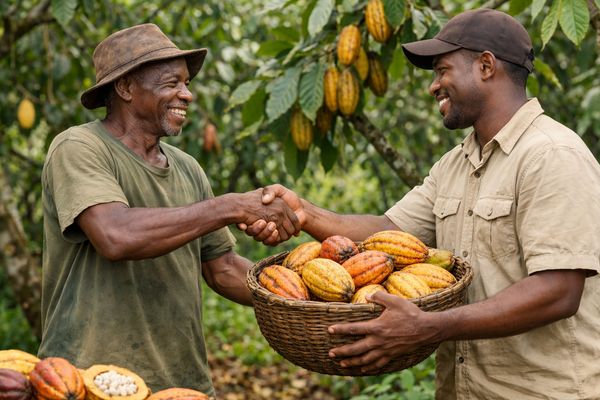
Weather-related stress in Côte d’Ivoire’s cocoa belt is increasing the risk of mid-crop yield losses and quality issues, supporting a firm to bullish price tone in the near term. Unless rains normalize before the end of May, the global market faces a higher probability of tighter supply from the world’s largest producer.
Cocoa plantations in key Ivorian regions are entering a critical window for pod development under suboptimal conditions. Reported below-average rainfall, elevated temperatures and signs of plant stress are undermining confidence in the ongoing March–August mid-crop. With many pods still on the trees, the coming weeks’ weather will be decisive for final output and bean quality. Market participants are watching precipitation patterns closely, as any sustained production loss from Côte d’Ivoire would tighten global balances and reinforce upward pressure on prices.
📈 Prices & Market Mood
Cocoa prices remain underpinned by concern over West African supply, with the Ivorian mid-crop now clearly identified as a weather risk. While day-to-day volatility will track speculative flows and macro sentiment, the fundamental tone is supported by fears of lower output and deteriorating bean quality from Côte d’Ivoire.
Given the heightened uncertainty around mid-crop performance, price dips are likely to meet solid buying interest from industry and investors seeking coverage against potential further tightening later in the season.
🌍 Supply & Demand Focus
The mid-crop in Côte d’Ivoire, running from March to August, is a key contributor to annual cocoa output. Farmers across major growing areas report that rainfall over the past week has been significantly below seasonal norms during a period that is critical for pod filling and bean development.
Despite the country officially entering the rainy season, moisture levels have not met expectations, raising the risk that both yields and bean quality will suffer. As Côte d’Ivoire is the world’s largest cocoa producer, any notable reduction in mid-crop production would directly tighten global supply and reduce flexibility for grinders and chocolate manufacturers.
🌦️ Weather & Crop Conditions
Growers in regions such as Soubre, Agboville, Divo, Abengourou and Daloa highlight a combination of prolonged dry spells and high daytime temperatures of around 29–33°C. These conditions are stressing trees, with some farms reporting premature pod drop, a clear sign of inadequate moisture and plant stress.
Short-term forecasts for core Ivorian cocoa zones point to continued hot conditions with only scattered thunderstorms rather than sustained, soaking rains, implying that moisture deficits may persist in the very near term. Without a shift toward more regular and heavier rainfall before the end of May, the probability of reduced pod development and lower-quality beans will rise further.
📊 Fundamentals & Risk Assessment
A large number of pods are still present on the trees, leaving room for partial recovery if robust rains arrive soon. This underpins a scenario of high uncertainty rather than a guaranteed crop failure. Nonetheless, current stress signals justify a risk premium in prices as traders factor in the asymmetric impact of a potential supply shortfall from Côte d’Ivoire.
The market is therefore trading a weather-dependent outlook: timely rainfall could stabilize yield expectations and cap further upside, while continued dryness and heat would likely trigger renewed price rallies and tighter availability for exporters and grinders.
📆 Trading Outlook & 3‑Day View
🔎 Strategic Takeaways
- Overall bias: weather-driven bullish, with strong sensitivity to rainfall news from Côte d’Ivoire through end-May.
- Buying on dips is favored for users needing physical cover, given the risk of lower mid-crop output and quality.
- Producers and sellers should consider scaling sales rather than aggressive forward hedging until rainfall trends become clearer.
- Short-term traders should watch forecasts and farmer reports from Soubre, Daloa and neighboring regions as primary price catalysts.
📉 3‑Day Regional Price Indication (Directional)
All indications in EUR terms; arrows show likely direction rather than precise levels.
| Exchange / Region | Near-Term Direction (3 days) | Comment |
|---|---|---|
| ICE Europe cocoa (EUR) | ⬆ / ➡ | Underlying support from Ivorian weather risk; consolidation with upside bias. |
| European physical spot (EUR) | ⬆ | Industry coverage and quality concerns likely to keep differentials firm. |
| West Africa export indications (EUR-equivalent) | ⬆ | Potentially tighter mid-crop availability and stress in key regions support offers. |