
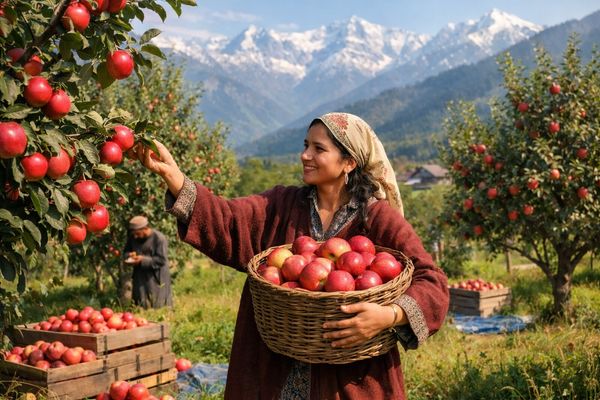
Apple prices in Jammu & Kashmir are recovering from last month’s brief dip, with controlled atmosphere (CA) storage allowing growers to ration remaining stocks and keep market levels supported compared with harvest-time lows.
After a short-lived downturn, the fresh apple market is stabilising as growers release only part of the still sizeable 20–30% stock in cold storage. Prices remain below the January–February winter peak but clearly above main-harvest levels, improving farm margins. CA storage has fundamentally changed marketing behaviour: instead of distress sales into an oversupplied market, farmers now time deliveries more strategically, improving price realisation and reducing dependence on intermediaries. This is feeding back into better investments in inputs and quality, while structural constraints such as limited rural storage capacity still cap the benefits for smaller producers.
[cmb_offer ids=44,781,780]
📈 Prices & Market Mood
Current fresh apple prices in Jammu & Kashmir have rebounded from the one–two week decline seen last month, though they are still trading below the mid-winter highs. Growers nevertheless report clearly stronger returns than during the main harvest, when heavy arrivals and weak demand pushed levels down. The mood is cautiously optimistic, with expectations that prices will stay underpinned as long as stocks are managed carefully.
In the processed segment, EU spot indications for dried apple cubes of Chinese origin in Dordrecht are slightly firmer month-on-month. Recent quotes are around EUR 4.30–4.40/kg FCA, reflecting a mild upward adjustment since late March. This signals that, beyond the fresh market recovery in Jammu & Kashmir, downstream value chains are also seeing steady to slightly stronger pricing.
🌍 Supply & Demand Balance
Roughly 20–30% of the crop in Jammu & Kashmir is still in cold storage, providing a critical buffer between farm and wholesale markets. By phasing releases, growers have avoided the sharp price breaks that occur when large volumes hit the market simultaneously. The residual stocks are sufficient to cover near-term demand without generating oversupply, pointing to a relatively balanced market.
During the peak harvest period, demand was too soft to absorb the heavy inflow of fruit, which triggered the earlier price slump and accelerated the shift into storage. Now, as demand normalises and stored fruit flows more gradually, buyers face a more orderly market with fewer deep discounts. This shift is reinforcing the role of CA storage as a key stabiliser of regional supply.
📊 Fundamentals & Structural Shifts
The expansion and full utilisation of CA and cold storage units during the last harvest season has structurally changed marketing practices. Farmers have reduced their reliance on intermediaries who previously benefited from distress sales right after harvest. With more control over timing and volumes, growers have gained bargaining power and can negotiate prices that better reflect quality and market conditions.
Improved returns from stored apples are already feeding back into higher on-farm investment in pesticides, packaging, and better cultivation practices. Over time, this should lift both productivity and average quality in the Jammu & Kashmir apple sector. However, infrastructure gaps persist: remote and small-scale farmers with limited access to nearby storage still face higher transport costs and post‑harvest losses, leaving some structural inequality in who captures the gains.
🌦️ Weather & Storage Outlook
With a significant share of the current crop secured in CA storage, short-term price formation is driven more by stock management than by immediate weather risks. As long as storage conditions remain stable and logistics are not disrupted, fruit quality can be preserved over an extended period, supporting consistent marketable volumes. Expectations of strengthening demand in the coming weeks suggest that remaining stocks will clear at supportive price levels.
Looking ahead, the key structural weather-related risk is not the current marketing season but future harvests. Continued investment in both on-farm resilience and post-harvest infrastructure will be essential to mitigate volatility from any adverse seasons and to ensure that CA storage can keep balancing supply and demand in years of both surplus and short crop.
📆 Trading & Risk Management Outlook
- For growers in Jammu & Kashmir: Maintain a disciplined, phased release of remaining CA stocks to preserve the current price recovery. Avoid front-loading sales while demand is still firming.
- For traders and wholesalers: Near-term price downside looks limited as long as 20–30% storage stocks are rationed. Use any temporary dips from localised selling pressure as buying opportunities for quality grades.
- For processors and exporters: Stable-to-firmer dried apple prices in Europe and better fresh-market realisations locally support a mildly bullish bias. Secure medium-term supply contracts where possible, especially for higher-quality fruit suited for premium dried or juice products.
- For policymakers and investors: Prioritise expansion of CA storage into remote and smallholder-dominated areas to reduce post-harvest losses and widen access to the current marketing advantages.
📉 Short-Term Price Indication (3 Days)
| Market | Product | 3-day outlook (EUR) |
|---|---|---|
| Jammu & Kashmir (fresh, wholesale) | Table apples | Sideways to slightly firmer vs recent levels; supported by managed releases |
| EU (NL, Dordrecht) | Dried apple cubes 5–12 mm | Around EUR 4.30–4.40/kg FCA; bias mildly firm after recent small increases |
[cmb_chart ids=44,781,780]