
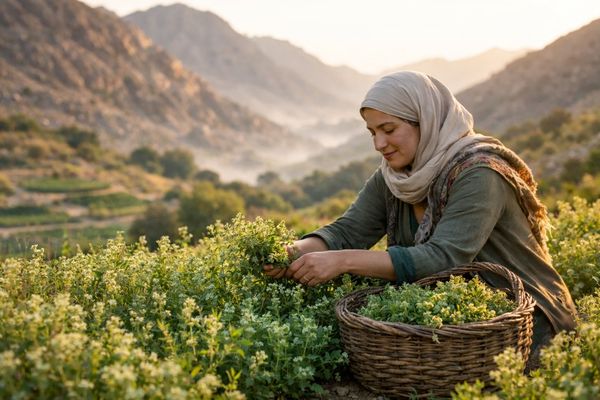
Marjoram FOB Cairo prices are holding steady in early May, with only marginal week‑to‑week moves as Egyptian supply remains ample and weather conditions are largely benign in key herb regions.
The dried marjoram market out of Egypt is currently driven more by currency and logistics than by crop stress. Exporter activity remains robust as Egypt consolidates its role as a leading supplier of dried culinary herbs to Europe and the Middle East, supported by competitive farm structures and modern processing lines. Warm, dry weather across Upper Egypt is creating favorable drying conditions without major heat stress in early May, while international demand for Mediterranean herb blends and natural ingredients stays solid but unspectacular. Overall, marjoram prices look range‑bound near current levels, with limited short‑term upside unless weather turns excessively hot or logistics costs rise.
Exclusive Offers on CMBroker

Marjoram dried
Whole
99,9%
FOB 1.77 €/kg
(from EG)
📈 Prices & Market Tone
Export offers for conventional dried whole marjoram (Egyptian origin, FOB Cairo) are effectively unchanged in late April and early May, showing a narrow range and low day‑to‑day volatility. Stable offers reflect comfortable inventories at processors and exporters, supported by continuous throughput from Fayoum and Minya growing zones. Currency dynamics and freight remain the main cost variables, but no abrupt shifts have been reported in the last few days.
| Product | Origin | Location / Term | Latest quoted level (EUR/kg) | 1‑month trend |
|---|---|---|---|---|
| Marjoram, dried whole, 99.9% purity, conventional | Egypt | Cairo FOB | ≈ 1.65–1.70 EUR/kg | Sideways, very slight firming |
Compared with late April, current indicative levels in EUR show only a marginal firming effect, largely due to minor FX moves and stable demand rather than any structural tightening in raw material. Competing Mediterranean herb suppliers such as Turkey continue to provide an alternative origin for EU buyers, helping cap any aggressive price appreciation for Egyptian material.
🌍 Supply & Demand Drivers
Egypt remains one of the key global suppliers of dried sweet marjoram, alongside other Mediterranean origins. Recent Codex documentation again highlights Egypt’s central role in the marjoram value chain, underscoring the maturity of local production and processing capacity. Exporters in Fayoum and Minya report diversified portfolios of herbs and spices, which allows them to balance capacity between marjoram and higher‑margin herbs without disrupting overall supply.
On the demand side, interest from Europe and high‑income markets remains steady but not explosive. Global fresh and dried marjoram trade is primarily linked to standardized retail herb assortments and foodservice blends; buyers emphasize residue control and certification more than spot price spikes. No acute shortage signals have emerged in the last few days, unlike sporadic retail gaps reported in past years, and pipeline stocks appear adequate.
📊 Fundamentals & Weather
Structural studies on Egyptian marjoram point to an established, economically viable crop with room for efficiency gains in drying and storage. Quality improvements (more uniform green color, better microbiological profiles) are increasingly important differentiators among exporters rather than headline price levels. This aligns with the current market tone, where buyers seem willing to pay modest premiums for consistent quality and certification instead of chasing the absolute lowest price.
Weather conditions in Upper Egypt (e.g., Minya region, a representative medicinal and aromatic plant area) over the coming 10–14 days are forecast to be seasonally warm and mostly dry, with daytime highs around the low‑ to mid‑30s °C, cool nights, and no significant rainfall. Such a pattern is generally favorable for both field operations and sun/oven drying, supporting good leaf color and minimizing fungal risk. Only if temperatures push well above mid‑30s °C for prolonged periods would concerns emerge about oil content and leaf fragility; forecasts so far do not indicate this for the next few days.
📆 Short‑Term Outlook
Given current supply coverage, benign weather, and balanced demand, the marjoram market from Egypt is expected to stay broadly range‑bound in the immediate term. Regulatory discussions at Codex on sweet marjoram standards may shape medium‑term quality and specification requirements, but they are not yet a direct short‑term price catalyst. The main risk factors to watch in May are logistics (container availability and freight) and any surprise heat waves during late vegetative and cutting phases.
📌 Trading Recommendations
- Buyers (importers, packers): Use current stability to cover near‑term requirements (1–2 months) at today’s levels, prioritizing suppliers with strong quality systems over marginally cheaper offers.
- Industrial users & blenders: Consider building a modest buffer stock while weather is supportive and logistics are predictable, but avoid over‑stocking as there is no clear bullish catalyst yet.
- Egyptian exporters: Focus on locking in forward sales with quality‑differentiated contracts and be prepared for selective discounting if competing Mediterranean origins turn more aggressive.
📉 3‑Day Price Direction (FOB Cairo, dried marjoram)
- Day 1 (3 May 2026): Prices expected to remain stable around ≈1.65–1.70 EUR/kg, with only minor negotiation room.
- Day 2 (4 May 2026): Sideways; buyers likely to test the lower end of the range but ample supply should prevent any spike.
- Day 3 (5 May 2026): Still stable to very slightly firm, mainly if FX or freight quotes edge higher; no fundamental tightening anticipated.
Related posts:
 Egyptian Chamomile FOB Cairo: Mild Softening Amid Heatwave and Firm EU Demand
 Egyptian Sage FOB Cairo Edges Higher on Firm Costs and Stable Weather
 Egyptian Marjoram FOB Cairo: Stable Range, Mild Firming in Late April
 Egyptian Lemongrass FOB Cairo Holds Firm Despite Costly Freight
 Egyptian Chamomile FOB Cairo: Mild Uptrend Amid Stable Weather and Firm Demand