India’s guar seed market is entering a structurally tighter phase, with production collapsing and stocks thin while end-user demand remains subdued. Prices are firm in key mandis and could break significantly higher once genuine industrial buying returns.
India’s core guar-producing belt in Rajasthan and Gujarat is facing one of its smallest crops in years, even as FOB guar gum offers out of India and Vietnam are steady. With most processing units running below capacity and some already closed, the market is currently dominated by stockists and speculative trade. This imbalance between shrinking supply and still-muted consumption is building latent upside pressure that could be released abruptly when export or oilfield demand revives.
[cmb_offer ids=221,220,221]
📈 Prices & Spreads
Spot guar gum in Ahmedabad and Jodhpur wholesale markets is holding around USD 0.68–0.69 per kg, with nearby futures at USD 0.70–0.71 per kg, maintaining a modest contango structure that reflects expectations of further tightening. Raw guar seeds (guar beej) command a much higher level at USD 1.35–1.37 per kg in the same markets, underscoring the value gap between seed and processed gum and the premium attached to limited seed availability.
Spot prices for raw guar are trading roughly USD 0.01–0.02 per kg below equivalent futures, signalling cautious optimism rather than exuberance among local traders. On the export side, organic guar gum powder offers are steady around EUR 4.10/kg FOB India and EUR 4.04/kg FOB Vietnam, unchanged in recent weeks, suggesting that the international gum market has not yet fully priced in India’s domestic seed squeeze.
| Product / Market | Price (EUR/kg) | Comment |
|---|---|---|
| Guar gum FOB New Delhi (organic) | ≈ 4.10 | Flat vs mid‑March offers |
| Guar gum FOB Hanoi (organic) | ≈ 4.04 | Stable; reflects ample non‑Indian origins |
| Guar gum spot Jodhpur/Ahmedabad | ≈ 0.64–0.65 | Converted from USD 0.68–0.69/kg |
| Guar seed (guar beej) spot Jodhpur/Ahmedabad | ≈ 1.26–1.28 | Converted from USD 1.35–1.37/kg |
🌍 Supply & Demand Balance
The current season’s guar crop in Rajasthan and Gujarat is estimated at only 33–34 lakh bags (around 3.3–3.4 million tonnes at 100 kg per bag), a steep decline from last year’s already low base, when output in these states reached only 44–45% of normal production. This season’s figure effectively locks in a multi-year supply squeeze, particularly as there is no additional crop expected before the next kharif cycle.
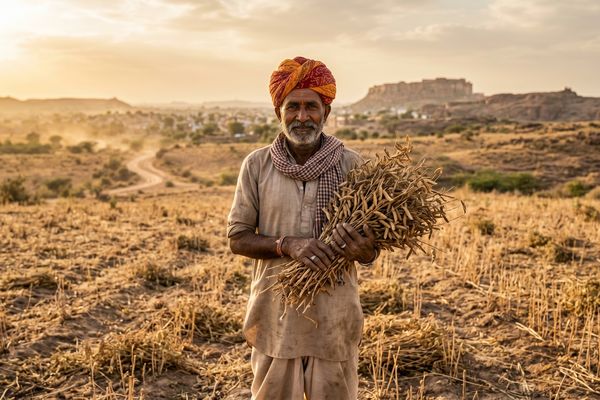
The structural driver is a decade of farmer disenchantment. After guar prices peaked near USD 3.66/kg in 2010–11 and later collapsed to lows around USD 0.32/kg, growers in key districts such as Mahendragarh, Hanumangarh, Jodhpur, Barmer, and Bikaner have switched acreage toward vegetables and millets. Many of those who still plant guar prefer selling green pods at attractive local prices instead of waiting for seed maturity, thinning seed availability further and reducing the effective harvest that reaches processors.
On the demand side, industrial consumption is still muted. Guar gum export volumes have been trending lower for years, squeezed by substitution in some food and oilfield applications and by price competition from alternative origins. Several processing units in Haryana’s Siwan belt have already shut down as low export volumes and weak gum prices made operations uneconomic, removing a segment of structural seed demand even as the supply base shrinks.
📊 Fundamentals & Market Structure
At present, market participation is heavily skewed toward stockists and speculative traders. Genuine consuming industries—food processors, oilfield service companies and textile users—are largely absent from the spot market, taking advantage of comfortable finished stocks and limited visibility on end-user demand. This creates a precarious setup: physical availability is thin, but the price discovery process is being driven mainly by financial players.
The current configuration closely resembles other agricultural markets where structural tightening preceded sharp price spikes, such as past episodes in coconut. With guar seed inventories low, little fresh supply on the near-term horizon, and export demand poised to normalise eventually, the market is setting up for potentially volatile upside once real buying interest resurfaces. A move toward at least EUR 0.78–0.80/kg (≈ USD 0.83/kg) in guar gum would not be surprising under a scenario of moderate demand recovery.
🌦 Weather & Regional Context
Weather is not an immediate driver for the current guar balance, since the 2025/26 crop is already harvested, but it will shape farmers’ planting decisions for the coming season. Western Rajasthan—including Jodhpur, Barmer and Bikaner—is currently under a heatwave regime, with maximum temperatures widely above 41–42°C and the India Meteorological Department flagging severe heat conditions and largely dry weather through at least late April.
Persistent early-season heat without meaningful pre-monsoon rainfall can further discourage moisture‑sensitive pulses and oilseeds, reinforcing the shift toward more resilient or remunerative crops. Unless kharif rains arrive on time and policy or price incentives change materially, there is little in the near-term weather outlook to entice farmers back into guar in a significant way.
📆 Short-Term Outlook & Risks
The near-term price outlook for guar seeds and gum is biased to the upside. With crop estimates locked at 33–34 lakh bags and visible stocks already lean, spot values are likely to remain firm, especially in Rajasthan and Gujarat mandis. The moderate contango between spot and futures suggests that the market is pricing incremental tightness but has not yet fully discounted a sharp demand rebound.
Upside risk is primarily tied to two triggers: a recovery in guar gum export orders from key food and industrial customers, and a fresh wave of buying from the oil and gas sector as hydraulic fracturing activity picks up globally. Either development would quickly translate into higher seed offtake, forcing stockists and processors to bid more aggressively for limited physical supplies. The main downside risk remains a prolonged period of weak export demand, which has weighed on the guar complex for over a decade and could cap rallies if macro conditions or substitution trends worsen.
💡 Trading & Procurement Strategy
- Industrial buyers (food, oil & gas, textiles): Consider covering a higher-than-usual share of Q2–Q3 2026 guar gum requirements at current EUR levels, given the asymmetric risk of a sharp rally once export orders normalise.
- Guar processors: Use any short‑lived price dips—such as the sharp corrections seen earlier in April—to incrementally rebuild seed inventories, focusing on quality lots in Jodhpur and Ahmedabad where liquidity is deepest.
- Producers and stockists: Avoid aggressive forward selling at today’s levels unless hedged on futures; the structural squeeze in seed, combined with heat‑stressed conditions in Rajasthan, favours a strategy of staggered sales.
- Speculative participants: Bias remains to the long side, but positions should be sized conservatively and protected with stops, given the thin underlying industrial participation and susceptibility to sharp, news‑driven corrections.
📍 3‑Day Regional Price Indication (Directional)
- Jodhpur (guar seed, physical): Stable to moderately firmer in the next 3 days, with local bids underpinned by tight arrivals.
- Ahmedabad (guar seed and gum): Slight upside bias as processors compete selectively for quality seed; limited downside absent a fresh negative demand shock.
- FOB India (guar gum exports): Flat to marginally higher in EUR terms; any uptick in overseas enquiries could quickly push offers above current EUR 4.10/kg levels.
[cmb_chart ids=221,220,221]