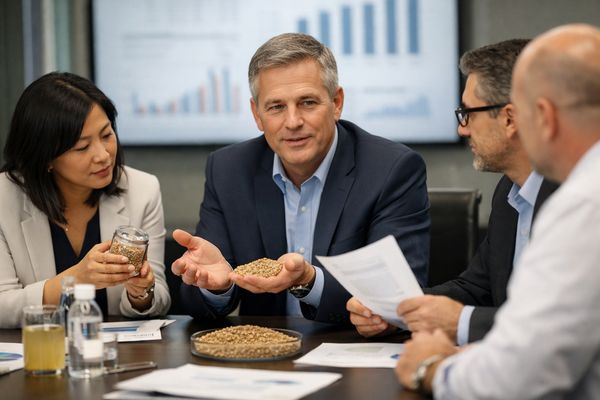
Guar seed prices are holding firm with a slight upward bias as industrial demand for guar gum strengthens, while verified physical-market data remain thin and highly localised. India’s dominant production role and the close link to global oilfield activity continue to anchor the market, with futures and gum prices signalling underlying support rather than a speculative spike.
The current publication provides only indicative grid prices for guar seeds and no editorial commentary, volumes or policy news, underlining how opaque this market still is. Nevertheless, guar’s role as a drought‑resistant legume in Rajasthan and Haryana, and its dependence on US oil and gas drilling and European food and industrial demand, place it squarely in the crosshairs of both weather and energy cycles. Recent futures and spot indications suggest mildly firmer levels in western India, while FOB guar gum prices in New Delhi and Hanoi remain stable, pointing to a balanced but fragile equilibrium in the guar complex.
Exclusive Offers on CMBroker

Guar gum
Powder
FOB 4.04 €/kg
(from VN)

Guar gum
Powder
FOB 4.10 €/kg
(from IN)
📈 Prices & Market Tone
Indicative grid quotes place guar seed around USD 47–50 per quintal at Delhi, though these figures are not corroborated by editorial market data and should be treated as approximate reference levels rather than firm benchmarks. Converting at roughly 1 USD = 0.93 EUR implies a broad range near EUR 44–47 per 100 kg, highlighting guar’s still relatively low absolute price compared with other specialty crops.
Fresh physical-market signals from western India point to a firmer tone: in Jodhpur and Ahmedabad, guar seed prices reportedly gained about INR 150 per quintal to roughly INR 5,750–5,800 per quintal in early May, equivalent to roughly EUR 63–64 per 100 kg at current exchange rates. At the same time, NCDEX guar seed and guar gum futures are trading near recent ranges, with guar gum May contracts around INR 11,200 per quintal, translating to approximately EUR 122 per 100 kg, consistent with stable FOB offers near EUR 4.1/kg for Indian guar gum powder.
| Product | Location / Contract | Indicative Price (EUR) | Unit |
|---|---|---|---|
| Guar seed | Delhi (grid quote, indicative) | ≈ 44–47 | per 100 kg |
| Guar seed | Jodhpur/Ahmedabad spot | ≈ 63–64 | per 100 kg |
| Guar gum powder (organic) | FOB New Delhi (IN) | ≈ 4.10 | per kg |
| Guar gum powder (organic) | FOB Hanoi (VN) | ≈ 4.04 | per kg |
🌍 Supply & Demand Drivers
India produces around 80% of the world’s guar, with Rajasthan and Haryana the key growing regions. The current edition offers no fresh data on arrivals, sown area or export volumes, but earlier-season indications pointed to modestly lower acreage and slower guar meal exports, which together limit downside potential in seed prices. As planting decisions for the next cycle approach, guar continues to compete with alternative kharif crops, making relative price performance versus pulses and oilseeds critical for future supply.
On the demand side, guar gum and splits remain heavily exposed to oilfield services, particularly US drilling activity, alongside steady structural demand from food processing and textiles. Recent commentary points to a recovery in industrial demand, with domestic guar gum prices in India up roughly INR 300 per quintal week‑on‑week in early May, while European and Asian buyers show renewed interest at current FOB levels. Feed and meal demand appears comparatively softer, suggesting the value chain is being pulled more by industrial than by feed uses at present.
📊 Fundamentals & Weather Outlook
Fundamental transparency for guar seeds remains low: today’s report does not provide verified stock levels, mandi arrivals or government policy changes. However, futures positioning and the firm basis between seed and gum indicate a relatively tight but not squeezed balance sheet. The spread between guar seed and guar gum margins remains attractive for processors, which should encourage steady crushing and support seed procurement at current levels.
Weather-wise, the India Meteorological Department projects above‑normal rainfall over India as a whole in May 2026, with normal to above‑normal rains expected across much of northwest India, including key guar areas in Rajasthan. Heatwave days in Rajasthan are forecast to be near or slightly below normal, suggesting limited immediate weather stress for soil moisture ahead of the monsoon. For a drought‑resistant crop like guar, this pattern is broadly neutral to slightly supportive, reducing near‑term production risk while leaving the main uncertainty tied to how the full monsoon season evolves.
📆 Trading & Procurement Outlook
- Producers (farmers): With seed prices firm and gum demand improving, there is little incentive to rush sales. Staggered selling into rallies, especially if futures test higher resistance levels, may capture better margins while managing stock risk.
- Processors & exporters: Stable FOB guar gum prices around EUR 4.0–4.1/kg and a healthy crush margin argue for maintaining active coverage of seed needs. Extending coverage modestly into early summer appears prudent, particularly for buyers exposed to oilfield and industrial contracts.
- Industrial buyers (oil & gas, food, textiles): The current equilibrium suggests limited downside in the near term. Securing a portion of Q3–Q4 needs now, while leaving some flexibility for monsoon‑driven corrections, can balance price risk and supply security.
📉 3‑Day Price Indication (EUR, Directional)
- Guar seed, Rajasthan/Haryana mandis: Bias slightly firmer to sideways, with local spot levels likely to hover near the recent EUR 60–65 per 100 kg equivalent, barring abrupt moves in futures.
- Guar gum FOB New Delhi: Expected to trade sideways around EUR 4.1/kg as export and domestic demand are broadly balanced.
- Guar gum FOB Hanoi: Also seen sideways near EUR 4.0/kg, tracking Indian values with only minor regional basis adjustments.