
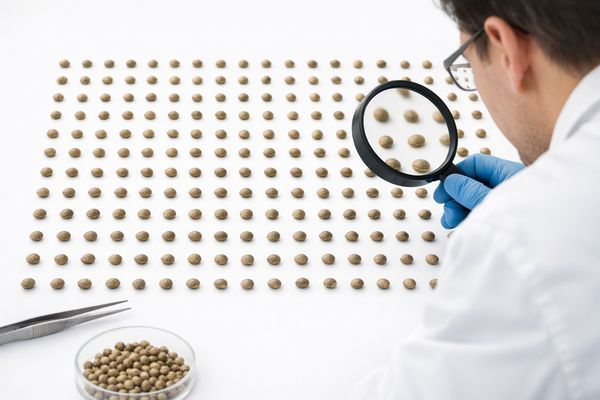
Hempseed prices for hulled material delivered to Dordrecht remain flat this week, with only a narrow premium for organic Chinese origin over conventional French seed. The market is balanced, and short‑term price risk is limited while planting and early‑season weather in China and France still pose medium‑term uncertainties.
European demand for hulled hempseed in food and health segments continues to grow steadily, but without the strong shocks seen in other oilseeds. Current wholesale benchmarks for French hempseed put export parity well above basic farm prices, supporting today’s Dordrecht indications but leaving little room for upside without a clear supply disruption. In this context, buyers are focused on timing: covering nearby needs on weakness while remaining cautious with forward commitments until more is known about the 2026 harvest potential in both China and France.
[cmb_offer ids=1111,1109,1111]
📈 Prices & Spreads
Hulled hempseed prices FCA Dordrecht are unchanged versus the previous assessment, with a tight spread between French conventional and Chinese organic origins. French hulled hempseed trades around the mid‑single‑digit EUR/kg level FCA, in line with broader French hempseed wholesale indications converted from recent USD benchmarks. This keeps export parity competitive within the European food ingredient chain while still reflecting processing and certification costs.
Organic hulled hempseed of Chinese origin maintains a modest premium over French conventional material, consistent with the broader European pattern where organic-certified hulled seeds command higher prices in specialty channels. Retail and food‑service offers for organic hulled seeds across Europe currently cluster in the low‑ to mid‑20s EUR/kg for packed product, implying that today’s FCA bulk levels still leave reasonable downstream margins.
| Origin | Product | Location / Term | Current level (EUR/kg) | 1‑month trend |
|---|---|---|---|---|
| France | Hempseed, hulled, conventional | Dordrecht, FCA | ≈5.37 | Stable after small dip in late March |
| China | Hempseed, hulled, organic | Dordrecht, FCA | ≈5.45 | Flat over past month |
🌍 Supply & Demand Drivers
On the demand side, the global hulled hempseed segment is projected to keep expanding at a mid‑single‑digit annual growth rate through the next decade, driven by plant‑protein, bakery and health food applications. Europe’s role as a key premium market remains intact, with buyers increasingly specifying organic and traceable supply but still price‑sensitive in the current macro environment.
Supply from France is underpinned by a generally supportive environment for oilseeds, as seen in this season’s higher rapeseed plantings encouraged by relatively attractive oilseed pricing. While hemp is a niche crop compared with rapeseed and cereals, similar agronomic conditions and farmer economics mean the country is unlikely to see a sharp contraction in hemp area in 2026 absent regulatory shocks. Chinese supply continues to dominate parts of the global hemp complex, especially fiber and grain flows to Asia, though near‑term data for seed export volumes is limited; trade statistics show China maintains a strong overall position in hemp‑related exports to multiple regions.
🌦 Weather & Crop Outlook (FR & CN)
For France, early‑spring conditions in major field‑crop regions have generally been described as favorable for winter crops, supporting stable soil moisture and emergence for spring‑sown oilseeds and specialty crops such as hemp. No acute short‑term weather threats have emerged in the last few days that would justify a weather‑premium in hempseed prices, though localized rainfall deficits or cold snaps could still influence stand establishment in coming weeks.
In China, research on recent seasons highlights the vulnerability of North China Plain crops to compound heat‑and‑drought events in late spring and early summer, which sharply reduced vegetation activity in 2024 under high vapor‑pressure deficits. While this work focuses on wheat–maize systems, hemp in northern Chinese provinces shares similar exposure during early establishment. For now, there are no fresh reports of a comparable event in April 2026, but weather‑risk for summer remains a key uncertainty for the 2026 hempseed supply outlook.
📊 Fundamentals & Market Structure
Structurally, Europe’s hempseed market is characterized by a growing share of value‑added processing (dehulling, protein concentration, cold‑pressed oils), with integrated processors using multi‑tonne per month lines to stabilize raw‑material costs and secure supply for both R&D and commercial runs. This integration tends to smooth spot price volatility, which aligns with the currently flat Dordrecht price curve for hulled seeds.
Forecasts for the EU hempseed sector indicate continued expansion in production and trade volumes, albeit from a low base compared with major oilseeds. At the same time, regulatory debates—such as proposals to adjust THC thresholds for industrial hemp—could further influence varietal choices and area allocation, but no immediate rule changes have been enacted in the last three days that would impact near‑term seed pricing.
📆 Trading Outlook & 3‑Day Price Indication
Trading recommendations
- Buyers with nearby Q2 needs can continue hand‑to‑mouth coverage at current Dordrecht levels; flat prices and balanced fundamentals argue against aggressive forward buying.
- For organic programs, the small premium on Chinese origin vs French conventional hulled seed remains acceptable; consider blend strategies to reduce average raw‑material cost while meeting label requirements.
- Sellers should lock in volumes where margins are satisfactory but avoid heavy discounting; absent new weather or policy shocks, downside appears limited in the immediate term.
3‑day regional price indication (directional)
- FR origin → Dordrecht (FCA, hulled conventional): around 5.37 EUR/kg, expected stable over the next 3 days, with a very narrow range and no clear trigger for movement.
- CN origin → Dordrecht (FCA, hulled organic): around 5.45 EUR/kg, expected stable to slightly firm, as steady organic demand supports a small premium but without strong upward momentum.
[cmb_chart ids=1111,1109,1111]
Related posts:
 French Rapeseed Flat as Market Watches Weather and Black Sea Flows
 Ukrainian Sunflower Prices Hold Firm as Crushers Compete for Tight Seed Supply
 Ukrainian Flaxseed Edges Higher as EU Buyers Seek Non‑Russian Supply
 Sunflower Market: SAFEX Futures Firm as Black Sea Seeds Hold Steady
 Kazakh and Russian Linseed Hold Steady as EU Duties Reshape Flows
 Hulled Hempseed Prices Hold Steady as CN Organic Premiums Persist
 Ukrainian Flaxseed Prices Hold Steady as EU Demand Supports Exports
 Czech Poppy Seeds Ease Lower as Buyers Stay Cautious