
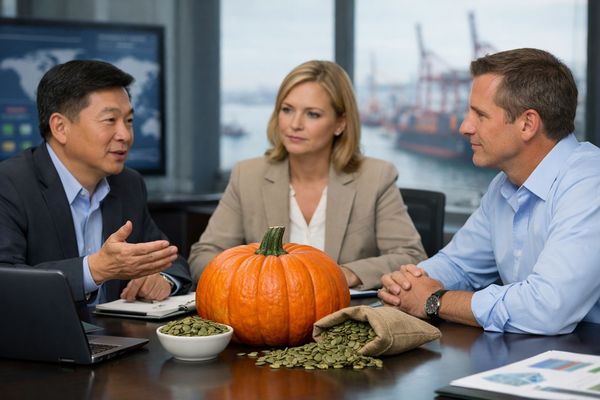
Escalating conflict around the Strait of Hormuz and renewed threats to Red Sea shipping are tightening costs and risks across China’s agri‑food export chains. For pumpkin seed exporters, already facing cautious demand, the crisis is extending transit times, raising freight and insurance costs, and delaying payments from key Middle Eastern buyers, even as FOB prices in Beijing and Dalian drift only modestly higher.
The worsening security situation in the Persian Gulf and adjacent waters has culminated in an effective closure of the Strait of Hormuz to normal commercial traffic, following Iranian moves to restrict transit and a US‑led naval blockade announced on 13 April 2026. Hormuz is a critical chokepoint not only for oil and LNG but also for fertilizer flows and containerized cargo moving between the Gulf and Asia. Simultaneously, shipping lines are again diverting away from the Red Sea/Suez corridor amid renewed Houthi threats, recreating a high‑cost, high‑uncertainty environment for east–west trade.
🌍 Immediate Market Impact
For China, the Middle East conflict is now a logistics rather than a physical supply shock for specialty crops like pumpkin seeds. Gulf ports that normally act as transshipment hubs for food and containerized cargo are operating with severe constraints, while most major container carriers have implemented full diversions around southern Africa or are using alternative hubs outside the conflict zone. This is extending voyage times by several weeks on some Asia–MENA routes and pushing up bunker, insurance and risk surcharges per container.
Higher oil prices linked to the Hormuz disruption are feeding into ocean freight and inland transport costs worldwide and, according to FAO analysis, are also supportive for biofuel feedstock prices as refiners maximize ethanol and biodiesel output. For Chinese pumpkin seed exporters, this means higher delivered costs into Middle Eastern markets and greater difficulty closing deals on price‑sensitive small lots, even as current FOB offers for shine-skin and GWS kernels from Beijing and Dalian show only incremental increases of a few cents over late March.
📦 Supply Chain Disruptions
Containerized food cargoes that previously moved via Gulf and Red Sea gateways are now being rerouted via alternative ports and longer sea lanes. Industry situation reports highlight that the key question for shippers has shifted from whether cargo can enter the region to which gateway it can use and at what additional cost. Emergency conflict, fuel and deviation surcharges from major carriers such as MSC, Maersk, Hapag‑Lloyd and CMA CGM are adding hundreds of dollars per TEU on Middle East‑linked trades.
For Chinese origin pumpkin seeds, this translates into several concrete disruptions: longer transit times and less reliable schedules for shipments to Gulf buyers; tighter container availability during peak periods as carriers reposition vessels away from the conflict zone; and more complex routing and documentation for cargoes that must avoid sanctioned or high‑risk waters. Smaller exporters and trade houses report that many export enquiries from the Middle East have shifted to small‑lot, just‑in‑time purchases, with buyers hesitant to commit to larger volumes amid logistics uncertainty and elevated freight.
📊 Commodities Potentially Affected
- Pumpkin seed kernels (China origin): Core impact via higher freight, insurance and transit times on shipments to the Middle East and North Africa, dampening new export orders and keeping trade focused on inventory liquidation and small replenishment deals.
- Oilseeds and vegetable oils (soybean, rapeseed, sunflower, palm): Biofuel‑driven demand support from higher energy prices, plus higher freight on Black Sea/Middle East–Asia routes, may indirectly firm international price benchmarks, influencing nut and seed price expectations.
- Fertilizers (urea, ammonium nitrate, phosphates): Around one‑third of global fertilizer trade typically transits Hormuz; current disruptions risk higher input costs for growers downstream, affecting planted area and yield decisions for oilseed and snack crop rotations in coming seasons.
- Containerized food and feed ingredients: Broad cost inflation and schedule risk on all Asia–Middle East lanes, with potential spillovers into freight benchmarks used for pricing routes from North China ports.
🌎 Regional Trade Implications
For Chinese exporters, the immediate effect is a relative erosion of competitiveness into the Gulf and Eastern Mediterranean where freight inflation and transit risk are most acute. Logistics bulletins focused on China note steep spot rate increases from Shanghai and North China to Middle East ports since late February, alongside the introduction of emergency conflict surcharges and extended transit times as carriers avoid the Gulf and Red Sea.
Some Chinese trade houses are responding by pivoting incremental pumpkin seed volumes toward Europe and East/Southeast Asia, where routing via non‑Gulf hubs remains more predictable and insurance premia lower, while treating Middle Eastern business primarily as an opportunity to liquidate existing inventories. At the same time, alternative suppliers closer to end‑markets or with overland access routes – for example, Central and Eastern European seed exporters supplying parts of MENA by truck or short‑sea – may capture niche demand where buyers prioritize logistics reliability over origin.
🧭 Market Outlook
In the short term, the conflict‑driven logistics shock reinforces a two‑speed pumpkin seed market for China: stable to slightly firmer FOB prices at origin, supported by higher freight and elevated energy costs, versus subdued end‑user demand and slow inventory drawdown in key import regions. With Hormuz shipping still severely constrained and Red Sea risk back in focus, traders should assume continued schedule volatility and premium freight into at least early Q3 unless there is a durable de‑escalation.
Traders and industrial users will closely monitor: the duration and enforcement intensity of the Hormuz blockade; any carrier moves to further adjust routings or surcharges on China–Middle East lanes; shifts in biofuel economics as oil prices respond to supply disruptions; and fertilizer price trajectories that could influence the 2026/27 planting decisions for oilseeds and snack crops. In this environment, contract structures with flexible shipment windows, freight adjustment clauses and diversified routing options will be at a premium.
CMB Market Insight
The current Middle East security crisis is primarily a freight and financial‑term shock rather than a direct supply shock for China’s pumpkin seed sector, but its strategic significance should not be underestimated. By simultaneously lifting ocean transport costs, lengthening transit times and complicating risk management around sanctions and insurance, it narrows margins and raises working‑capital demands across the export chain.
For now, origin prices for Chinese pumpkin seed kernels are adjusting only gradually, reflecting balanced but cautious domestic supply–demand, while the main squeeze is occurring in delivered‑CFR economics into the Gulf and nearby markets. Exporters and buyers who proactively hedge freight exposure, diversify destination portfolios away from the most exposed corridors, and build in longer lead times for shipment and payment will be best positioned to navigate the next phase of this conflict‑driven market.
Related posts:
 Sunflower Market Steady to Firm as Black Sea Logistics Tighten
 Strait of Hormuz War Escalation and US Blockade Threat Jolt Global Oil and Product Markets
 China Pumpkin Seed Kernels: FOB Prices Ease While Freight Stays Elevated
 Middle East Escalation and Hormuz Closure Tighten Global Food and Sunflower Trade Routes
 Iran War, Strait of Hormuz Controls and Red Sea Risks Add New Layer of Tension to Sunflower Trade Into China
 Middle East Conflict and Hormuz Closure Tighten Logistics, Pressure China’s Pumpkin Seed Export Chain
 Chinese Pumpkin Seed Kernels Hold Firm as Freight Squeezes Margins