
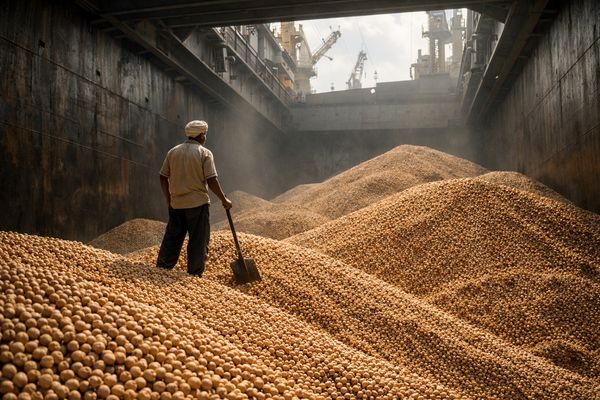
Indian chickpea prices in New Delhi are broadly steady in EUR terms after early‑April volatility, with premium 12 mm lots near the upper end of the recent range and smaller calibres holding a modest discount. Firm domestic demand and expectations of only gradual selling during the ongoing rabi harvest are keeping a floor under the market, while exporters watch summer weather and policy signals for the next move.
A sharp transition to hotter, drier conditions across much of India is under way this week, with the India Meteorological Department (IMD) flagging a steady rise in temperatures across central and western regions and emerging heatwave risk in Maharashtra and parts of central India. While this does not immediately threaten the freshly harvested rabi chickpea crop, it could disrupt late harvesting, transport and storage logistics if heat intensifies. In the short term, prices in New Delhi are expected to remain range‑bound with a mild upward bias in EUR terms, supported by solid domestic consumption and cautious farmer selling.
Exclusive Offers on CMBroker

Chickpeas dried
count 60-62, 8 mm
FOB 0.87 €/kg
(from IN)

Chickpeas dried
count 42-44, 12 mm
FOB 1.20 €/kg
(from MX)

Chickpeas dried
count 75-80, 8 mm
FOB 0.79 €/kg
(from MX)
📈 Prices & Recent Moves
Using an indicative rate of 1 EUR = 90 INR and current FOB/FCA quotes converted from USD-equivalent levels, New Delhi chickpea export offers sit roughly in the following bands:
| Origin / Grade | Location & Terms | Calibre | Latest Price (EUR/kg) | WoW Change* |
|---|---|---|---|---|
| India Desi Chickpeas | New Delhi, FOB | 42–44 count, 12 mm | ≈ EUR 0.89 | Flat vs 11 April |
| India Desi Chickpeas | New Delhi, FOB | 44–46 count, 11 mm | ≈ EUR 0.86 | Flat vs 11 April |
| India Desi Chickpeas | New Delhi, FOB | 46–48 count, 10 mm | ≈ EUR 0.83 | Flat vs 11 April |
| India Desi Chickpeas | New Delhi, FOB | 58–60 & 60–62 count, 8–9 mm | ≈ EUR 0.78–0.81 | Flat vs 11 April |
*Week‑on‑week change refers to movements between 4–11 April 2026.
Indian FCA offers for similar grades in New Delhi show a mild firming versus early April, consistent with recovering sentiment after a brief correction in the first week of the month. Converted to EUR, FCA levels for 12 mm material are now only marginally below FOB, implying limited room for further downside unless arrivals surprise on the upside. Mexican chickpea offers remain at a premium to Indian origin in EUR/kg terms, but that spread has been broadly stable over the last 10 days, suggesting no immediate arbitrage shock from the Americas.
🌍 Supply, Demand & Trade Flows
The Indian rabi chickpea (chana) harvest is progressing, and trade commentary in recent weeks points to expectations of a reasonably good domestic crop for marketing year 2025/26, reducing the need for very large imports compared with earlier years. At the same time, India has been diversifying pulse import sources, including higher volumes of peas and chickpeas from Russia, helping to stabilise overall pulse availability and temper extreme spikes in domestic prices.
Government policy remains an important swing factor. Stock limits and subsidised distribution programmes in prior seasons showed that authorities are ready to intervene in the chana market to contain retail inflation. With food inflation still a policy concern, the market is assuming that aggressive price rallies will meet resistance through faster public stock releases or import facilitation, which is one reason current New Delhi prices are consolidating rather than surging.
🌦 Weather Outlook – Key Growing States (India)
IMD and media reports signal a rapid warming trend and emerging heat stress in central and western India. Nationwide, temperatures are forecast to rise steadily through this week following a brief cooler spell, pushing much of the country into early peak‑summer conditions. In Maharashtra, the IMD expects a 2–3°C rise in maximum temperatures up to Friday 17 April, with heatwave conditions likely in parts of the state and daytime highs already above 40°C in several districts.
For Madhya Pradesh, an IMD-linked outlook points to strongly rising early‑morning and daytime temperatures and the risk of below‑normal southwest monsoon rainfall during June–September, though that monsoon guidance is still long‑range. In the near term (next week), central India is expected to remain largely hot and dry, with heatwave watches extending over parts of Madhya Pradesh and neighbouring regions from around 16–18 April. For the freshly harvested chickpea crop, this pattern is neutral‑to‑slightly supportive for prices: it avoids harvest‑time rain damage but raises risks for storage and transport quality if cooling and ventilation are inadequate.
📊 Market Fundamentals & Price Drivers
- Harvest & Arrivals: The ongoing rabi harvest and arrivals into mandis are providing physical liquidity, but farmer selling is described as measured rather than aggressive, which supports current EUR‑denominated prices in New Delhi.
- Policy & Inflation: With pulses a key part of India’s food inflation basket, prior experience with stock limits and subsidised chana distribution suggests government is likely to cap sharp price spikes through policy tools, containing upside risk.
- Import Mix: Increased imports of peas and chickpeas from Russia and steady but lower‑than‑peak demand for Australian chickpeas next season point to more diversified supply channels, reducing extreme tightness in the Indian market.
- Macro & FX: Higher domestic fuel prices and freight costs, alongside a relatively stable INR/EUR, mean exporters may seek slight nominal price increases to protect margins rather than discounting heavily in EUR terms.
- Weather: Intensifying heat across Maharashtra, Madhya Pradesh and Rajasthan raises operational risks (shrinkage, quality loss) but, in the absence of rain, does not yet threaten production, so it is a secondary, not primary, price driver in mid‑April.
📆 3-Day Price Outlook (India, New Delhi)
- India FOB New Delhi – 12 mm (42–44 count): Expected to trade broadly steady around ≈ EUR 0.89/kg over the next three days, with a slight upward bias if local demand stays firm.
- India FOB New Delhi – 10–11 mm: Likely to remain in a narrow range around ≈ EUR 0.83–0.86/kg, closely tracking domestic mandi sentiment and export enquiry.
- India FOB New Delhi – 8–9 mm: Discount to large calibres should hold near current levels, with prices seen stable around ≈ EUR 0.78–0.81/kg barring any sudden policy headlines.
💡 Trading Outlook & Recommendations
- Importers (EU/Middle East): Consider staggered coverage at current EUR levels for May–June shipment from India, as firm domestic demand and rising summer heat argue against a deep price correction in the very short term.
- Indian Exporters: Use current stability to lock in forward sales where workable; monitor IMD updates and any new stock or import policy announcements that could quickly alter margins.
- Domestic Buyers (India): For near‑term physical needs, leaning slightly into purchases now reduces the risk of weather‑related logistics premiums later in April if heatwaves intensify.