
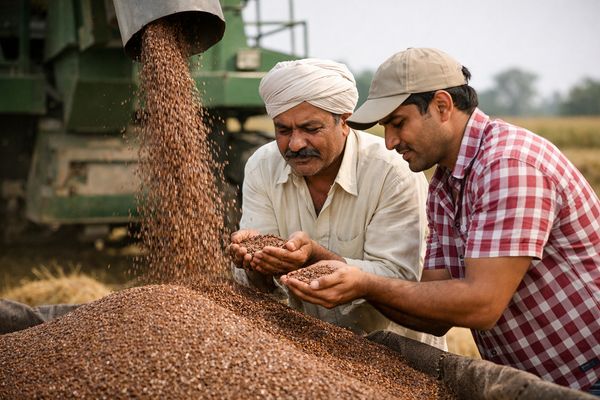
Indian flaxseed prices are holding broadly steady, with only slight firming on export offers, as ample Black Sea and Canadian supply keeps a lid on any sharp upside. Very hot but seasonally normal weather in North India and stable logistics mean no immediate weather premium is priced in.
Indian flaxseed sits in a narrow range, with domestic FCA New Delhi values broadly unchanged and FOB export offers edging only marginally higher over recent weeks. Overseas competition from Ukraine and Canada remains strong, but also relatively stable, keeping import and export parity tight. At the same time, vegetable oil markets in the Black Sea and Russia show robust export flows for linseed and other oils, signaling comfortable seed availability and preventing any sudden rally for linseed in the short term. For now, the market is mainly driven by crush margins, freight, and currency rather than fundamentals shocks.
Exclusive Offers on CMBroker

Flax seeds brown
brown
99.9%
FCA 0.89 €/kg
(from IN)

Flax seeds brown
brown
99,95%
FCA 0.70 €/kg
(from PL)

Flax seeds brown
brown
98%
FCA 0.66 €/kg
(from UA)
📈 Prices & Spreads
All prices below are approximate and converted to EUR for comparability.
| Origin / Location | Spec (brown, non-organic) | Term | Latest price (EUR/kg) | 1-week change |
|---|---|---|---|---|
| India, New Delhi (IN) | 99.9% purity | FCA | ≈0.89 | Stable w/w |
| India, New Delhi (IN) | 99.9% purity | FOB | ≈0.92 | +1–2% over mid-April |
| Ukraine → Poland (PL) | 99.95% purity | FCA | ≈0.70 | Down vs. late April |
| Ukraine, Kyiv/Odesa (UA) | 98% purity | FCA | ≈0.66 | Stable m/m |
| Ukraine → Germany (DE) | 99.95% purity | FCA | ≈0.78 | Modest uptick d/d |
| Canada, Ottawa (CA) | 97% organic | FOB | ≈1.43 | Stable m/m |
- Indian FCA New Delhi flaxseed is trading at a small discount to FOB export offers, reflecting inland freight and handling costs.
- Black Sea-origin flax remains clearly cheaper than Indian or Canadian product, keeping a cap on any Indian export price ambitions.
- Organic supplies from Canada and Kazakhstan command a significant premium, but this segment is niche and does not set the base market.
🌍 Supply, Trade Flows & External Drivers
Ukraine’s broader agri exports accelerated in April, with total agri‑food shipments reported around 5.7 million tonnes, underlining that the corridor and land routes are functioning despite the war. While flax is a small component relative to grains and sunflower, the overall export strength suggests no major bottlenecks for oilseeds and niche crops like linseed.
At the same time, Russia has significantly increased vegetable oil exports this year, with linseed oil exports reported to have risen multiple times year‑on‑year as part of a broader surge in vegoil shipments. This points to comfortable linseed availability in the wider Black Sea region and contributes to a bearish undertone for seed values globally.
Canadian flaxseed and flaxseed oil remain a structural supply pillar for premium and organic segments. Recent trade intelligence highlights Canada’s positioning as a major exporter into health‑oriented and specialty markets, which helps anchor medium‑term supply confidence for importers in Asia, including India. For Indian crushers and traders, this means external replacement cost for high‑quality seed and oil is well‑defined and not under immediate upward pressure.
🌦 Weather & Crop Conditions (India – Region Focus: IN)
In New Delhi and surrounding North Indian plains, the next three days are forecast to remain very warm to hot, with highs around 39–40°C on 2–3 May and only a slight easing to mid‑30s by 4 May. Some isolated afternoon thunderstorms are possible but do not yet signal the onset of a widespread monsoon pattern.
For flax, which is often grown as a rabi crop in cooler months in parts of India, these early‑May temperatures are seasonally high but not abnormal. With harvest for most plantings largely completed, near‑term weather in North India is more relevant for storage conditions and logistics than for yield. The current forecast therefore does not justify any weather risk premium on Indian flaxseed prices.
📊 Fundamentals & Market Sentiment
- Stocks & Availability: Strong Black Sea and Russian vegoil exports, including linseed oil, imply no acute shortage of raw seed.
- Crush Margins: Higher‑value linseed oil markets (health foods, specialty oils) offer a modest buffer for crushers, but there is no sign of explosive demand that would bid aggressively for seed.
- Logistics & Geopolitics: Despite ongoing war‑related risks and reports of stolen grain flows from occupied territories, Black Sea export channels remain active, and freight to Asia stays competitive.
- India Demand: Domestic consumption for food, bakery and health applications is gradually expanding, but official trade data and anecdotal exporter feedback indicate a fragmented market with growing interest rather than tightness.
📆 3-Day Price Outlook (Region: IN, New Delhi)
- Spot FCA New Delhi (non-organic, 99.9%): Sideways; expected to trade around ≈0.89 EUR/kg over the next three days, with a very narrow ±0.01 EUR/kg band, assuming stable INR/EUR and freight.
- FOB West Coast/Port from North India: Slightly firm tone but largely range‑bound near ≈0.92 EUR/kg for standard quality; any move above this level is likely to be capped by cheaper Black Sea offers.
- Basis vs. Black Sea: Indian origin is likely to retain a premium of roughly 0.20–0.25 EUR/kg over Ukrainian FCA values, reflecting quality perception and longer haul, with no major change by 5 May.
💡 Trading Outlook & Strategy
- Indian crushers & domestic buyers: With local prices flat and external supply comfortable, hand‑to‑mouth coverage for 1–2 months appears adequate. Consider using any short‑term dips from currency moves to extend coverage modestly rather than chase rallies.
- Exporters from India: Maintain competitive FOB offers but be cautious about over‑committing volumes at aggressive fixed prices; Black Sea competition remains intense, and buyers can easily switch origins.
- Importers in Asia/MENA: Ukrainian and Russian‑linked supply offers attractive pricing but carry geopolitical and sanctions‑related risks. Indian origin offers a diversification option at a premium that may be worth paying for buyers sensitive to traceability and compliance.
Overall, the flaxseed market entering early May 2026 is balanced to slightly oversupplied on the global side, with Indian prices steady and closely tied to developments in Black Sea exports, vegoil values, and currency moves rather than domestic weather shocks.
Related posts:
 Black Sea Sunflower Prices Edge Higher on Tight Seed and Oil Supply
 Ukrainian Flax Prices Hold Firm as Black Sea Risks Remain Elevated
 Flaxseed Prices Hold Steady as India Firms and Canada Eyes Easier EU Access
 Sunflower Market Steady as SAFEX Firms and Black Sea Prices Hold Range
 Sunflower Market Steady as SAFEX Firms and Black Sea Prices Hold Range
 Sunflower Market: SAFEX Softens While Black Sea Cash Values Stay Firm
 Sunflower Market Softens on SAFEX While Black Sea Offers Hold Steady
 Brown flaxseed prices ease slightly as India undercuts Canada and Kazakhstan