
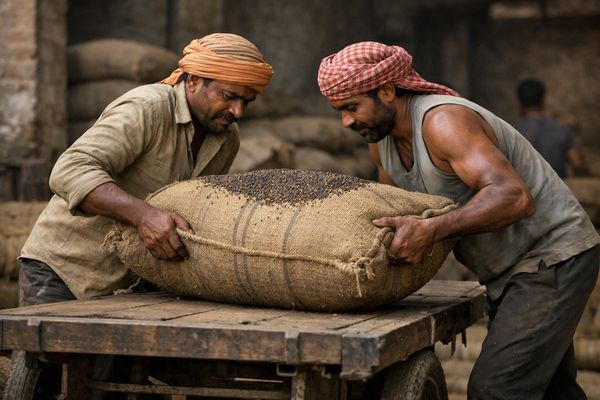
Indian mustard seed export prices from New Delhi have edged slightly lower week‑on‑week as new crop arrivals build, but the overall tone remains orderly with no sign of a sharp sell‑off. Hot, dry weather now returning across key growing states supports quality and harvest progress, limiting immediate downside.
Physical markets in North and Central India are transitioning from peak arrivals to a more balanced flow, while hot summer conditions and firm mustard oil demand provide a floor. With futures liquidity on NCDEX constrained and MSP still above many mandi bids, farmers are showing only selective selling at current levels. For exporters, the next few days look broadly stable with a mild soft bias for lower grades.
Exclusive Offers on CMBroker

Mustard seeds
yellow, micro, sortex
99.95%
FOB 0.89 €/kg
(from IN)

Mustard seeds
yellow, bold, sortex
99.95%
FOB 0.99 €/kg
(from IN)

Mustard seeds
brown, micro, sortex
FOB 0.79 €/kg
(from IN)
📈 Prices & Recent Moves
FOB New Delhi export offers for conventional mustard seed (non‑organic, 99.95% where specified) as of 11 April 2026 show a marginal easing versus early April, driven mainly by heavier new‑crop flows rather than demand weakness. Based on the latest quotations and an approximate INR/EUR conversion, current levels can be summarised as:
| Type (IN, New Delhi) | Delivery | Current price (EUR/t) | WoW change (EUR/t) |
|---|---|---|---|
| Yellow, micro, sortex, 99.95% | FOB | ~€880 | ≈ -€10 |
| Yellow, bold, sortex, 99.95% | FOB | ~€980 | ≈ -€10 |
| Brown, micro, sortex | FOB | ~€810 | ≈ -€10 |
| Brown, bold, sortex, 99.95% | FOB | ~€720 | ≈ -€10 |
Domestic mandi prices in producing states like Madhya Pradesh and Rajasthan are reported broadly steady to slightly firmer in early April, with all‑India assessments highlighting a stable to gently rising trend and advisory to stagger sales in expectation of potentially higher prices later.
🌍 Supply, Demand & Policy Drivers
New crop mustard arrivals are now well advanced across Rajasthan and neighbouring states, and recent reports from export brokers indicate that the modest FOB weakness is tied mainly to the seasonal bulge in physical supplies rather than any structural demand loss. At the same time, India’s edible oil complex remains underpinned by robust household demand and high import dependence, so domestic crushers continue to compete for seed.
On the demand side, mustard oil consumption stays resilient, with retail prices described as elevated across parts of eastern and central India amid broader edible‑oil inflation. Meanwhile, the earlier suspension of rapeseed–mustard futures trading on NCDEX has kept more trade interest in the spot and physical segments, reinforcing the role of mandi and export‑parity pricing. Farmers are also comparing private bids with the government’s MSP, encouraging them to release stocks only gradually where local prices lag the support level.
🌦️ Weather Outlook in Key Indian Regions
Weather conditions over the next few days are turning decisively hotter and drier in much of North and Central India. IMD‑linked forecasts highlight a sharp rise in daytime temperatures from 13–15 April, with clear skies and 40–42°C expected over parts of Rajasthan, Madhya Pradesh and adjoining states, while most of the country remains dry. Rajasthan is already seeing maximums in the upper‑30s and is forecast to edge toward or above 40°C under a renewed dry spell.
For mustard, the immediate harvest window is largely over, so these hot, dry conditions mainly aid rapid curing and movement of seed rather than threatening yield. Short‑term weather, therefore, is mildly bearish for quality‑sensitive buyers (more uniform seed, lower moisture) but broadly neutral for overall supply. No rain‑related harvest disruption is expected in the next 3–5 days in the main mustard belt.
📊 Market Balance & Price Implications
With arrivals still seasonally heavy but no major weather or policy shock on the horizon, the Indian mustard seed market appears near short‑term equilibrium. Export commentary notes that global vegoil markets are monitoring India’s pricing versus imported oils, but current FOB levels are seen as competitive enough to keep a steady export flow without needing aggressive discounts.
Given strong domestic edible oil demand and the MSP floor, meaningful downside in seed prices looks limited unless there is a clear slide in international vegoil benchmarks or a sudden slowdown in crushing margins. At the same time, the absence of active mustard futures on NCDEX reduces speculative swings, leading to a more fundamentals‑driven, gradual price path in spot markets.
📆 3‑Day Price Outlook (FOB New Delhi, EUR)
- Yellow, micro, sortex (99.95%): Sideways to slightly softer, expected in a ~€870–885/t range as export interest remains steady but new‑crop availability is ample.
- Yellow, bold, sortex (99.95%): Stable to marginally weaker, seen around ~€970–990/t; limited buyer urgency but no aggressive offers from sellers.
- Brown, micro & bold, sortex: Sideways to mildly soft bias, roughly ~€705–825/t, tracking relative discounts to yellow seed and domestic mandi indications.
🧭 Trading Outlook & Strategy Hints
- Exporters / Traders: Use any intra‑week dips from heavy arrivals to secure coverage for nearby shipments; basis risk is modest with stable domestic demand and dry weather aiding movement.
- Crushers: Maintain staggered procurement rather than front‑loading purchases, but avoid becoming under‑covered given the support from mustard oil prices and MSP.
- Buyers Overseas: Short‑term, consider incremental buying on a spot‑plus‑one‑month basis; the risk of a sharp downside break appears low without a broader vegoil correction.