
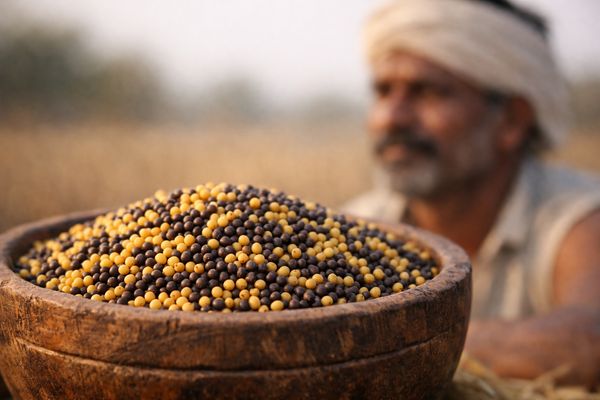
Indian mustard seed export offers out of New Delhi are broadly steady to softer, with brown types under mild pressure and yellow grades holding firm. A record-sized 2025‑26 crop and comfortable mandi arrivals are capping upside, while an emerging April heatwave in Rajasthan and North India has not yet translated into weather‑related supply risk.
Indian spot and export markets are digesting a fundamentally well-supplied balance sheet at the start of the new marketing year. Domestic mandi prices are hovering only modestly above the minimum support price, indicating crushers are well covered and farmers continue to sell into strength rather than hold back. At the same time, IMD forecasts point to several days of intense heat across Rajasthan, Uttar Pradesh and other northern states, which could accelerate stock off‑take from farms and warehouses but is unlikely to damage an already harvested crop. Near-term price action should therefore remain range-bound with a slight downward bias for brown mustard.
[cmb_offer ids=255,254,252]
📈 Prices & Market Tone
Export offers from New Delhi (FOB, conventional, 99.95% purity where specified) converted to EUR are approximately:
| Type | Spec / Terms | Latest Price (EUR/kg) | 1W Change |
|---|---|---|---|
| Yellow, micro, sortex | FOB New Delhi | ≈ 0.81 | Flat vs 12 Apr |
| Yellow, bold, sortex | FOB New Delhi | ≈ 0.90 | Flat vs 12 Apr |
| Brown, bold, sortex | FOB New Delhi | ≈ 0.63 | Down ~4% w/w |
| Brown, micro, sortex | FOB New Delhi | ≈ 0.71 | Down ~4% w/w |
Indicative domestic wholesale prices in key mandis are close to the all‑India average around ₹6,150/quintal (≈ EUR 0.76/kg), only slightly above the MSP, reflecting a bearish but orderly market as new-crop pressure weighs on values. Yellow seed retains a premium over brown amid steadier export and crushing demand, while FCA indications in New Delhi track a similar structure but at slightly lower levels reflecting inland logistics.
🌍 Supply, Demand & Policy Drivers
Acreage and production for India’s 2025‑26 rapeseed–mustard crop are estimated higher year-on-year, with trade sources pointing to a roughly 4% increase in sown area and near-record output that is keeping arrivals strong into April. Stock data from NCDEX-linked warehouses in Rajasthan confirm comfortable rapeseed–mustard inventories as of mid‑April, underlining ample nearby availability for crushers and exporters.
On the policy side, the central government has already signalled a willingness to authorise record procurement of oilseeds, including mustard, under the Price Support Scheme for the 2025‑26 rabi marketing season to underpin farm incomes and support oilseed self-sufficiency. This backstop at MSP is limiting downside in domestic prices but has not been aggressive enough yet to trigger a significant rally, given the scale of the crop and still-easy private buying.
Edible oil demand remains firm but is being met largely through a combination of domestic oilseed crushing and continued imports of palm, soy and sunflower oil under an extended low-duty structure. As a result, mustard oil’s share in consumer blends is supported, yet the channel is not tight enough to force seed prices sharply higher. Overall, fundamentals point to a soft, carry-heavy balance sheet through at least early Q3 2026.
🌦️ Weather Snapshot – North India (Rajasthan, Delhi, UP)
The India Meteorological Department (IMD) has issued a heatwave alert for large parts of North and Central India through at least 23 April, with East and West Rajasthan, Uttar Pradesh and neighbouring states expected to see maximum temperatures well above normal. Daily bulletins highlight severe heat stress over the plains, including Delhi NCR, with no major rain-bearing systems forecast for the region in the immediate term.
For mustard, the key point is that the 2025‑26 crop has already been harvested, with arrivals typically peaking from February to April. Consequently, the current heatwave is unlikely to damage standing crops but may accelerate drying, transport and marketing of farm-stored seed and oil. In logistics, persistent high temperatures can affect handling and storage conditions, marginally increasing quality risks if warehouses lack adequate ventilation, though no major disruptions are reported as of 20 April.
📊 Market Fundamentals & Price Drivers
- Oversupplied balance: Higher acreage and near-record output, combined with healthy warehouse stocks, are exerting structural downward pressure on brown mustard prices, especially in inland markets and for lower-spec parcels.
- MSP as a floor: Domestic mandi values hovering just above MSP indicate that while farmers are still incentivised to sell, the downside below government support is limited without a policy change.
- Heatwave but low crop risk: The ongoing heatwave across Rajasthan, Delhi and adjoining states is a headline risk but largely a post-harvest phenomenon, more relevant for logistics and short-term selling patterns than for yield losses.
- Energy & macro backdrop: The broader energy complex remains volatile amid geopolitical tensions, but recent emergency measures to stabilise fuel supplies reduce immediate cost-push pressure on Indian agri logistics.
📆 Trading Outlook (Next 1–2 Weeks)
- Exporters: Use current levels in New Delhi to extend short-term coverage on yellow mustard for nearby shipments, prioritising micro and bold sortex lots where price spreads to brown remain justified by demand. Consider staggered hedging on NCDEX rapeseed–mustard futures to manage downside if the market tests MSP levels again.
- Crushers: With comfortable stock positions and a bearish crop profile, resist chasing seed higher on any weather-led headlines this week. Instead, target incremental purchases on dips in brown seed, especially if mandi prices soften further towards MSP in Rajasthan and Haryana.
- Importers / Overseas buyers: For EU and Middle East buyers, current EUR‑denominated FOB offers from India are competitive versus alternative origins, particularly for brown mustard. Lock in near-term volumes but keep some flexibility for Q3 when heavy stocks could still cap prices.
📉 3‑Day Price Indication (Region: IN)
Based on current fundamentals, IMD’s near-term weather outlook and domestic market structure, the directional view for 21–23 April (New Delhi reference, EUR/kg) is:
- Yellow mustard (micro & bold, sortex, FOB): Stable to slightly firm around ≈ 0.81–0.90 EUR/kg as export and crushing demand remain steady and supplies are ample but not excessive at premium grades.
- Brown mustard (bold & micro, sortex, FOB): Mild downward bias, drifting ≈ 0.01–0.02 EUR/kg lower from current levels as record crop pressure and comfortable warehouse stocks outweigh any logistical tightness from heatwave conditions.
- Domestic mandi prices (all-India avg): Likely to hover close to ≈ 0.75–0.77 EUR/kg equivalent, staying marginally above MSP with government procurement expectations providing a soft floor but not a catalyst for a rally.
[cmb_chart ids=255,254,252]
Related posts:
 Indian Organic Cassia FOB Delhi Steady as Heat Builds in Key Spice Belt
 Indian Nigella Prices Ease Slightly but Stay Firm Under Heatwave Risk
 Indian Mustard Seed Prices Ease as New Crop Pressure Builds
 Indian Dill Seed Prices Ease Slightly as Weather Turns Hot in Key Belt
 Indian Dill Seed Prices Ease Slightly as Heat Builds in Key Belt
 Indian fennel prices ease slightly as summer heat builds in key growing belts
 Indian Dill Seed Prices Ease Slightly as Heat Builds into Peak Summer
 Indian Cardamom Eases from Highs as Heat Builds in Kerala Growing Belt