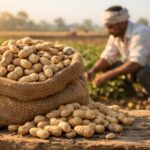
Indian peanuts are entering a phase of policy‑driven stability: fresh Minimum Support Price (MSP) procurement in Odisha is putting a floor under local values, while export demand remains structurally firm and logistics costs are elevated but manageable. Overall, the near‑term outlook is for stable to slightly firmer prices rather than sharp moves.
India’s central government has just cleared MSP procurement of over 20,000 tonnes of peanuts (groundnuts) in Odisha under the PM‑AASHA scheme, directly supporting farmers in a state where oilseeds and pulses have been trading below MSP. At the same time, Indian export offers for bold and java grades have edged up modestly in April, while the Iran conflict and related freight surcharges are adding to landed costs for European and Middle Eastern buyers without yet derailing flows. For importers, this combination argues for disciplined, phased coverage rather than waiting for lower spot prices.
Exclusive Offers on CMBroker

Peanuts
bold, 40-50
FOB 1.05 €/kg
(from IN)

Peanuts
bold 50-60
FOB 1.04 €/kg
(from IN)

Peanuts
bold 60-70
FOB 1.03 €/kg
(from IN)
📈 Prices & Recent Moves
Recent Indian peanut export offers (FOB/FCA, April 2026) show a mildly firmer tone in EUR terms. Converting at ~1.07 USD/EUR, mainstream bold grades from Gujarat and New Delhi are broadly in a range of about EUR 0.95–1.10/kg, with java and roasted splits commanding a premium closer to EUR 1.10–1.25/kg.
Over the last three to four weeks, bold 40–60 count offers have ticked up by roughly EUR 0.03–0.05/kg, while some java sizes have eased slightly from earlier highs, reflecting more comfortable availability in select grades. Brazilian raw peanut offers are higher, around EUR 1.20–1.25/kg FOB Brasília equivalent, keeping Indian origin competitive for price‑sensitive buyers in Europe and Southeast Asia.
| Origin / Grade | Terms | Latest price (EUR/kg) | 1–2 week change (EUR/kg) |
|---|---|---|---|
| India bold 40–50 (Gujarat, FOB) | FOB | ~1.00 | +0.03 |
| India bold 50–60 (New Delhi, FOB) | FOB | ~0.99 | +0.03 |
| India java 50–60 (New Delhi, FOB) | FOB | ~1.20 | -0.03 to -0.04 |
| India roasted splits 60/70/80 | FOB | ~1.15–1.20 | Stable |
🌍 Policy, Supply & Demand
The key development is India’s approval of MSP procurement for 20,219 tonnes of peanuts in Odisha, as part of a broader package for five crops under PM‑AASHA. The 90‑day, point‑of‑sale based operation is explicitly designed to address situations where local market prices are below MSP and to prevent distress sales by farmers.
India remains one of the world’s largest peanut producers and exporters, with core production in Gujarat and Rajasthan and a growing footprint in Andhra Pradesh and Odisha. The new procurement in Odisha does not materially change national supply, but it shifts local farmer behaviour: producers are less likely to dump stocks at discounted prices, which supports a more orderly market and limits downside in domestic values.
On the demand side, export interest from Europe, Southeast Asia and the Middle East for Indian blanched, roasted and edible oil grades stays structurally firm. Food manufacturers, snack producers and peanut butter processors continue to favour Indian origin for its price–quality balance. Some short‑term hesitancy is visible in Middle East destinations because of freight disruptions linked to the Iran conflict, but this has so far translated into shipment delays and higher logistics costs rather than demand destruction.
📊 External Drivers & Freight Environment
The 2026 Iran conflict and effective closure of the Strait of Hormuz have tightened global energy and freight markets, raising bunker costs and war‑risk premiums. Recent attacks and seizures of vessels around Hormuz underline that risk premia remain elevated, even as broader global trade flows adjust via alternative routes.
For peanuts, which typically move in containers rather than bulk, the main impact is higher all‑in freight to and via the Middle East and extended transit times on some Asia–Europe and Asia–Gulf services. Trade press and logistics reports highlight container rates into the Indian subcontinent and Gulf that are significantly above early‑year levels, with additional war‑risk surcharges layered onto base rates. This feeds directly into CIF/CFR costs for European and Middle Eastern buyers of Indian peanuts, reinforcing the modestly firm tone in origin offers.
🌦️ Weather & Crop Conditions (Key Indian Regions)
Short‑term weather in India’s main groundnut belts (Gujarat, Rajasthan, Andhra Pradesh) is seasonally quiet, with no immediate threat to standing crops or near‑term sowing. Pre‑monsoon conditions over the coming weeks will be watched closely, but current indications point to a largely normal pattern without acute heat or moisture stress for peanuts in the two‑to‑four week horizon.
Given that the latest policy action in Odisha targets marketing of existing production rather than a new crop shock, near‑term price risk in India is more policy‑ and logistics‑driven than weather‑driven. Weather will become a more dominant factor closer to kharif sowing and monsoon onset.
📆 Market & Trading Outlook
Over the next 2–4 weeks, MSP‑backed procurement in Odisha and similar support in other states are likely to underpin a stable to slightly firmer domestic price environment for peanuts. Export buyers should not expect a return to significantly discounted Indian peanut prices as long as policy support is actively engaged and freight markets remain tight.
- Price bias: Sideways to modestly firmer in EUR terms, with downside limited by MSP and upside capped by comfortable overall Indian supply.
- Volatility drivers: Any expansion of MSP procurement to additional volumes or states, sudden changes in freight capacity or war‑risk premiums, and shifts in energy prices linked to the Middle East conflict.
- Regional differentials: Odisha‑origin peanuts will effectively trade at or near MSP, while Gujarat and Rajasthan remain more market‑driven but indirectly supported by the national policy stance.
💼 Strategy Pointers for Market Participants
- European buyers / food manufacturers: Consider layering in coverage for Q2–Q3 needs at current Indian price levels, accepting slightly higher freight, rather than waiting for significant origin discounts that are unlikely while MSP programs are active.
- Middle East importers: Build in longer lead times and higher logistics costs; diversify ports and carriers where possible to mitigate Hormuz‑related disruption and war‑risk surcharges.
- Indian crushers and traders: MSP procurement reduces distress‑sale opportunities but stabilises farmer supply; focus on grade differentiation (bold vs java, edible vs birdfeed) and timing exports to capture periods of tight container availability.
- Farmers in Odisha and neighbouring states: Use MSP procurement windows to lock in floor prices, but remain attentive to potential private‑trade premiums for higher‑grade or exportable lots when logistics allow.
📍 3‑Day Indicative Direction (EUR terms)
- India FOB (Gujarat/New Delhi) bold grades: Steady to slightly firmer; offers expected to hold around current levels with limited downside.
- India FOB java and roasted splits: Mostly stable; minor adjustments by grade possible depending on export enquiries.
- Brazil FOB raw peanuts: Stable at a premium to Indian origin; no major short‑term directional change expected.