
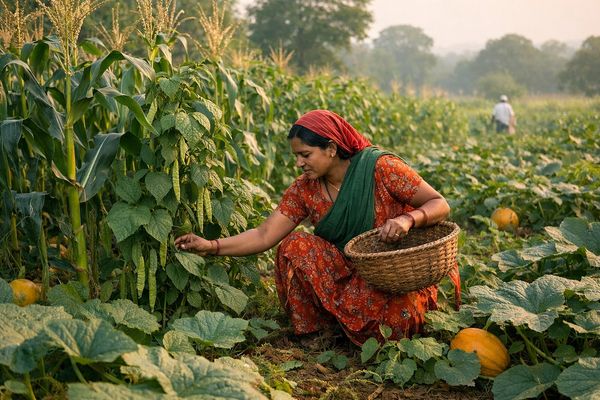
India’s rapidly expanding summer corn area is tilting the balance mildly bearish, with higher domestic supplies set to pressure prices unless feed, starch or export demand accelerates.
The corn market is entering a phase of supply-led softness driven by India’s larger summer crop and cautious domestic buyers. Summer corn sowing has risen sharply year-on-year, especially in central and western India, as farmers pivot out of guar into corn and other coarse grains. With poultry and starch demand steady rather than booming, the additional volumes arriving from June are likely to cap rallies in Indian physical markets and enhance export competitiveness into Southeast Asia. Overseas, benchmark yellow corn and corn‑starch offers show slight week‑on‑week easing in EUR terms, underlining a broadly weak global tone.
[cmb_offer ids=308,1121,736]
📈 Prices & Current Levels (in EUR)
Physical indicators point to a slightly softer tone across key corn segments. Recent offers (converted from USD at ~0.93 EUR/USD) suggest:
| Product | Origin / Term | Latest price (EUR/kg) | Prev. price (EUR/kg) | Trend |
|---|---|---|---|---|
| Yellow corn | France FOB Paris | 0.21 | 0.22 | ⬇ mildly weaker |
| Corn, bulk export | Ukraine FOB Odesa | 0.16 | 0.17 | ⬇ softer |
| Corn, yellow feed (98% purity) | Ukraine FCA Odesa | 0.22 | 0.22 | ➡ stable |
| Corn starch, organic | India FOB New Delhi | 1.26 | 1.30 | ⬇ easing |
| Popcorn | Argentina FOB Buenos Aires | 0.75 | 0.76 | ⬇ marginally lower |
| Popcorn | Brazil FCA Netherlands | 0.69 | 0.70 | ⬇ marginally lower |
These levels are consistent with the domestic picture in India, where producing belts in Madhya Pradesh, Karnataka and Bihar are already seeing mildly pressured prices amid adequate supply and restrained feed compounder buying.
🌍 Supply & Demand Dynamics
India’s summer corn sowing has expanded to 8.46 lakh hectares as of 17 April 2026, up from 7.85 lakh hectares a year earlier – a robust 7.8% increase. Corn remains the clear leader within coarse grains, forming the bulk of the 13.81 lakh hectares under summer coarse cereals. The strongest gains are in central and western India, where growers are structurally reallocating land away from guar into corn and other coarse grains.
This acreage growth sits within a broader expansion in summer cropping: total summer sowing has reached 69.06 lakh hectares, up 4.41% year-on-year. Pulses, particularly green and black gram, have also seen sharp gains, indicating diversified farmer strategies rather than a single-commodity bet. For corn, this means higher near‑term availability without a matching step‑up in domestic use.
📊 Fundamentals & External Drivers
On the demand side, India’s two main corn consumers – poultry feed and the starch industry – are expected to buy steadily rather than aggressively. This steady but unspectacular pull, combined with increased acreage, keeps the near-term balance comfortably supplied. Domestic spot markets are already reflecting this in slightly weaker prices and a lack of follow‑through on short‑lived rallies.
India’s status as a meaningful exporter adds a second channel for absorbing the larger crop. With expanded production, Indian corn is well-placed to compete into Southeast Asian feed markets against Ukrainian and South American origins, especially if freight or geopolitical disruptions intermittently lift Black Sea offers. For value‑added products such as starch and modified starches, European buyers may also benefit from softer Indian replacement costs, although realized prices will depend on logistics and quality premia.
⛅ Weather & Short-Term Outlook
Weather through the late summer sowing window and early vegetative phase will be important but, at this stage, the primary driver is acreage rather than yield risk. Unless a marked heat or moisture shock emerges in key belts of central and western India, the enlarged area points to comfortable summer‑season availability from June onward.
Over the next two to four weeks, the most likely scenario is for Indian corn prices to trade stable to modestly softer as fresh sowing data reinforces a well-supplied narrative. Any meaningful upside would need a positive surprise in poultry placements, increased starch runs, or a sudden acceleration of export inquiries from Southeast Asia.
📆 Trading Outlook & Recommendations
- Feed buyers (India): Consider a staggered coverage strategy, taking advantage of current softness while keeping some flexibility for potential further downside as the summer crop progresses.
- Exporters: Use India’s expanded crop and easing domestic basis to actively pursue Southeast Asian feed tenders; competitive EUR‑denominated offers versus Black Sea origins are likely in coming weeks.
- Starch processors: Lock in part of raw corn requirements on price dips to protect margins, but avoid over‑coverage until clearer signals emerge on downstream demand in food and industrial applications.
- European buyers of corn‑based products: Monitor Indian offers for starch and derivatives, as softer origin prices and favorable FX can provide attractive hedging opportunities against potential volatility in other origins.
📉 3‑Day Directional View (EUR-based)
- India (corn & starch export offers, EUR-equivalent): Bias slightly lower to sideways as sowing data continues to weigh on sentiment.
- EU (yellow corn, FOB France): Mildly weaker to stable, tracking global softness and comfortable nearby supply.
- Black Sea (Ukraine feed corn): Largely range‑bound; competitive pricing in EUR persists, with geopolitical and logistics risks the main upside catalysts rather than fundamentals over the next few days.
[cmb_chart ids=308,1121,736]
Related posts:
 Corn Market Steady as India Stalls and Early US Planting Turns Bearish
 Corn futures steady as global markets await new weather and demand signals
 Corn Futures Steady as Heavy Global Supply Caps Early-Spring Rally
 Global Corn Balances Loosen on Big Southern Hemisphere Crops, Pressuring Prices
 Corn Market at a Structural Crossroads as Prices Drift Sideways