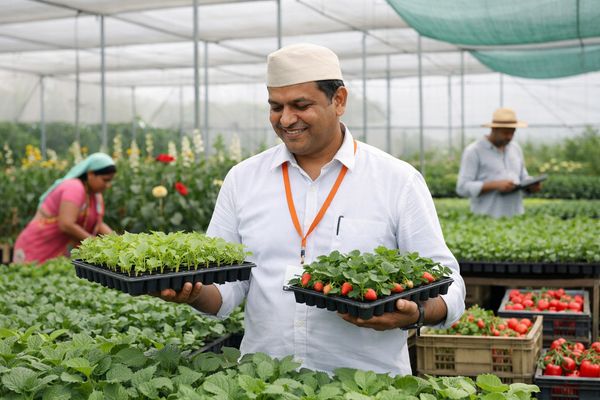
India’s National Academy of Agricultural Sciences (NAAS) has urged the government to adopt a one-time licensing model for key imported horticultural varieties and hybrids, aiming to cut recurring royalty outflows and seed costs for farmers while boosting export-oriented breeding and processing capacity. The recommendations, outlined in a recent policy paper on horticultural export growth, also call for stronger domestic breeding, food-safety traceability and support for India’s emerging role as a global hybrid seed supplier.
NAAS’ proposals arrive as India’s horticultural trade faces a structural paradox: despite robust domestic output, imports of fresh fruits and spices have risen in recent years, even as horticultural exports reached roughly ₹925.32 billion (about US$11.1 billion) in the triennium ending 2024–25. Spices, plantation crops and processed horticulture dominate export value, while imports increasingly reflect demand for premium fruit and specialized varieties not yet widely bred domestically.
🌍 Immediate Market Impact
In the near term, NAAS’ policy paper is advisory rather than binding, so immediate price moves in international markets are likely to be limited and sentiment-driven. However, the signal is clear: India is preparing to curb structural dependence on imported planting material in high-value horticulture, a shift that could reshape seed royalty flows and medium-term import demand for certain fruit and vegetable categories.
If New Delhi eventually adopts a one-time licensing framework, global seed and planting-material suppliers active in India’s horticulture segment could see lower recurring royalty streams but potentially higher initial license valuations and stronger volume growth as more farmers gain access to elite genetics at lower cost. For physical trade in fresh produce, concurrent NAAS recommendations on export-oriented breeding, sea-route logistics and traceability enhancements point toward a more competitive Indian footprint in global fruit, spice and processed horticural product markets over the medium term.
📦 Supply Chain Disruptions
The NAAS proposal does not immediately disrupt physical flows, but it targets several structural bottlenecks in India’s horticulture supply chain that matter for global traders. By advocating domestic breeding for import-dependent crops such as apple, walnut, hazelnut and kiwifruit, NAAS aims to reduce India’s reliance on repeated import consignments of high-royalty planting material, which currently face phytosanitary checks and quarantine-related delays.
Recommendations to develop sea-route protocols for long-duration shipments of banana, pomegranate and mango are particularly relevant for logistics players. Successful implementation could gradually shift a portion of India’s current airfreight-heavy exports in these categories to refrigerated ocean freight, lowering per-unit logistics costs, widening destination options and potentially smoothing seasonal availability in destination markets. At the same time, the push for stronger traceability and Bharat GAP-aligned good agricultural practices will require investment in compliance systems, packhouses and documentation, but should ultimately ease market entry into stringent-regulation destinations.
📊 Commodities Potentially Affected
- Temperate fruits (apple, walnut, hazelnut, kiwifruit) – Priority crops for reducing dependence on imported varieties; one-time licensing and domestic breeding could alter long-run import needs for planting material and shape India’s future export profile.
- Tropical fruits (banana, mango, pomegranate) – NAAS’ focus on sea-route export protocols and shelf-life oriented breeding may lower logistics costs and support higher export volumes into the Middle East, Asia and Europe.
- Spices and plantation crops – Already accounting for roughly 38% and 29% of horticultural export value respectively, these categories could gain from improved processing varieties and better traceability, reinforcing India’s dominant supplier role.
- Processed tomato, onion, potato, chilli, turmeric and marigold – Recommended development of processing-specific, high-extract varieties (e.g., high-paste tomato, high-oleoresin chilli, high-curcumin turmeric) could enhance export competitiveness in paste, dehydrated, colourant and nutraceutical segments.
- Hybrid vegetable seeds (solanaceous crops and cucurbits) – India is positioned as a cost-competitive hub for hybrid seed production; simplified export policy could expand global supply from Indian seed producers.
🌎 Regional Trade Implications
India currently exports horticultural products to over 100 countries, with major fresh-fruit markets in the Middle East, Europe and Asia, and key vegetable destinations including the UAE, Nepal, Bangladesh, Malaysia, Sri Lanka, the UK and Oman. A successful pivot toward export-oriented varietal development and lower logistics costs could deepen India’s penetration in these markets and open new destinations, especially where price-sensitive buyers seek alternatives to traditional suppliers.
For competing exporters of fruits, spices and processed horticultural products, an efficiency-driven Indian export push could mean tighter competition on price and quality, particularly in the Gulf and South Asian markets where Indian products already have strong presence. Conversely, seed and agrochemical companies with strong R&D pipelines may find new partnership opportunities in India’s proposed breeding expansion and hybrid seed export strategy, even as the royalty model evolves.
🧭 Market Outlook
Policy transmission will be gradual: NAAS’ recommendations must first be evaluated within India’s policy and budget cycle before any legal changes to seed licensing, export facilitation or pesticide regulation occur. Over the next 12–24 months, the main observable signals for markets will be draft regulations on one-time licensing, revised seed or export rules for hybrid seeds, and pilot initiatives on sea-freight protocols for key fruits.
Medium term, if implemented, reduced seed royalty burdens could improve farm-level margins in targeted crops, encouraging area expansion and higher-quality output. This, combined with stronger processing varieties and traceability, would likely increase India’s availability of exportable surpluses in spices, processed horticulture and selected fresh fruits, potentially exerting competitive pressure on global prices in those segments while rebalancing some planting-material trade flows away from recurring imports.
CMB Market Insight
NAAS’ policy push should be read as an early indicator of a more self-reliant yet export-ambitious horticulture strategy in India. For commodity traders and food-industry buyers, the key themes are lower structural input costs for Indian producers, a likely increase in processed and value-added horticultural exports, and an eventual shift in hybrid seed sourcing patterns as India’s role as a seed-production hub deepens.
While near-term price and flow impacts will be limited pending regulatory action, forward-looking participants in fruit, spice, processed vegetable and seed markets should factor India’s evolving policy stance into multi-year sourcing, investment and partnership strategies. Close monitoring of India’s regulatory follow-through on one-time licensing, export simplification and GAP-aligned traceability will be critical to anticipating when these structural intentions begin to translate into tangible shifts in trade volumes and price dynamics.