
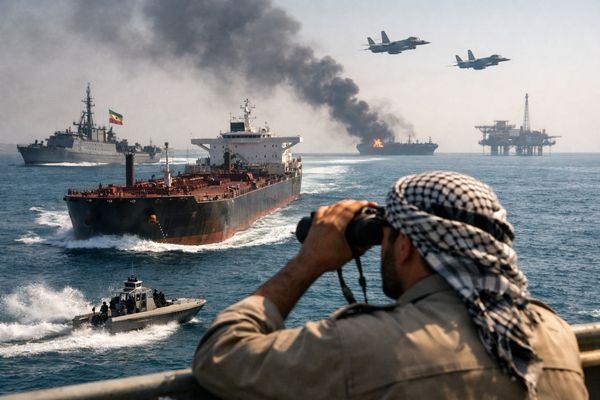
The ongoing US–Israel war with Iran and the near-halt of tanker traffic through the Strait of Hormuz have triggered one of the largest disruptions in global oil trade in decades. With around a fifth of the world’s petroleum liquids effectively stranded and Brent back above US$100 per barrel, refiners in Europe and Asia are aggressively reshaping their crude procurement toward US, Atlantic Basin and African grades.
The crisis has rapidly tightened seaborne supply, driven up freight and insurance costs, and injected a renewed war premium into oil prices despite a brief ceasefire earlier this month. The escalation to a formal US naval blockade of Iranian ports, layered on top of Iran’s earlier shutdown of Hormuz traffic, has entrenched uncertainty over the timing and scale of any resumption in Gulf exports.
Introduction
Since late February 2026, coordinated US–Israeli strikes on Iranian energy infrastructure and Iran’s response in closing the Strait of Hormuz have slashed tanker traffic through the world’s most important oil chokepoint by more than 90%. Roughly 20% of global oil and petroleum liquids exports and significant LNG volumes normally transit this corridor.
On April 13, the United States imposed a naval blockade on Iranian ports following the breakdown of talks, further complicating any efforts to restore normal flows. Brent and WTI futures immediately jumped back above US$100 per barrel, reversing much of the ceasefire-driven price correction seen earlier in April and re‑tightening global balances.
🌍 Immediate Market Impact
With tanker traffic through Hormuz “all but idle,” an estimated 15–20 million barrels per day of crude and refined products plus key LNG and LPG volumes have been knocked out or severely delayed. This has re-priced the entire liquids complex upward and widened differentials for barrels that can bypass the Gulf.
Brent has rebounded to the low US$100s per barrel range, with WTI trading at a slight premium as US barrels become a critical replacement source. The Brent–WTI spread, which had narrowed during the ceasefire window, has re‑widened as international benchmarks re‑price shipping risk, while inland US prices remain partially cushioned by domestic inventories and prospective SPR management.
Freight rates for crude and product tankers on Atlantic and transpacific routes have surged as charterers scramble for ships able to load in US Gulf, West African and North Sea ports. LNG and LPG freight has similarly tightened on diversions away from the Gulf toward US and Atlantic Basin exporters.
📦 Supply Chain Disruptions
The most immediate disruptions are concentrated in Middle Eastern export terminals and downstream import hubs in Asia and Europe. Near-halt conditions at Hormuz have constrained outbound flows from Saudi Arabia, Kuwait, the UAE, Qatar and Iran itself, forcing these producers to route limited volumes via alternative pipelines and the Red Sea where possible.
Refiners in Northeast Asia and Southern Europe, many of which traditionally source above 90% of their crude from Gulf producers, face mounting supply gaps and are drawing down inventories while bidding up prompt cargoes from the US, North Sea and West Africa. Extended voyage times, port congestion at alternative load and discharge ports, and longer ballast legs are tightening tanker availability and raising delivered costs.
Beyond crude, nitrogen fertilizer markets are experiencing acute stress as exports of urea and ammonia from Persian Gulf plants are curtailed, raising input costs for agriculture and threatening planting economics in import-dependent regions such as the United States and Latin America.
📊 Commodities Potentially Affected
- Crude oil (Brent, WTI, Dubai) – Directly impacted by the loss of Gulf exports and higher shipping risk premia, with front-month prices back above US$100 per barrel and elevated time spreads.
- Refined products (diesel/gasoil, gasoline, jet fuel) – Tight Gulf supplies and longer haul routes for replacement barrels are lifting product cracks, particularly middle distillates into Europe and Asia.
- LNG and LPG – Disrupted Qatar and regional exports are tightening Atlantic and Asian gas balances and increasing competition for US and African cargoes.
- Nitrogen fertilizers (urea, ammonia, UAN) – Export slowdowns from Gulf producers are pushing up prices and squeezing farm margins, especially in the US Midwest.
- Oilseed and grain costs – Higher fuel and fertilizer costs are inflating production and transport expenses across global grain and oilseed supply chains, with potential pass‑through into CIF values and food prices.
🌎 Regional Trade Implications
Asia, particularly China, Japan, South Korea and India, is the most exposed to sustained Gulf supply losses due to its heavy reliance on Saudi, Kuwaiti, Emirati and Qatari grades. These buyers are pivoting toward US Gulf Coast, Brazilian, North Sea and West African barrels, accepting higher voyage times and freight.
European refiners, already re‑orienting away from Russian crude, now face a second structural shock as Gulf availability drops. Atlantic Basin crude exporters—including the United States, Nigeria, Angola and Brazil—stand to benefit from firmer differentials and sustained demand, though logistical constraints limit how far these flows can scale in the near term.
For agricultural markets, key fertilizer importers such as the US, Brazil and India will need to diversify sourcing toward producers in Russia (where permitted), North Africa and Southeast Asia, potentially changing traditional trade lanes for several seasons even if Hormuz gradually reopens.
🧭 Market Outlook
In the short term, traders should anticipate elevated volatility across crude, products and fertilizer benchmarks as the market tests how much non-Gulf supply and strategic stocks can offset the Hormuz shortfall. Price risks skew to the upside while tanker traffic remains below 10–20% of normal levels and the US blockade stays in force.
Key triggers to watch include any credible roadmap for de‑escalation and phased reopening of Hormuz, signals of additional SPR releases from major consuming countries, and evidence of demand destruction in price‑sensitive emerging markets. A durable resolution could compress Brent–WTI and other regional spreads quickly, but the conflict has already accelerated a structural shift toward diversified, non‑Gulf supply that may persist beyond the current crisis.
CMB Market Insight
The Iran war and the effective shutdown of the Strait of Hormuz mark a pivotal stress test for global energy and, by extension, agricultural commodity supply chains. Gulf export disruptions are tightening the cost base for farmers and food processors via higher fuel and fertilizer prices, while reshaping seaborne trade flows toward the Atlantic Basin and alternative producers.
For commercial hedgers and traders, this episode underscores the need to integrate cross‑commodity risk—energy, freight, fertilizers—into pricing and procurement strategies. Until safe, reliable transit through Hormuz is restored, markets should assume an enduring risk premium and continued re‑routing of trade, with US and other non‑Gulf exporters playing an outsized balancing role but unable on their own to fully replace lost Gulf volumes.