
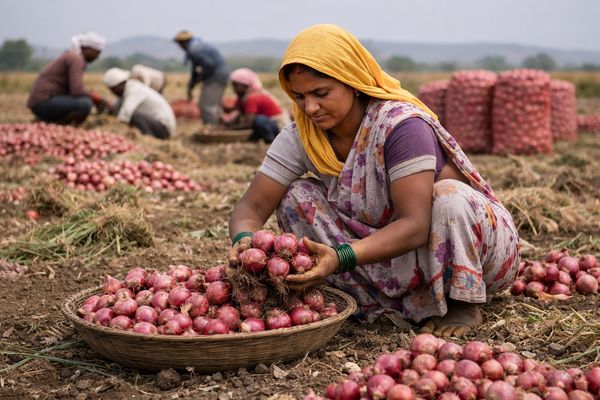
Maharashtra Seeks Crop Relief After Nashik Losses, Raising Concerns Over Indian Onion Supply
Unseasonal March rainfall and hailstorms in India’s Nashik district have triggered officially assessed crop losses over 41,500 hectares, with local authorities seeking ₹73.34 crore (about USD 8.8 million) in compensation for affected farmers. The scale and crop mix of the damage, heavily concentrated in onions and perennial fruit orchards, point to potential tightening in India’s onion supply chain and localized price firming through the coming marketing months.
The Nashik district agriculture department has completed a government-verified panchanama field survey and submitted its relief proposal to the Maharashtra state government. The assessment identifies 65,756 farmers as eligible for support after unseasonal March 2025 rains and hailstorms caused losses exceeding 33% of crop value in key talukas, notably Satana and Malegaon, both major onion-growing hubs serving domestic and export channels.
🌍 Immediate Market Impact
According to the final assessment, total crop damage spans 41,556 hectares, of which horticulture accounts for 36,641 hectares. Onion is the single largest casualty, with 34,136 hectares impacted, alongside wheat damage over 1,538 hectares and maize over 821 hectares. This concentration in onions is significant because Nashik is India’s largest onion-producing district and a reference point for wholesale pricing via the Lasalgaon mandi.
While nationwide onion prices currently show broad variability by mandi and region, with modal wholesale levels typically in the ₹600–₹1,800 per quintal range depending on local arrivals and quality, the Nashik losses introduce a bullish undertone for the May–July shipment window. Traders can expect increased price volatility as the actual harvest outturn from damaged fields becomes clearer and as stockists reassess inventory strategies.
📦 Supply Chain Disruptions
The damage footprint is highly localized within Nashik district. Satana and Malegaon talukas, both established onion belts serving wholesale markets across Maharashtra and other states, bear the heaviest impact from rainfall and hail. Sinnar also reports measurable losses, while several other talukas recorded no qualifying damage, underscoring that storm tracks were concentrated rather than district-wide.
On the logistics side, there is no immediate physical disruption to port or road infrastructure, but the reduced marketable surplus from affected talukas is likely to cut trucked volumes into Lasalgaon and other Nashik mandis as the rabi crop moves to market. Given Lasalgaon’s benchmark role for onion pricing across India and parts of Asia, even moderate declines in arrivals from key catchment areas can reverberate into procurement costs for traders supplying Mumbai, other Indian metros and export packers.
Perennial orchard damage in grapes and pomegranates adds a multi-season supply dimension. While these categories are less bulk-sensitive than onions in freight terms, yield losses over several years could affect export programs out of western India, particularly for fresh table grapes, where Nashik is a major origin.
📊 Commodities Potentially Affected
- Onions: Core impact, with 34,136 hectares damaged in India’s largest onion-producing district, likely reducing arrivals into Lasalgaon and other Nashik mandis and firming regional prices in the coming months.
- Table grapes: Orchard damage in Nashik’s fruit belt may reduce exportable volumes over multiple seasons, affecting European and Middle Eastern buyers accustomed to Indian supply during specific calendar windows.
- Pomegranates: Similar to grapes, perennial losses imply longer recovery times, potentially tightening availability for both domestic premium markets and export programs.
- Wheat: Losses across roughly 1,500 hectares are modest at national scale but could influence local feed and flour supply-demand balances in parts of Maharashtra.
- Maize: Damage over more than 800 hectares may trim local supply for feed users, though broader Indian maize availability should cushion systemic effects.
🌎 Regional Trade Implications
Any sustained tightening in Nashik onion supply will primarily affect domestic Indian trade flows, but it also carries consequences for regional importers. Nashik-origin onions move via Maharashtra’s ports to buyers in the Gulf and parts of Asia; reduced volumes or higher floor prices could prompt importers in these regions to diversify sourcing towards Pakistan, Egypt, Turkey or Central Asian origins, depending on seasonal availability and sanitary requirements.
Within India, tighter supplies from Nashik could support prices in competing producing states if traders shift procurement to Uttar Pradesh, Madhya Pradesh or Karnataka. Current onion price data from other mandis show wide intra-India dispersion, with some markets already trading near ₹1,200–₹1,400 per quintal for bulk onions, suggesting room for upside where inventories are thin and demand remains stable.
For table grapes and pomegranates, buyers in Europe and the Middle East may need to watch for potential reductions in Indian shipping programs and be prepared to increase coverage from alternative Southern Hemisphere or Mediterranean suppliers if Nashik’s orchard recovery lags.
🧭 Market Outlook
In the near term (next 30–90 days), onion markets will focus on realized arrivals and quality from Nashik relative to the damage estimates. If state compensation is approved and disbursed promptly under the proposed rates of ₹17,000 per hectare for irrigated crops, ₹22,500 for perennial fruit crops and ₹8,500 for rain-fed crops, farmers’ liquidity constraints could ease, supporting replanting where agronomically feasible.
However, perennial grape and pomegranate orchards will not recover within the current crop year, implying a longer tail of reduced output. For onions, the impact on export parity will depend on how quickly other Indian states and alternative exporters can fill any gap left by Nashik, as well as on domestic policy choices such as export restrictions or minimum export prices should retail inflation become a concern later in the year.
CMB Market Insight
The Nashik panchanama and associated compensation proposal mark a notable weather-induced supply shock in one of the world’s most influential onion-producing regions. While the physical damage is localized, its concentration in high-value onions and perennial fruit crops amplifies the market signal for domestic and regional buyers.
Commodity traders, importers and food processors should closely track Nashik mandi arrivals, Lasalgaon benchmark prices and any policy responses from the Indian central and Maharashtra state governments. For now, the event reinforces the case for diversified origin strategies in onion and high-value fruit sourcing, as well as for tighter risk management around Indian rabi onion exposure in the 2025–26 marketing cycle.