
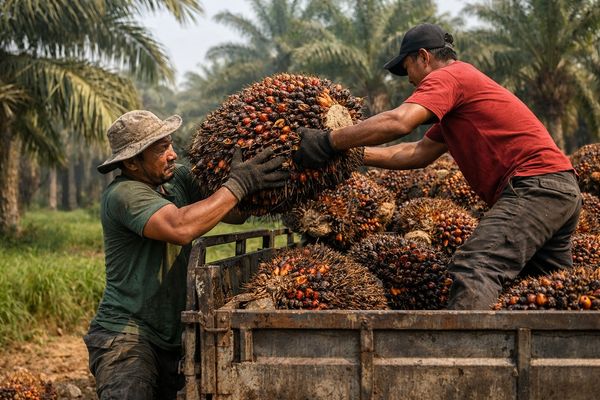
Palm oil futures on the Malaysian exchange softened by around 1% on April 17, 2026, with the curve gently declining into 2027–28, signaling a market that is easing from recent highs but still underpinned by firm demand. Rising Indonesian biodiesel mandates and robust export flows keep the medium‑term balance tight, while weather and policy remain key swing factors for prices.
After several weeks of firm values, the palm oil market is consolidating as traders reassess supply risks against solid demand from food and energy. The nearby May 2026 MDEX contract closed at 4,386 MYR/t, down 1.3% on the day, with subsequent months posting smaller losses and edging gradually lower toward 4,268 MYR/t for 2028 maturities. The forward curve signals expectations of slightly easier fundamentals over the next few years, yet Indonesia’s plan to halt diesel imports and roll out B50 biofuel from July 1, 2026, points to structurally higher domestic CPO use and a floor under prices.
📈 Prices & Term Structure
The MDEX palm oil strip on April 17, 2026 shows broad-based, moderate declines across listed contracts:
- May 2026: 4,386 MYR/t (−57, −1.30% vs. prior close)
- June 2026: 4,422 MYR/t (−54, −1.22%)
- July 2026: 4,450 MYR/t (−45, −1.01%)
- August–December 2026: 4,401–4,457 MYR/t, losses mostly below 1%
- May 2027: 4,349 MYR/t (−0.62%), easing further into late 2027
- 2028–2029 positions: around 4,268 MYR/t, implying a mild backwardation from current nearby levels
Converted roughly at 1 MYR ≈ 0.20 EUR, front‑month values sit near 880–900 EUR/t, with outer years nearer 850 EUR/t. The gentle downward slope suggests the market is not pricing an acute supply shock but rather a slow normalization of stocks.
| Contract | Close (MYR/t) | Close (EUR/t, approx.) | D/d Change (%) |
|---|---|---|---|
| May 2026 | 4,386 | ~880 | −1.30% |
| July 2026 | 4,450 | ~890 | −1.01% |
| December 2026 | 4,401 | ~880 | −0.68% |
| May 2027 | 4,349 | ~870 | −0.62% |
| 2028–2029 strip | 4,268 | ~855 | −0.63% |
🌍 Supply & Demand Drivers
On the demand side, Indonesian palm oil exports have been strong in early 2026, with shipments of crude and refined palm oil up more than 36% year-on-year in the first two months, confirming vigorous global buying interest, particularly from key Asian customers. At the same time, authorities have raised the CPO export levy to 12.5% of the reference price to help fund higher biodiesel blending, which marginally raises export costs but supports domestic consumption.
Structurally, policy is turning palm oil ever more into an energy feedstock. Indonesia has confirmed it will stop importing diesel fuel from July 1, 2026, in line with full implementation of B50 (50% palm-based biodiesel), a major step up in local CPO use and a likely constraint on exportable surplus over time. This comes on top of robust food demand and recovering discretionary consumption in emerging markets. On the supply side, plantations in Southeast Asia are emerging from a La Niña phase, with forecasters expecting ENSO-neutral conditions through April and an increasing probability of El Niño later in 2026, which could cap yield growth if it brings hotter, drier conditions.
📊 Policy, Regulation & Fundamentals
In the near term, Indonesia continues to fine‑tune its fiscal regime around palm oil, with higher export levies channelling funds toward biodiesel subsidies. While this may slightly temper FOB competitiveness, the broader impact is to tighten domestic balances as more palm oil is directed into the fuel pool. For international buyers, that combination tends to underpin a higher structural price floor even if futures are currently in a corrective phase.
On the demand side from key importing blocs, the EU deforestation regulation will begin to bind large operators at the end of 2025 and smaller ones by mid‑2026, increasing compliance costs and potentially reshaping trade flows from non‑certified origins. However, recent trade diplomacy has secured tariff exemptions for Indonesian palm oil into the US, improving access to that market and partially offsetting regulatory headwinds elsewhere. Overall, fundamentals point to a market that is tight but not yet in shortage, with policy and weather as the main upside risks.
🌦️ Weather Outlook for Key Regions
Recent analysis of plantation sectors suggests La Niña conditions are fading, with models pointing toward ENSO-neutral in April and a tilt toward El Niño by mid‑year. Historically, transitions to El Niño have been associated with lower fresh fruit bunch yields and higher average CPO returns over time, particularly if dryness becomes more pronounced in major producing regions of Sumatra, Kalimantan, and Peninsular Malaysia.
So far, field reports do not indicate an acute weather shock, but the seasonal outlook warrants close monitoring for signs of moisture stress as the Northern Hemisphere summer approaches. Any confirmation of persistent dryness would likely reprice the back end of the futures curve higher from its current gentle decline.
📆 Trading Outlook & 3‑Day Price Indication
- Producers/Crushers: The mild backwardation and recent 1% daily correction argue for incremental hedging of late‑2026 and 2027 output above ~870 EUR/t, while keeping some upside exposure in case El Niño risks materialize.
- Industrial buyers (food & oleochemicals): Nearby easing offers an opportunity to lock in part of H2 2026 needs, but given strong biodiesel demand, staggered buying is prudent rather than over‑hedging at once.
- Speculators: With policy and weather skewing risks to the upside against a currently softening curve, strategies that buy deferred spreads or call options on 2027 maturities may offer attractive risk‑reward.
For the next three trading days, we expect palm oil futures on MDEX to trade slightly firmer to sideways in EUR terms (roughly within ±10–15 EUR/t of current levels), as the market digests Indonesian biodiesel developments and watches early signals from the evolving ENSO pattern.
Related posts:
 Palm Oil Futures Edge Higher While Sunflower Oil Softens
 Indonesia’s Palm Oil: Production Growth Meets Biodiesel and Drought Risks
 Palm Oil Futures Ease From Highs As Oilseed Complex Stays Firm
 Palm Oil Pressured by Weak Crude, Softer Vegoils and Disappointing Biodiesel Support
 Palm Oil Futures Hold Firm as Vegoil Complex and Biodiesel Demand Support Prices
 Palm Oil Market Firms on Futures Strength and Tightening Asian Supply Controls
 Palm Oil Futures Edge Higher on Supply Concerns and Geopolitical Risk