
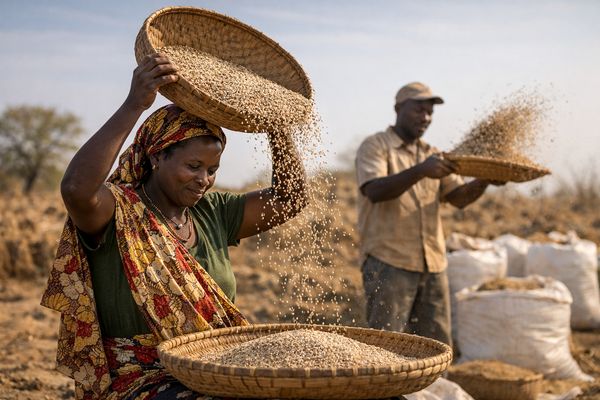
Indian sesame prices are edging lower from recent highs, while Egyptian FOB offers remain broadly stable, leaving near‑term buying opportunities but with elevated logistics and weather risk into late April.
The sesame complex is moving into a consolidation phase. Indian FOB New Delhi values have slipped modestly after a strong Q1 rally, pressured by competitive Brazilian supplies and cautious export demand, even as domestic availability stays relatively tight. Egypt’s sesame market shows stable wholesale and retail ranges, suggesting a balanced local supply situation, though external trade data still point to structurally weaker export prices versus a year ago. With summer heat building in North India and ongoing freight and route risks on West Asia corridors, participants should use the current soft patch to fine‑tune coverage and hedge logistics exposure rather than expect a sustained bear market in high‑quality sesame.
[cmb_offer ids=704,703,702]
📈 Prices & Recent Moves
Using an approximate EUR/USD rate of 1.08, India’s latest natural sesame corrections from around ₹98–99/kg to roughly ₹92–94/kg in key producing belts translate into a mild pullback in export‑equivalent values, aligning with the small declines seen in recent FOB indications. Sortex‑grade export material has fallen from about ₹125–126/kg to ₹116–117/kg, while hulling‑grade eased to ₹110–111/kg, confirming a broad but shallow correction rather than a collapse.
In Egypt, indicative wholesale sesame prices around USD 0.69/kg (≈ EUR 0.64/kg) and retail prices near USD 0.98/kg (≈ EUR 0.91/kg) in Cairo and Alexandria highlight a relatively stable domestic market, despite a year‑on‑year decline in proxy export prices to about USD 2,229/ton (≈ EUR 2,064/ton). This keeps Egypt competitively priced versus some African origins but still at a premium to the lowest‑priced Asian offers.
| Origin | Segment | Price level (EUR/kg) | Trend vs early April |
|---|---|---|---|
| India (FOB New Delhi) | Hulled, mainstream export | ≈ 1.40–1.55 | Slightly softer, consolidating |
| India (domestic belts) | Natural, bulk | ≈ 0.85–0.95 (export‑equiv.) | Down ~5–6% from recent highs |
| Egypt (Cairo/Alexandria) | Wholesale | ≈ 0.64 | Stable |
| Egypt (Cairo/Alexandria) | Retail | ≈ 0.91 | Stable |
🌍 Supply, Trade Flows & Logistics
India enters 2026 with broadly stable sesame production around 0.8–0.9 million tonnes, but the market tone has shifted from pure supply to a more complex mix of logistics and origin competition. Multiple western gateway ports have temporarily restricted West Asia‑bound cargo, raising execution risk and freight costs for sesame exporters targeting Gulf buyers. At the same time, Brazilian sesame shipments into India around ₹100/kg (≈ EUR 1.10/kg) have prompted profit‑taking and reinforced a ceiling on Indian domestic prices in the short run.
For Egypt, recent trade research shows a 10.6% year‑on‑year drop in sesame import volumes and a 20% fall in value, with Sudan still dominating import supply (≈73%), followed by Brazil, India, Chad and Pakistan. This combination of softer import demand and diversified sourcing explains the current stability in local price ranges, while also limiting Egypt’s near‑term leverage to push export prices higher.
📊 Fundamentals & Weather (India & Egypt)
Summer sesame sowing in India has expanded, with Gujarat acreage reported up about 11% year‑on‑year to over 135,000 ha by mid‑April, and national summer area around 309,000 ha (+3% y/y), adding potential supply later in the year. However, India’s meteorological outlook flags a harsh March–May 2026 summer with above‑normal temperatures in many regions, and Delhi’s climate data indicate typical April highs near or above 38°C, increasing heat and moisture‑stress risks for oilseeds. Extended‑range guidance from IMD suggests no strong monsoon‑disruptive signal yet, but markets remain sensitive to any shift given sesame’s vulnerability to erratic rainfall.
In Egypt, the main recent weather event of note was March’s Mediterranean medicane Samuel, which affected parts of Libya and Egypt but has since dissipated, with no fresh severe‑weather alerts dominating agricultural commentary in mid‑April. Typical April conditions in Upper Egypt trend hot and dry, generally favourable for drying and storage of sesame rather than active crop development. Combined with the absence of new production shocks in recent reporting, the short‑term weather signal for Egyptian sesame is neutral to slightly supportive of stable prices.
📌 Market Drivers to Watch
- Origin competition: Brazilian sesame at competitive rupee levels is capping Indian domestic prices but has not yet overwhelmed the market; constrained Indian supply means any renewed demand spike could quickly tighten FOB offers again.
- Logistics & freight: Restrictions on West Asia‑bound cargo from key Indian ports, coupled with broader Red Sea and Gulf route risk, are adding basis and freight premiums to contracts and may shift some demand to African or South American origins.
- Demand trends: Trade data show structurally softer Egyptian sesame import demand and weaker export prices, while global buyers (notably the US and EU) continue to favour competitively priced and compliant Indian origin when logistics allow.
- Weather risk: Intensifying heat in North India and still‑uncertain monsoon performance into mid‑year are key upside risks for prices if they dent yield prospects for summer or main‑season sesame.
📆 3‑Day Price & Trading Outlook (Regional)
India (IN, FOB New Delhi)
For the next three days, Indian sesame prices are likely to trade sideways to slightly softer in EUR terms, with mainstream hulled FOB indications expected to hover in roughly the EUR 1.40–1.55/kg band. This reflects recent domestic corrections, ongoing Brazilian competition and steady but not surging export demand. Bids from risk‑averse buyers may test the lower end of the range, but tight quality supply should limit deeper discounts.
Egypt (EG, FOB/wholesale)
Egyptian wholesale sesame prices are projected to remain broadly stable over the coming three days, around EUR 0.60–0.70/kg equivalent at wholesale and roughly EUR 0.90/kg at retail, assuming no abrupt currency or freight shocks. With no new crop or logistics headlines, any moves are likely to be modest and driven mainly by FX and external demand signals rather than domestic fundamentals.
🎯 Trading Recommendations
- Short‑term buyers (India‑origin): Use the current correction in Indian natural and hulled sesame to extend nearby coverage, especially for EU‑grade and high‑purity lots, but avoid over‑committing beyond 1–2 months given monsoon and logistics uncertainty.
- Importers into Egypt: Maintain a balanced stance, leveraging stable local prices to negotiate small discounts from origins facing freight or route disruptions; consider some diversification across Sudan, India and Brazil to mitigate origin‑specific risk.
- Sellers in India: Protect downside via flexible offers linked to freight surcharges and route premiums rather than cutting base FOB too aggressively, as fundamental tightness could re‑emerge quickly if Chinese or Middle Eastern demand improves.
[cmb_chart ids=704,703,702]
Related posts:
 Sesame market caught between Chinese stocks, Ethiopian costs and Indian monsoon risk
 Sunflower Market Steady to Firm as Black Sea Logistics Tighten
 Indian Sesame FOB New Delhi: Firm Prices as Heat Builds and Demand Stays Cautious
 Indian Sesame FOB Prices Hold Firm as Global Demand Stays Soft
 Sesame Prices Edge Softer in Egypt While Hulled Markets Stay Firm
 Middle East Conflict and Hormuz Closure Tighten Logistics, Pressure China’s Pumpkin Seed Export Chain
 Chinese Pumpkin Seed Kernels: Mild FOB Softening Amid Firm Logistics Costs
 Indian Sesame: Larger Gujarat Rabi Area Meets Weather Risk and Firm Prices