
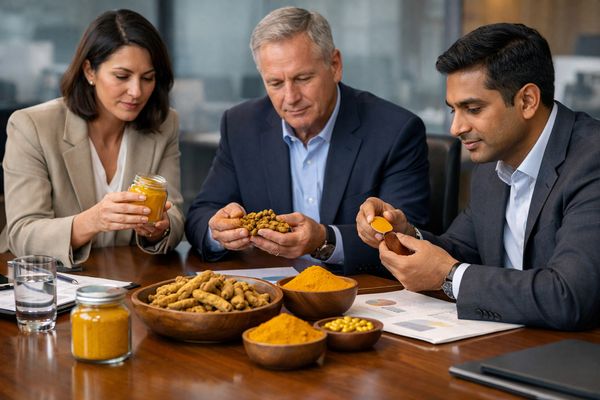
Indian turmeric prices have started to correct from elevated levels, with the Erode benchmark easing as weak export demand collides with heavy carryover stocks and fresh rabi arrivals. Downside risk persists over the next few weeks, but a first support zone is emerging that should eventually attract renewed European and North American buying.
The market is digesting last year’s speculative run-up and a still-healthy global demand base. Traders are facing dual supply pressure: significant old-crop positions carried forward in anticipation of stronger exports, and ongoing inflows of new crop from the current harvest. International buyers, squeezed by high CIF costs and uncertain downstream demand, have stepped back and shifted some volumes to alternative origins, waiting for clearer value. This correction phase is likely to define pricing and procurement strategies through late May.
Exclusive Offers on CMBroker

Turmeric whole
FOB 2.45 €/kg
(from IN)

Turmeric powder
FOB 3.30 €/kg
(from IN)

Turmeric dried
finger salem,double polished, grade A
FOB 1.57 €/kg
(from IN)
📈 Prices & Benchmarks
At Erode, gatta-grade turmeric has retreated by about ₹400 per quintal week-on-week, trading around ₹15,100–₹15,200 per quintal. In EUR terms, this equates to roughly 1.68–1.70 EUR/kg, assuming an exchange rate of approximately 94.9 INR per EUR.
Export-oriented offers from India are broadly aligned with these domestic levels. Recent quotations show organic turmeric whole FOB New Delhi around 2.45 EUR/kg and organic turmeric powder near 3.30 EUR/kg, while conventional double-polished dried fingers from Telangana are indicated at about 1.42–1.57 EUR/kg FOB for Nizamabad and Salem types. These export prices have been relatively stable in late April and early May, but are now sitting on a softer domestic base.
| Product | Origin / Grade | Location & Terms | Latest Price (EUR/kg) |
|---|---|---|---|
| Turmeric whole (organic) | India | New Delhi, FOB | 2.45 |
| Turmeric powder (organic) | India | New Delhi, FOB | 3.30 |
| Turmeric dried fingers (conventional) | Salem, double polished, grade A | Telangana, FOB | 1.57 |
| Turmeric dried fingers (conventional) | Nizamabad, double polished, grade A | Telangana, FOB | 1.42 |
🌍 Supply & Demand Balance
The current correction is rooted in supply-side heaviness rather than a collapse in end-user demand. Traders carried substantial stocks from last season into this one, betting that export demand would remain robust and justify higher valuations. Instead, the combination of elevated domestic prices and earlier supply concerns drove Indian CIF values above what many buyers in Europe and North America were willing to pay.
Concurrently, new crop turmeric from the rabi harvest is flowing into major mandis. Erode, Nizamabad and other hubs are reporting increased arrivals, reinforcing the perception of an oversupplied spot market. While some speculative positioning persists, the tone has shifted: many holders are now more focused on risk management and orderly liquidation than on aggressively marking prices higher.
On the demand side, export weakness is the defining challenge. High Indian price benchmarks have prompted European processors and food manufacturers to either shift part of their procurement to competing origins or delay purchases. The broader spice complex shows similar patterns, with other Indian spices experiencing weak export-linked buying at high domestic prices, underscoring a more price-sensitive global environment.
📊 Fundamentals & External Drivers
India remains the dominant global supplier, accounting for around 80% of world turmeric production and exports. Over the past decade, turmeric’s position in European and North American markets has strengthened, driven by its role as a natural colourant and its association with wellness and functional food products. This structural demand backdrop is intact, but current purchasing is disciplined and heavily value-driven.
Recent futures and spot data indicate that, despite near-term softness, underlying support is still present at higher historical levels, reflecting both elevated production costs and the strong multi-year demand trend. However, export channels have been disrupted or repriced by factors such as higher freight costs and regional geopolitical tensions, which have constrained India’s competitiveness in some trade lanes and encouraged buyers to diversify suppliers.
Weather remains a secondary but important watchpoint. Harvesting is ongoing across major Indian growing regions, and recent reports highlight unseasonal rainfall in some central belts. For now, this is contributing more to quality dispersion than to a clear-cut supply shock, but any escalation into disease or yield losses later in the year could tighten availability of higher-curcumin, export-grade material.
📉 Short-Term Outlook (2–4 Weeks)
In the near term, prices face further downside risk if foreign buyers do not return promptly. A first meaningful support zone is expected around ₹14,500–₹15,000 per quintal at Erode, equivalent to roughly 1.61–1.68 EUR/kg. As long as last year’s stocks remain significant and harvest arrivals stay strong, rallies are likely to invite farmer and trader selling.
For European buyers, the key timing signal will be the pattern of arrivals at Erode and other benchmarks. Historically, the seasonal floor in prices tends to form once new crop volumes peak and then start to decline. At that point, international interest typically revives, especially from segments focused on health supplements and high-curcumin formulations, as import economics become more attractive.
📆 Trading & Procurement Strategy
- European and North American buyers: Consider a staggered buying strategy. Begin modest coverage near the ₹15,000 per quintal area while keeping capacity to add if Erode tests the ₹14,500 zone. Focus on locking in high-quality, compliant lots where discounts emerge.
- Indian exporters: Use the current softening to rebuild export pipelines, offering sharper EUR-based quotes to recapture market share from competing origins. Prioritise long-term customers in Europe and North America with transparent quality and documentation to benefit from the health and wellness demand trend.
- Traders and stockists in India: Be cautious with fresh speculative longs while both old-crop stocks and new arrivals are heavy. Consider incremental liquidation into any short-covering rallies, and watch export enquiry closely as an early indicator of a durable floor.
📍 3-Day Directional Outlook (Key References)
- Erode physical (gatta grade, benchmark): Mildly bearish to sideways; trade expected to gravitate toward the ₹15,000 per quintal mark in the very short term as sellers remain active.
- FOB India (whole & powder, organic): Slightly softer bias in EUR terms, reflecting domestic easing and stable FX; any sharp moves are more likely driven by freight or risk sentiment than by immediate fundamentals.
- Telangana dried fingers (FOB): Range-bound with a gentle downward tilt as fresh arrivals intersect with subdued export interest; discounts for larger parcels may surface for prompt shipment.